 Librería Samer Atenea
 Kálamo Books
 Librería Elías (Asturias)
 Librería Kolima (Madrid)
 Librería Proteo (Málaga)
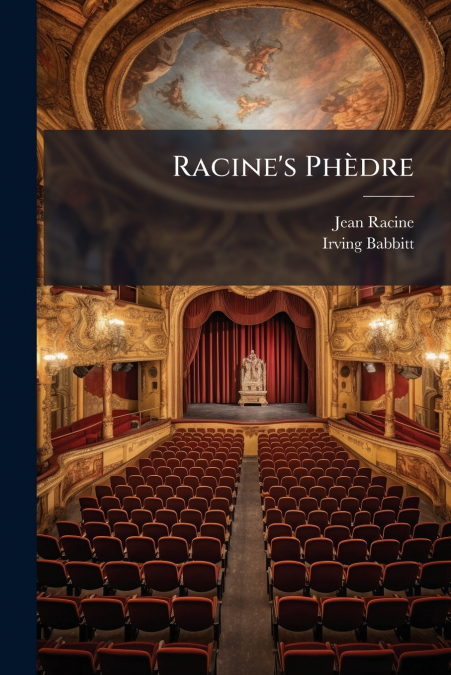
Phèdre is a French tragic play in five acts by Jean Racine, based on Greek mythology and the play Hippolytus by Euripides. It tells the story of Phèdre, wife of Theseus, who falls in love with her stepson Hippolyte. When Hippolyte rejects her advances, Phèdre accuses him of rape, leading to his tragic death and, ultimately, her own. Racine’s play is a masterpiece of French classicism, known for its powerful emotions, elegant language, and exploration of themes such as love, guilt, and fate.This edition, likely published around 1910, offers readers the timeless drama of Racine’s 'Phèdre', accompanied by insightful commentary or analysis, possibly by Irving Babbitt. A cornerstone of French literature, 'Phèdre' continues to resonate with audiences today due to its profound examination of human passions and its enduring influence on Western theater.This work has been selected by scholars as being culturally important, and is part of the knowledge base of civilization as we know it. This work was reproduced from the original artifact, and remains as true to the original work as possible. Therefore, you will see the original copyright references, library stamps (as most of these works have been housed in our most important libraries around the world), and other notations in the work.This work is in the public domain in the United States of America, and possibly other nations. Within the United States, you may freely copy and distribute this work, as no entity (individual or corporate) has a copyright on the body of the work.As a reproduction of a historical artifact, this work may contain missing or blurred pages, poor pictures, errant marks, etc. Scholars believe, and we concur, that this work is important enough to be preserved, reproduced, and made generally available to the public. We appreciate your support of the preservation process, and thank you for being an important part of keeping this knowledge alive and relevant.