Bonifacius Leslie / Heinrich Jacobi
 Librería Samer Atenea
 Kálamo Books
 Librería Elías (Asturias)
 Librería Kolima (Madrid)
 Librería Proteo (Málaga)
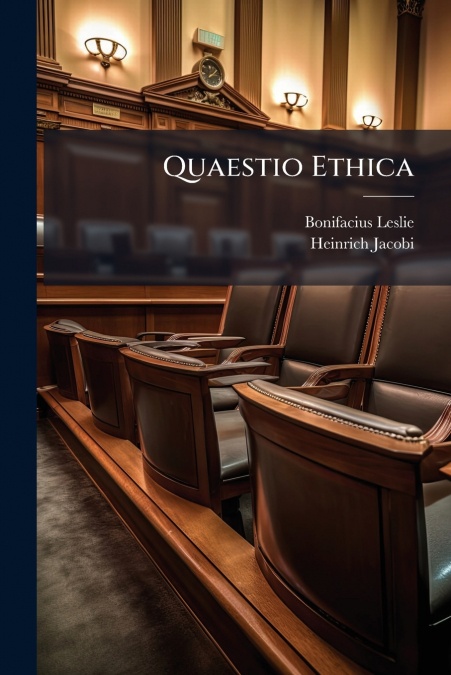
Quaestio Ethica explores the complex ethical dilemma faced by a judge who knows a defendant to be innocent, yet must condemn them to death based on presented evidence. This profound work, originally titled 'An Possit Iudex Salva Iustitia Ad Mortem Condemnare, Quem Certo Scit Innocentem, Si Probatus Fuerit Nocens,' delves into the conflict between legal obligation and moral conscience. Bonifacius Leslie and Heinrich Jacobi present a rigorous examination of justice, exploring the limits of judicial authority and the potential for tragic outcomes within the framework of law.This edition offers readers an opportunity to engage with timeless questions of right and wrong, as relevant today as when they were first posed. Perfect for students of law, philosophy, and political science, ’Quaestio Ethica’ challenges us to confront the uncomfortable realities of legal decision-making and the burden of moral responsibility.This work has been selected by scholars as being culturally important, and is part of the knowledge base of civilization as we know it. This work was reproduced from the original artifact, and remains as true to the original work as possible. Therefore, you will see the original copyright references, library stamps (as most of these works have been housed in our most important libraries around the world), and other notations in the work.This work is in the public domain in the United States of America, and possibly other nations. Within the United States, you may freely copy and distribute this work, as no entity (individual or corporate) has a copyright on the body of the work.As a reproduction of a historical artifact, this work may contain missing or blurred pages, poor pictures, errant marks, etc. Scholars believe, and we concur, that this work is important enough to be preserved, reproduced, and made generally available to the public. We appreciate your support of the preservation process, and thank you for being an important part of keeping this knowledge alive and relevant.