Inicio > Humanidades > Historia > Put Your Bodies Upon The Wheels
Put Your Bodies Upon The Wheels

Put Your Bodies Upon The Wheels

PUT YOUR BODIES UPON WHEELS PB

Kenneth J. Heineman / Kenneth JHeineman

19,48 €
IVA incluido
Disponible
Editorial:
Bloomsbury Publishing plc
Año de edición:
2002
Materia
Historia
ISBN:
9781566633529
19,48 €
IVA incluido
Disponible

Selecciona una librería:

  • Librería Samer Atenea
  • Librería Aciertas (Toledo)
  • Kálamo Books
  • Librería Perelló (Valencia)
  • Librería Elías (Asturias)
  • Donde los libros
  • Librería Kolima (Madrid)
  • Librería Proteo (Málaga)

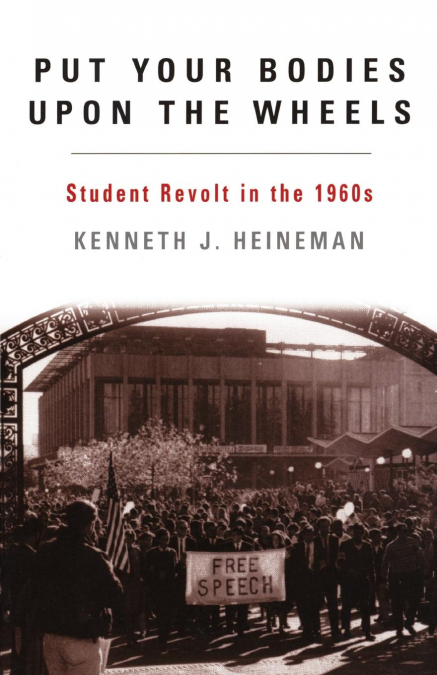
What began at colleges in the sixties as a rejection of parental authority and the Vietnam War rapidly evolved into a social movement, one with lasting influences in diverse areas of American life. As anti-Communist and Great Society Democrats lost control of the Vietnam War and the unrest in America’s inner cities, Students for a Democratic Society (SDS), the chief organization of the campus-based New Left, gained strength, ending the decade with 100,000 members. From political protest, SDS and its faculty and intellectual allies moved to violent confrontation with university and government officials. Sit-ins, building takeovers, riots, and strikes hit more than 300 of the nation’s 2,000 campuses in the 1960s. Between January 1969 and April 1970, young radicals bombed 5,000 police stations, corporate offices, military facilities, and campus buildings. Twenty-six thousand students were arrested and thousands injured or expelled while engaged in protest activities. Meanwhile 57,000 youths, many of whom lacked the financial means to attend college and secure draft deferments, died in Vietnam. Against a backdrop of student protest, the campus drug culture blossomed. In Put Your Bodies Upon the Wheels (a quote from Free Speech leader Mario Savio), Mr. Heineman plays no favorites in indicting foolishness and absurdity on both left and right. While his account may make us wonder what happened to our common sense in those years, his assessment of the causes and consequences of the sixties revolt is impossible to evade. 'Heineman’s sensible survey of student protest in the 1960s neither celebrates upheaval nor condemns the reform impulse. As a result, members of both camps can read his chronicle of events at Berkeley and elsewhere with nostalgia and for insight.'-Dallas Morning News.


Artículos relacionados

  • Raising Freedom's Banner
    Paul Harris
    World wide history of peaceful street demonstrations from their earliest beginning in eighteenth century England to their use throughout the world in the twenty-first century. Describes why some demonstration movements succeeded and others failed. Contrasts demonstrations within the law with civil disobedience demonstrations. Describes Peterloo, the Chartists, the Suffragettes,...
    Disponible

    23,59 €

  • Waipi’o Valley
    Jeffrey L. Gross
    Waipi’o Valley: A Polynesian Journey from Eden to Eden recounts the remarkable migrations of the Polynesians across a third of the circumference of the earth. Their amazing journey began from Kalana i Hau’ola, the biblical “Garden of Eden” located along the shore of the Persian Gulf, extended to the Indus River Valley of ancient Vedic India, to Egypt where some ancestors of the...
  • Floralia
    June Rainsford Butler
    A century characterized by a growing interest in science, the opportunity for travel, and leisure for gardening furnishes the setting for Butler’s book. The rise of landscape gardening in England is traced, and the origin and history of its most famous gardens are given. The close relation between England and America in the field of horticulture is also discussed.Originally pub...
    Disponible

    61,20 €

  • President Wilson’s Addresses
    Woodrow Wilson
    'These addresses of President Woodrow Wilson are almost entirely concerned with political affairs, and more specifically with defining Americanism. Yet they also show that even as he moved from academia to the heights of politics, Wilson retained something of the teacher’s interest in showing the relation between specific instances and the general forms of thought or action of ...
  • The Story of my Life
    John Albert Macy
    The Story of My Life, is Helen Keller’s autobiography detailing her early life, especially her experiences with Anne Sullivan. The book is dedicated to inventor Alexander Graham Bell. The dedication reads, 'To ALEXANDER GRAHAM BELL Who has taught the deaf to speak and enabled the listening ear to hear speech from the Atlantic to the Rockies, I dedicate this Story of My Life.' ...
  • The Story of My Life Vol. 6 Spanish Passions
    Giacomo Casanova
    Casanova was an Italian adventurer and author from the Republic of Venice. His autobiography, Histoire de ma vie (Story of My Life), is regarded as one of the most authentic sources of the customs and norms of European social life during the 18th century. He has become so famous for his often complicated and elaborate affairs with women that his name is now synonymous with 'wom...