
Inicio > Derecho > Derecho internacional > Prosecution of Politicide in Ethiopia
Prosecution of Politicide in Ethiopia

Prosecution of Politicide in Ethiopia

Marshet Tadesse Tessema

181,63 €
IVA incluido
Consulta disponibilidad
Editorial:
Springer Nature B.V.
Año de edición:
2018
Materia
Derecho internacional
ISBN:
9789462652545

Selecciona una librería:

  • Librería Samer Atenea
  • Librería Aciertas (Toledo)
  • Kálamo Books
  • Librería Perelló (Valencia)
  • Librería Elías (Asturias)
  • Donde los libros
  • Librería Kolima (Madrid)
  • Librería Proteo (Málaga)

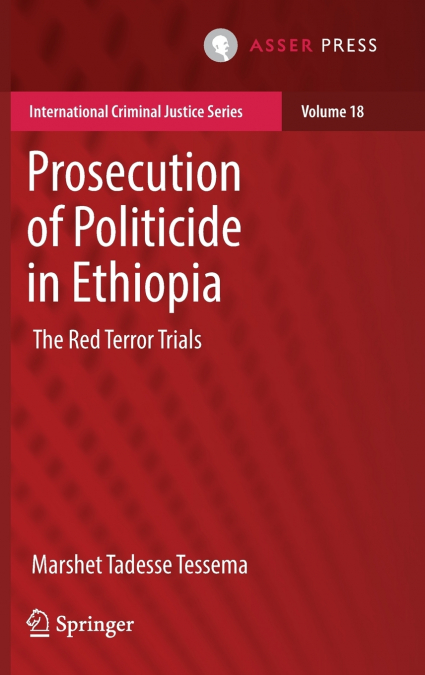
This book investigates the road map or the transitional justice mechanisms that theEthiopian government chose to confront the gross human rights violations perpetratedunder the 17 years’ rule of the Derg, the dictatorial regime that controlled state powerfrom 1974 to 1991. Furthermore, the author extensively examines the prosecution ofpoliticide or genocide against political groups in Ethiopia.Dealing with the violent conflict, massacres, repressions and other mass atrocities ofthe past is necessary, not for its own sake, but to clear the way for a new beginning.In other words, ignoring gross human rights violations and attempting to close thechapter on an oppressive dictatorial past by choosing to let bygones be bygones, is nolonger a viable option when starting on the road to a democratic future. For unaddressedatrocities and a sense of injustice would not only continue to haunt a nation butcould also ignite similar conflicts in the future.So the question is what choices are available to the newly installed government whenconfronting the evils of the past. There are a wide array of transitional mechanismsto choose from, but there is no 'one size fits all' mechanism. Of all the transitionaljustice mechanisms, namely truth commissions, lustration, amnesty, prosecution,and reparation, the Ethiopian government chose prosecution as the main means fordealing with the horrendous crimes committed by the Derg regime.One of the formidable challenges for transitioning states in dealing with the crimes offormer regimes is an inadequate legal framework by which to criminalize and punishegregious human rights violations. With the aim of examining whether or not Ethiopiahas confronted this challenge, the book assesses Ethiopia’s legal framework regardingboth crimes under international law and individual criminal responsibility.This book will be of great relevance to academics and practitioners in the areas ofgenocide studies, international criminal law and transitional justice. Students in thefields of international criminal law, transitional justice and human rights will alsofind relevant information on the national prosecution of politicide in particular andthe question of confronting the past in general.Marshet Tadesse Tessema is Assistant Professor of the Law School, College of Law andGovernance at Jimma University in Ethiopia, and Postdoctoral Fellow of the SouthAfrican-German Centre, University of the Western Cape in South Africa.
Artículos relacionados

  • Comparative regulation, economic analysis, and applications of private equity in the united states and european union
    Irini Liakopoulou
    The present work examines the economics and legal doctrine of private equity. After a consideration of private equity’s origins, the book will explore the evolution of private equity in the United States and Europe. The reference economic model then will be reconstructed, with particular attention to financial flows to and from private equity firms and funds. This reconstructio...
  • Complicity in International Law
    Dimitris Liakopoulous
    Complicity in International Law aims to analyze questions arising from a state’s complicity in conflict with another state or an international organization. On the basis of international legal provisions, a state that assists the illicit fact of another state or an international organization in turn commits an offense if it is aware of the main fact and is bound by the same obl...
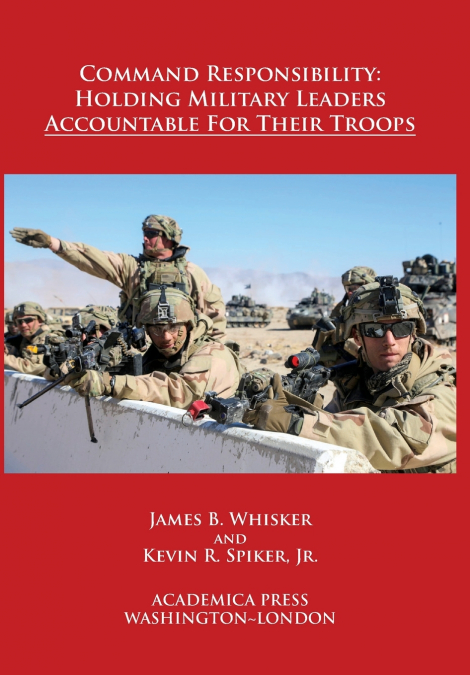
  • Command responsibility
    James B Whisker / Kevin R Spiker
    Command responsibility, or executive accountability, assumes that leaders are responsible for the actions of their subordinates. If subordinates misbehave, violate basic moral laws, transgress international law, or thwart international standards of behavior, their leader may be called before to justice. Standards that set the boundaries of human action have been evolving for ma...
  • International Organizations and Reparations
    Dimitris Liakopoulos
    In the first part of this book, noted legal scholar Dimtris Liakopoulos deals with reconstructing the legal regulatory framework governing human rights violations in the activities of organizations. After identifying rules that are generally applicable to organizations’ offenses and govern the profile of reparations, this study assesses primary rules that guarantee the right to...
  • International Organizations and Legal Sanctions Against Governments
    Dimitris Liakopoulos
    This book examines the relationship between governments and international organizations under international law. After surveying the policing powers of international organizations under international law, it illustrates some normative aspects of law that distinguish regulation from enforcement via study of recent legal cases before international judicial bodies. According to Di...
  • The EU Foreign Subsidies Regulation
    Andreas Reindl / Isabelle Van Damme
    'The EU Foreign Subsidies Regulation' is a pioneering manual authored by legal experts Andreas Reindl and Isabelle Van Damme. This essential guide, the first of its kind, is tailored for legal practitioners, offering a thorough exploration of the tools and mechanisms embedded within this novel European regulatory framework. The authors meticulously dissect the EU Foreign Subsid...