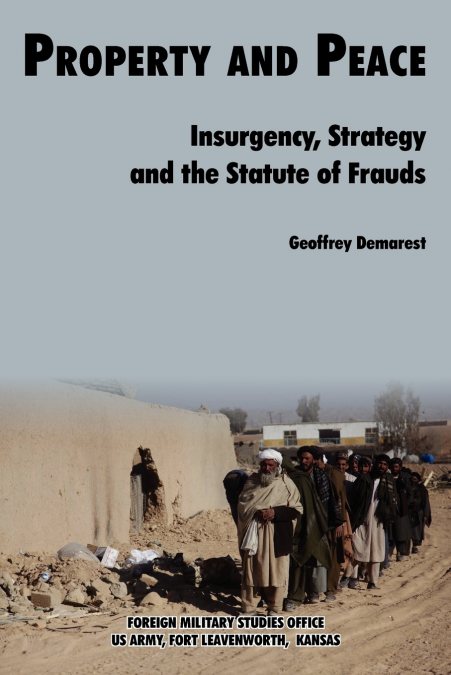
Foreign Military Studies Office / Geoffrey Demarest
 Librería Samer Atenea
 Kálamo Books
 Librería Elías (Asturias)
 Librería Kolima (Madrid)
 Librería Proteo (Málaga)
The success of a society depends on formal, liberal property regimes. The West’s property regimes are successful because of the high quality of evidence of everyday rights, the capacity of citizenry and governments to implement the meaning of that evidence, and because the basic rules which determine what can be owned and who can be owners are liberal in measure appropriate to the common understanding of justice. Formalized property information feeds conflict resolution mechanisms by clearly identifying owners, claimants, rights and duties; creates stakeholders willing to support the rule of law; produces landowners who are less inclined to engage in illegal behavior because they risk forfeiture; and the records associated with formal property provide a powerful forensic tool with which to support peaceful conflict resolution processes, restitution programs, and bring violators to justice. Outside the lines of formal property lies possession by force. The gamut of societal choices is few - formal property, internal violence, or tyranny. People should not be led to choose tyranny over violence because the condition of formal property has not been offered. This book argues that the quality of foreign real-property systems be made a priority issue in US thinking and strategy. A polity that does not formalize ownership rights and duties, especially to land, will not enjoy peace. Comprehensive, precise and transparent expression of real property is a necessary precondition of peace. If by success of a society we mean parallel improvement in freedom, material prosperity and social peace, then construction of formal, liberal property regimes and land-use systems is as important as elections or prosecuting human rights violators. The process of formalizing property, moreover, illuminates power and power relationships. It also exposes the otherwise invisible lines of communication and sanctuary that power over places provides.