
Inicio > > Programación informática/desarrollo de software > Prompting Java for Backend Development
Prompting Java for Backend Development

Prompting Java for Backend Development

Dorival Querino

55,26 €
IVA incluido
Disponible
Editorial:
Orange Education Pvt Ltd
Año de edición:
2026
Materia
Programación informática/desarrollo de software
ISBN:
9788169646147
55,26 €
IVA incluido
Disponible

Selecciona una librería:

  • Librería Samer Atenea

  • Kálamo Books
  • Librería Elías (Asturias)
  • Librería Kolima (Madrid)
  • Librería Proteo (Málaga)

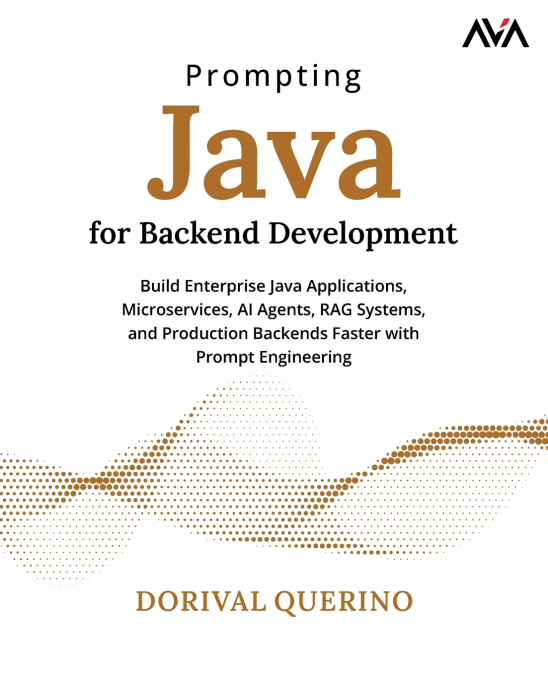
Code Less. Build More. Scale Faster with Java and AI.Book DescriptionJava powers the enterprise - and the developers who know how to direct AI with precision are the ones building and shipping production systems faster than anyone else. Prompting Java for Backend Development shows you how to translate natural-language intent directly into production-ready Java code using AI, accelerating every stage of development from core fundamentals to intelligent agentic applications.You use prompt engineering techniques to generate Java code, debug errors, build microservices, and optimize production systems using modern AI tools and frameworks. Every chapter pairs practical Java development with guided prompt workflows, addressing real enterprise challenges including scalable architecture, code quality, and ethical AI use.The final chapter pushes into intelligent Java application development - building a chatbot using Jlama and an autonomous agentic assistant with Retrieval-Augmented Generation (RAG). Hence, by the end of the book, you can confidently build, evaluate, and ship modern Java applications with AI!What you will learn● Translate natural language into production-ready Java code using AI-assisted prompt workflows.● Build and debug real-world Java applications using modern IDEs and AI development tools.● Generate, refine and validate Java code using targeted prompt engineering techniques.● Architect and deploy scalable enterprise Java systems using microservices and cloud-native patterns.● Build intelligent Java applications including chatbots and agentic AI systems using Jlama and RAG.● Identify and mitigate AI limitations, bias and ethical risks in production Java development.Table of Contents1. Introduction to Generative AI in Programming2. Setting up an AI-Powered Development Environment3. Learning Java Fundamentals with AI4. Crafting Beyond Java Classes with AI Prompts5. Production-Flavored Mini Projects Using AI6. Debugging and Optimization with AI7. Limitations, Ethics, and Human Supervision8. The Future of AI in Java Programming       Index

Artículos relacionados

  • SPARK 2014 Reference Manual
    AdaCore / Altran UK Ltd
    SPARK 2014 is a programming language and a set of verification tools designed to meet the needs of high-assurance software development. SPARK 2014 is based on Ada 2012, both subsetting the language to remove features that defy verification, but also extending the system of contracts and aspects to support modular, formal verification.This manual is available online for free at ...
    Disponible

    19,91 €

  • Software and Intelligent Sciences
    Yingxu Wang
    The junction of software development and engineering combined with the study of intelligence has created a bustling intersection of theory, design, engineering, and conceptual thought. Software and Intelligent Sciences: New Transdisciplinary Findings sits at a crossroads and informs advanced researchers, students, and practitioners on the developments in computer science, theor...
  • Power System Planning Technologies and Applications
    Fawwaz Elkarmi / Nazih Abu Shikhah / Nazih Abu-Shikhah
    Planning is an important function of the management of any business, providing knowledge of future prospects and enabling prudent and appropriate decision-making. Planning is especially critical for power systems, since electricity is a fundamental part of modern societies and many conventional electrical energy resources currently in use are limited. Power System Planning Tech...
  • Concept Parsing Algorithms (CPA) for Textual Analysis and Discovery
    Masha Etkind / Uri Shafrir
    Text analysis tools aid in extracting meaning from digital content. As digital text becomes more and more complex, new techniques are needed to understand conceptual structure. Concept Parsing Algorithms (CPA) for Textual Analysis and Discovery: Emerging Research and Opportunities provides an innovative perspective on the application of algorithmic tools to study unstructured d...
  • Model-Based Design for Effective Control System Development
    Wei Wu
    Control systems are an integral aspect of modern society and exist across numerous domains and applications. As technology advances more and more, the complexity of such systems continues to increase exponentially. Model-Based Design for Effective Control System Development is a critical source of scholarly information on model-centric approaches and implementations for control...
  • Verification, Validation and Testing in Software Engineering
    ...