
Inicio > Matemáticas y ciencia > Química > Prevalência de carbamato de etilo em bebidas alcoólicas
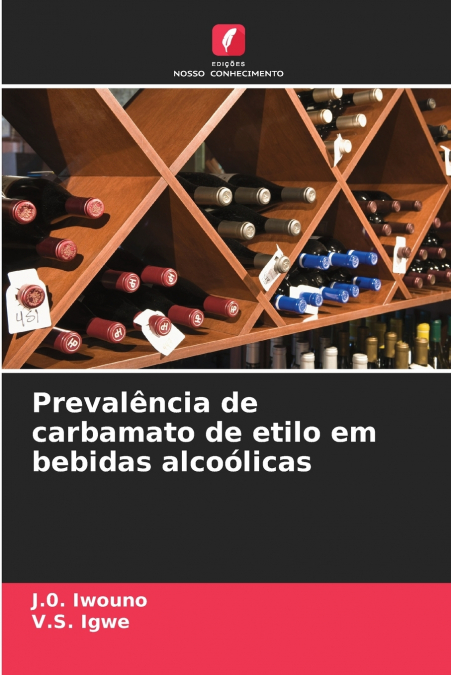
Prevalência de carbamato de etilo em bebidas alcoólicas

Prevalência de carbamato de etilo em bebidas alcoólicas

J.0. Iwouno / V.S. Igwe

35,43 €
IVA incluido
Disponible
Editorial:
KS OmniScriptum Publishing
Año de edición:
2025
Materia
Química
ISBN:
9786208471408
35,43 €
IVA incluido
Disponible

Selecciona una librería:

  • Librería Samer Atenea
  • Librería Aciertas (Toledo)
  • Kálamo Books
  • Librería Perelló (Valencia)
  • Librería Elías (Asturias)
  • Donde los libros
  • Librería Kolima (Madrid)
  • Librería Proteo (Málaga)

O carbamato de etilo (EC) é um éster etílico do ácido carbâmico. É um composto que pode ocorrer naturalmente em bebidas fermentadas e alimentos, como bebidas alcoólicas, vinho, cerveja, pão, molho de soja e iogurte. O carbamato de etilo pode ser formado a partir de várias substâncias derivadas de alimentos e bebidas, incluindo cianeto de hidrogénio, ureia, citrulina e outros compostos N-carbamilos. A presença de carbamato de etilo em bebidas é um indicador de más condições de armazenamento ou exposição e stress ao calor ou fermentação inadequada. O EC tem sido associado a irritações cutâneas e, obviamente, representa um sério risco à saúde humana quando presente em altas concentrações. No entanto, deve-se prestar atenção e criar mais consciência, uma vez que a sua relevância toxicológica foi parcialmente elucidada, recomenda-se que certos limites (limites máximos) sejam estabelecidos em bebidas e outros alimentos fermentados, minimizando assim os riscos à saúde.


Artículos relacionados

  • Suzuki-Miyaura Cross-Coupling Reaction and Potential Applications
    Suzuki–Miyaura cross-coupling remains a powerful tool in organic synthesis for C–C bond formation and has various industrial applications, for example, the synthesis of pharmaceuticals and materials. Intensive research efforts are being made into finding ways of improving and expanding the scope of this process, and the development of more efficient catalytic systems for this e...
    Disponible

    67,89 €

  • Catalysis for Low Temperature Fuel Cells
    Today, the development of active and stable catalysts still represents a challenge to overcome in the research field of low temperature fuel cells. Operation at low temperatures demands the utilization of highly active catalysts to reduce the activation energy of the electrochemical reactions involved at the electrodes, and thus obtain practical performances and high efficienci...
    Disponible

    59,74 €

  • Trends in Microextraction Techniques for Sample Preparation
    Micro-extraction techniques in sample preparation are gaining interest among analytical chemists as they comply with green analytical chemistry demands and ensure environmental protection and public safety. Savings in cost and time are considered as valuable benefits by using novel micro-extraction approaches in sample handling. Selectivity, sensitivity and lower detection limi...
    Disponible

    59,87 €

  • Advances and Applications of Nano-antimicrobial Treatments
    Nowadays, great concerns are associated with the resistance demonstrated by many microorganisms towards the conventional antibiotic therapies. The failure of traditional antimicrobials, and the increasing healthcare costs, have encouraged scientific research and the development of novel antimicrobial agents. Particularly, there is a great deal of interest in nanotechnologies an...
    Disponible

    51,68 €

  • Handbook of Research on Uncovering New Methods for Ecosystem Management through Bioremediation
    Kajal Srivastava / Shivom Singh
    Maintaining and preserving the environment is a crucial consideration in an era where climate change and rising sea levels are common knowledge. It is important for researchers and developers alike to explore potential solutions for a steadily warming world. The Handbook of Research on Uncovering New Methods for Ecosystem Management through Bioremediation focuses on the agricul...
  • Structural Design and Properties of Coordination Polymers
    The assembly of organic ligands and metal centres yields coordination polymers, many of which find applications in conductivity, catalysis, magnetism, gas sorption, biological sensing and luminescence. The structure and topology of coordination polymers may be manipulated by changing the reaction conditions, leading to a large variety of structurally and topologically unique pr...
    Disponible

    43,77 €

Otros libros del autor

  • Vorkommen von Ethylcarbamat in Spirituosen
    J.0. Iwouno / V.S. Igwe
    Ethylcarbamat (EC) ist ein Ethylester der Carbaminsäure. Es handelt sich um eine Verbindung, die natürlicherweise in fermentierten Getränken und Lebensmitteln wie Spirituosen, Wein, Bier, Brot, Sojasauce und Joghurt vorkommen kann. Ethylcarbamat kann aus verschiedenen Substanzen gebildet werden, die aus Lebensmitteln und Getränken stammen, darunter Cyanwasserstoff, Harnstoff, C...
    Disponible

    35,50 €

  • Występowanie karbaminianu etylu w napojach spirytusowych
    J.0. Iwouno / V.S. Igwe
    Karbaminian etylu (EC) jest estrem etylowym kwasu karbaminowego. Jest to związek, który może występować naturalnie w sfermentowanych napojach i produktach spożywczych, takich jak napoje spirytusowe, wino, piwo, pieczywo, sos sojowy i jogurt. Karbaminian etylu może powstawać z różnych substancji pochodzących z żywności i napojów, w tym z cyjanowodoru, mocznika, cytruliny i innyc...
    Disponible

    35,43 €

  • Prévalence du carbamate d’éthyle dans les spiritueux
    J.0. Iwouno / V.S. Igwe
    Le carbamate d’éthyle (EC) est un ester éthylique de l’acide carbamique. Il s’agit d’un composé qui peut être présent naturellement dans les boissons et les aliments fermentés, tels que les spiritueux, le vin, la bière, le pain, la sauce soja et le yaourt. Le carbamate d’éthyle peut se former à partir de diverses substances dérivées des aliments et des boissons, notamment le cy...
    Disponible

    35,50 €

  • Prevalenza dell’etilcarbammato negli alcolici
    J.0. Iwouno / V.S. Igwe
    L’etilcarbammato (EC) è un estere etilico dell’acido carbamico. È un composto che può essere presente naturalmente nelle bevande e negli alimenti fermentati, come alcolici, vino, birra, pane, salsa di soia e yogurt. Il carbammato di etile può formarsi da varie sostanze derivate da alimenti e bevande, tra cui acido cianidrico, urea, citrullina e altri composti N-carbamilici. La ...
    Disponible

    35,43 €