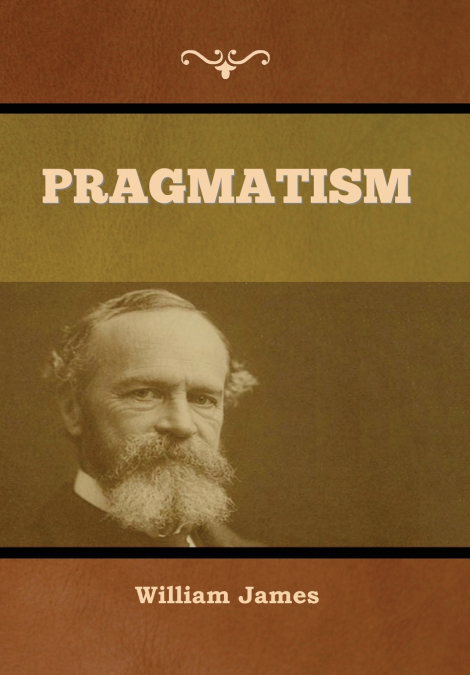

Pragmatism

Pragmatism

William James

28,33 €
IVA incluido
Consulta disponibilidad
Editorial:
IndoEuropeanPublishing
Año de edición:
2023
Materia
Filosofía
ISBN:
9798889421986

Selecciona una librería:

  • Librería Samer Atenea
  • Librería Aciertas (Toledo)
  • Kálamo Books
  • Librería Perelló (Valencia)
  • Librería Elías (Asturias)
  • Donde los libros
  • Librería Kolima (Madrid)
  • Librería Proteo (Málaga)

Pragmatism is a philosophical tradition that considers words and thought as tools and instruments for prediction, problem solving, and action, and rejects the idea that the function of thought is to describe, represent, or mirror reality. Pragmatists contend that most philosophical topics-such as the nature of knowledge, language, concepts, meaning, belief, and science-are all best viewed in terms of their practical uses and successes. Pragmatism began in the United States in the 1870s. Its origins are often attributed to the philosophers Charles Sanders Peirce, William James, and John Dewey. In 1878, Peirce described it in his pragmatic maxim: 'Consider the practical effects of the objects of your conception. Then, your conception of those effects is the whole of your conception of the object.'About William James:William James (January 11, 1842 - August 27, 1910) was an American philosopher and psychologist, and the first educator to offer a psychology course in the United States. James was a leading thinker of the late nineteenth century, one of the most influential U.S. philosophers, and has been labelled the 'Father of American psychology'. Along with Charles Sanders Peirce, James established the philosophical school known as pragmatism, and is also cited as one of the founders of functional psychology. A Review of General Psychology analysis, published in 2002, ranked James as the 14th most eminent psychologist of the 20th century. A survey published in American Psychologist in 1991 ranked James’s reputation in second place, after Wilhelm Wundt, who is widely regarded as the founder of experimental psychology. James also developed the philosophical perspective known as radical empiricism. James’ work has influenced intellectuals such as Émile Durkheim, W. E. B. Du Bois, Edmund Husserl, Bertrand Russell, Ludwig Wittgenstein, Hilary Putnam, and Richard Rorty, and has even influenced former US President Jimmy Carter. Born into a wealthy family, James was the son of the Swedenborgian theologian Henry James Sr. and the brother of both the prominent novelist Henry James and the diarist Alice James. James trained as a physician and taught anatomy at Harvard, but never practiced medicine. Instead he pursued his interests in psychology and then philosophy. James wrote widely on many topics, including epistemology, education, metaphysics, psychology, religion, and mysticism. Among his most influential books are The Principles of Psychology, a groundbreaking text in the field of psychology; Essays in Radical Empiricism, an important text in philosophy; and The Varieties of Religious Experience, an investigation of different forms of religious experience, including theories on mind-cure. 'The Varieties of Religious Experience' comprises James’ edited Gifford Lectures on natural theology, which were delivered at the University of Edinburgh in Scotland in 1901 and 1902. The lectures concerned the nature of religion and the neglect of science in the academic study of religion. Soon after its publication, Varieties entered the Western canon of psychology and philosophy and has remained in print for over a century. James later developed his philosophy of pragmatism. There are many overlapping ideas in Varieties and his 1907 book, Pragmatism. (wikipedia.org)

Artículos relacionados

  • Introduction to a Future Way of Thought
    Kostas Axelos / Kenneth Mills
    'Technologists only change the world in various ways in generalized indifference; the point is to think the world and interpret the changes in its unfathomability, to perceive and experience the difference binding being to the nothing.'Anticipating the age of planetary technology Kostas Axelos, a Greek-French philosopher, approaches the technological question in this book, firs...
    Disponible

    18,58 €

  • Capsule
    John Kenneth Press
    Join John and Adam as they wander the mean streets of Japan on a psychedelic fueled search for identity. While fun for the average reader, this book could also serve as a philosphy textbook because of its ordered exploration of sources of identity. Ultimately this trip through nationalist attacks, sex, and drugs, will take you to a better understanding of yourself and your pl...
    Disponible

    11,51 €

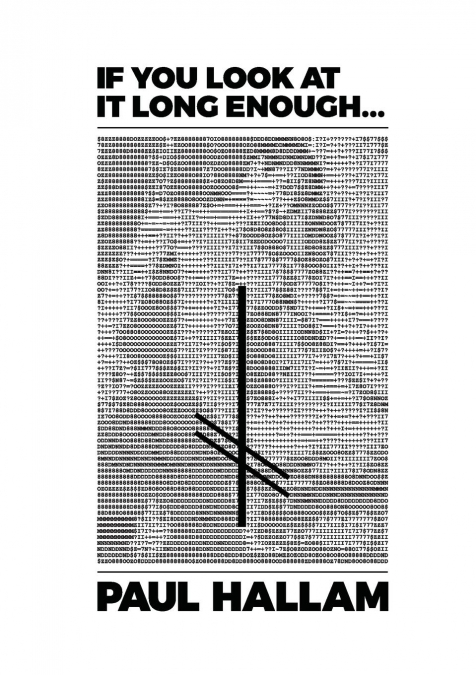
  • If you look at it long enough...
    Paul Hallam
    Originally written for an academic journal, If you look at it long enough... is primarily a personal account of Paul Hallam’s recollections of “self-abuse” through the consumption of porn over several decades. Challenging the familiar form of an “academic essay,” this autobiographical narrative raises several questions in relation to our contemporary morals related to sex in ge...
    Disponible

    11,30 €

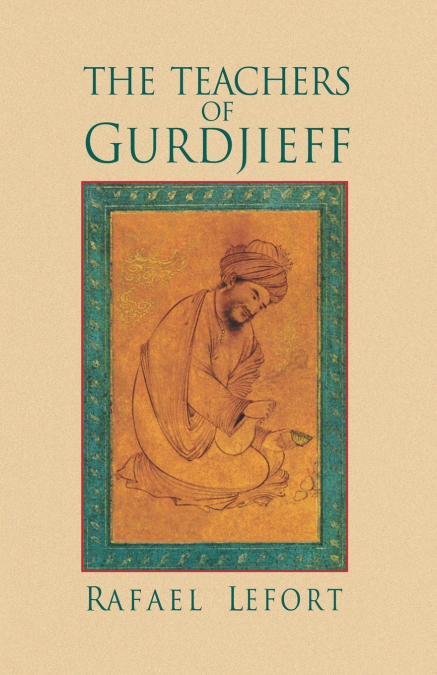
  • The Teachers of Gurdjieff
    Rafael Lafort / Rafael Lefort
    When The Teachers of Gurdjieff was first published more than 50 years ago, it made a considerable stir. George Ivanovich Gurdjieff had been one of the most famous mystics in the West in the first half of the 20th century - a teaching master who had many fashionable and influential pupils. He had a striking appearance and manner of teaching, and his teaching proved to be very in...
    Disponible

    20,45 €

  • Manifesto of the Communist Party
    Karl Marx
    The Communist Manifesto was first published on February 21, and it is one of the world’s most influential political tracts. Commissioned by the Communist League and written by communist theorists Karl Marx and Friedrich Engels, it laid out the League’s purposes and program. The Manifesto suggested a course of action for a proletarian (working class) revolution to overthrow the ...
  • The Art of Literature
    Arthur Schopenhauer
    Collected here are eight short essays, On Authorship, On Style, On the Study of Latin, On Men of Learning, On Thinking for Ones Self, On Criticism, On Reputation, On Genius, by the world renowned philosopher Arthur Achopenhauer. ...

Otros libros del autor

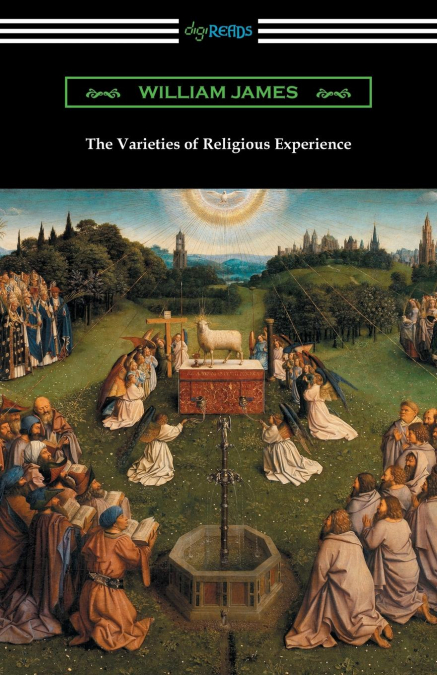
  • The Varieties of Religious Experience
    William James
    First published in 1902, “The Varieties of Religious Experience” is William James’ philosophical and psychological examination of the nature of religion in human civilization. Based on James’s own Gifford Lectures given at the University of Edinburgh in Scotland between 1901 and 1902, James argues that “Scientific theories are organically conditioned just as much as religious e...
    Disponible

    15,59 €

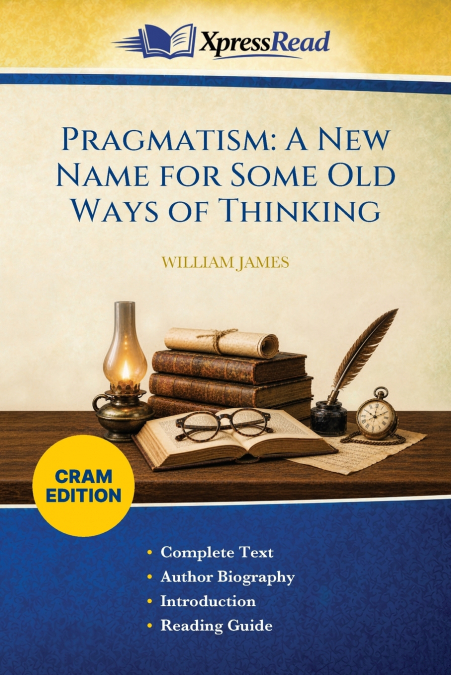
  • Pragmatism
    William James
    Pragmatism (1907) by William James presents a philosophy that judges ideas by their practical consequences rather than by abstract principles. James argues that the meaning and truth of any belief lie in how it works in real life-whether it helps us navigate experience, solve problems, or make sense of the world.He challenges rigid, absolutist systems of philosophy and defends ...
    Disponible

    14,18 €

  • Pragmatism
    William James
    Pragmatism (1907) by William James presents a philosophy that judges ideas by their practical consequences rather than by abstract principles. James argues that the meaning and truth of any belief lie in how it works in real life-whether it helps us navigate experience, solve problems, or make sense of the world.He challenges rigid, absolutist systems of philosophy and defends ...
  • The Principles of Psychology
    William James
    In The Principles of Psychology, Vol. II, William James continues his masterful inquiry into the workings of the human mind. With depth and clarity, he examines will, belief, attention, and the self-offering a profound synthesis of philosophy and science that remains a cornerstone of psychological thought. ...
    Disponible

    26,72 €

  • The Principles of Psychology
    William James
    In The Principles of Psychology, Vol. I, William James lays the foundation for modern psychology. Blending philosophy and science, he explores consciousness, habit, and emotion with vivid insight and human warmth. A landmark work that reshaped how we understand the mind and the stream of thought itself. ...
    Disponible

    27,98 €

  • A Pluralistic Universe
    William James
    A Pluralistic Universe by William James argues for a reality composed of many interacting, independent perspectives rather than a single, unified whole. James challenges the dominant monistic views of his time, advocating for a more nuanced understanding of experience that embraces the diversity and complexity of the world.James critiques philosophical systems that attempt to r...
    Disponible

    18,80 €