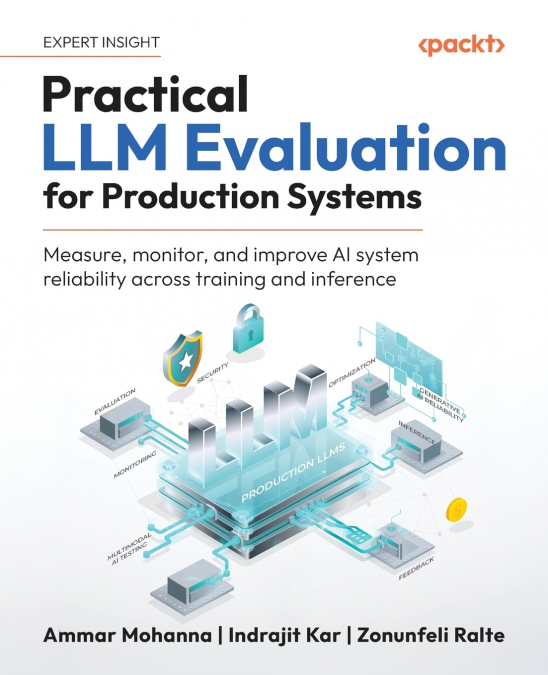
Ammar Mohanna / Indrajit Kar / Zonunfeli Ralte
 Librería Samer Atenea
 Kálamo Books
 Librería Elías (Asturias)
 Librería Kolima (Madrid)
 Librería Proteo (Málaga)
Build reliable Build reliable AI evaluation frameworks that measure quality, safety, grounding, and production readiness across modern LLM and SLM applicationsFree with your book: DRM-free PDF version + access to Packt’s next-gen Reader*Key Features:- Design evaluation frameworks for LLMs, SLMs, multimodal, reasoning, and agentic AI systems- Measure quality, safety, grounding, robustness, and production readiness with practical metrics- Apply unified evaluation methods to text, multimodal, and agentic AI systemsBook Description:Modern AI systems are expected to do far more than generate fluent text. They should be able to retrieve information, reason through complex problems, understand images and documents, call external tools, execute workflows, and support critical business decisions. Evaluating these systems requires methods that go beyond traditional NLP benchmarks.Taking a product-first approach, this book presents evaluation as a continuous operational capability spanning training, inference, and end-to-end system operation. You’ll learn how to connect evaluation metrics directly to deployment gates, rollback criteria, monitoring systems, and production reliability objectives.Using practical examples and real-world workflows, you’ll explore evaluation strategies for text LLMs, vision-language models, multimodal conversational systems, mixture-of-experts architectures, reasoning models, agentic systems, retrieval pipelines, Text2SQL and Text2Cypher systems, embedding models, OCR workflows, and guardrail SLMs. You’ll also learn how to manage non-determinism, design repeatable test suites, validate tool execution, and measure long-horizon agent behavior in production.By the end of the book, you’ll be able to design robust evaluation systems that help teams deploy reliable, safe, and economically viable LLM-powered applications with confidence.*Email sign-up and proof of purchase requiredWhat You Will Learn:- Design repeatable evaluation pipelines for LLM systems- Assess inference quality, latency, and operational cost- Evaluate multimodal, agentic, and reasoning AI systems- Build regression gates and deployment evaluation workflows- Detect hallucinations and grounding failures in VLMs- Assess routing stability in mixture-of-experts models- Evaluate Text2SQL, OCR, and retrieval-based systems- Translate evaluation signals into production decisionsWho this book is for:ML engineers, GenAI engineers, AI architects, data scientists, platform engineers, and engineering managers responsible for deploying LLM-powered systems in production will benefit from this book. Applied AI researchers and technical decision-makers looking to measure reliability, safety, and operational readiness across modern AI systems will also find it valuable. Readers should have a working understanding of machine learning, Python, and modern LLM concepts.Table of Contents- Foundations of LLM Evaluation: Core Concepts and Primitives- Building Reliable Text-Only LLMs Through Training-Time Evaluation- Controlling Text-Only LLM Behavior at Inference Time- Grounding and Reliability in Vision Language Models During Training- Evaluating Visual Grounding and Reliability at Inference Time- Evaluating Multimodal Conversational LLMs Across Training and Inference- Evaluating Routing and Reliability in Mixture of Experts LLMs- Evaluating Reliability and Control in Computer-Using Agent Systems- Evaluating Information Extraction and Document-Understanding LLMs- Evaluating Reasoning LLMs in Depth- Evaluating Specialized LLM Systems