
Politics of Extraction

Politics of Extraction

Jaskoski

127,96 €
IVA incluido
Consulta disponibilidad
Editorial:
Oxford University Press
Año de edición:
2022
Materia
Relaciones internacionales
ISBN:
9780197568927

Selecciona una librería:

  • Librería Samer Atenea
  • Librería Aciertas (Toledo)
  • Kálamo Books
  • Librería Perelló (Valencia)
  • Librería Elías (Asturias)
  • Donde los libros
  • Librería Kolima (Madrid)
  • Librería Proteo (Málaga)

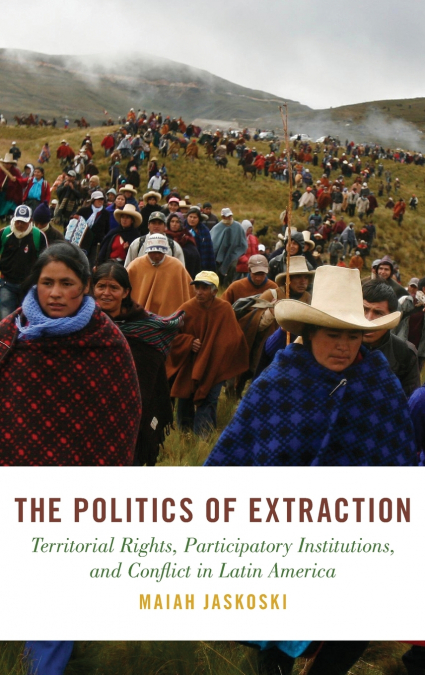
Mining and hydrocarbon production in Latin America is high-stakes for extractive firms, communities in resource-rich zones, and states. Amid global commodity price increases and liberal economic policies, the sectors have expanded dramatically in recent decades. This surge has made privateinvestors and governments in the region ever more committed to extraction. It also has increased alarm within local communities, which have organized around the environmental, cultural, and social impacts of mining and hydrocarbons. Moreover, activists have mobilized to demand material benefits, inthe forms of royalty distributions and direct company investment in local services and infrastructure. These conflicts take the form of legal battles, large-scale protests, and standoffs that pit communities against companies and the state, and consequently have suspended production, destabilizedpolitics, and expended state security resources. In The Politics of Extraction, Maiah Jaskoski looks at how mobilized communities in Latin America’s hydrocarbon and mining regions use participatory institutions to challenge extraction. In some cases, communities act within formal participatory spaces, while in others, they organize around or inreaction to these institutions, using participatory procedures as focal points in the escalation of conflict. Based on analysis of thirty major extractive conflicts in Bolivia, Colombia, and Peru in the 2000s and 2010s, Jaskoski examines community uses of public hearings built into environmentallicensing, state-led prior consultation with native communities affected by large-scale development, and local popular consultations or referenda. She finds that communities select their strategies in response to the specific participatory challenges they confront: the trials of initiatingparticipatory processes, gaining inclusion in participatory events, and, for communities with such access, expressing views about extraction at the participatory stage. Surprisingly, the communities least likely to channel their concerns through state institutions are the most unified and have thestrongest guarantee of participation. Including a wealth of data and complex stories, Jaskoski provides the first systematic study of how participatory institutions either channel or exacerbate conflict over extraction.
Artículos relacionados

  • Realism in Practice
    The purpose of this book is to appraise the current relevance and validity of realism as an interpretative tool in contemporary International Relations. All chapters of the book are animated by a theoretical effort to define the conceptual aspects of realism and attempt to establish whether the tradition still provides the necessary conceptual tools to scholars.The chapters add...
    Disponible

    20,36 €

  • Predicting gender violence in India
    Shritha K Vasudevan
    In this provocative new book, Shritha Vasudevan argues that feminist international relations (IR) theory has inadvertently resulted in a biased worldview, the very opposite of what feminist IR set out to try to rectify. This book contests theoretical presumptions of Western feminist IR and attempts to reformulate it in contexts of non-Western cultures. Vasudevan deftly utilizes...
  • Contemporary security issues in Africa
    Isiaka Alani Badmus / Lere Amusan
    In volume, an emerging generation of African scholars examines specific states in Africa where instability is the order of the day. Considerations of African instability are highly relevant in today’s world, where one examines the types of regimes that were put in place after the Cold War and their effects on Africa. Multiparty systems introduced in Africa, rather than bringing...
  • Chronicles of the first and second chechen wars
    Ilya Milyukov
    Presented by Russian author and attorney Ilya Milyukov, Chronicles of the First and Second Chechen War presents the main events of the First (1994-1996) and Second (1999-2009) Wars in Chechnya, Russia’s deadliest conflicts since World War II. The First War began in December 1994 and lasted for one year and nine months, ending in August 1996. There were two major urban battles -...
  • Political instability in Africa
    Isiaka Alani Badmus / Lere Amusan
    This book offers broad-gauged analyses of the causes, nature, and changing patterns of armed conflict in Africa as well as the reasons for these patterns. It also situates conflicts that have been haunting the African continent since the time of decolonization within the various theoretical schools such as 'new war,' 'economic war,' 'neo-patrimonial,' and 'globalization.' It be...
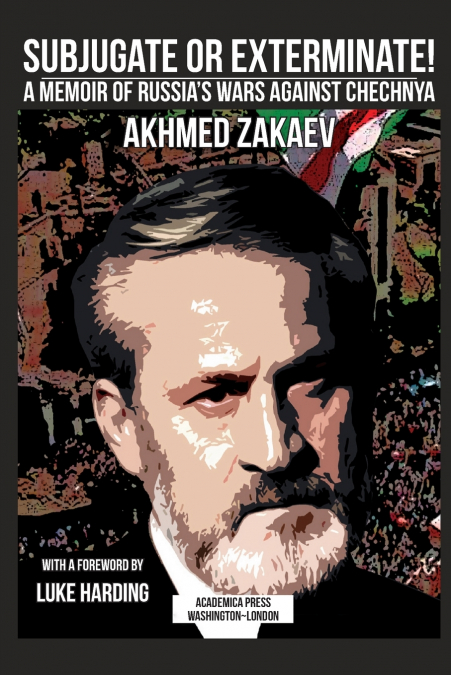
  • Subjugate or exterminate!
    Akhmed Zakaev / Arch Tait
    Foreword by Luke HardingAkhmed Zakaev is a symbol of the indomitable will of the Chechen nation. In this important memoir, he tells the story of the Chechen struggle as he experienced it, describing the conflict in human terms and providing a detailed documentary record of little known or badly understood events that will be of benefit to historians for generations to come.- Da...
    Disponible

    41,63 €