 Librería Samer Atenea
 Kálamo Books
 Librería Elías (Asturias)
 Librería Kolima (Madrid)
 Librería Proteo (Málaga)
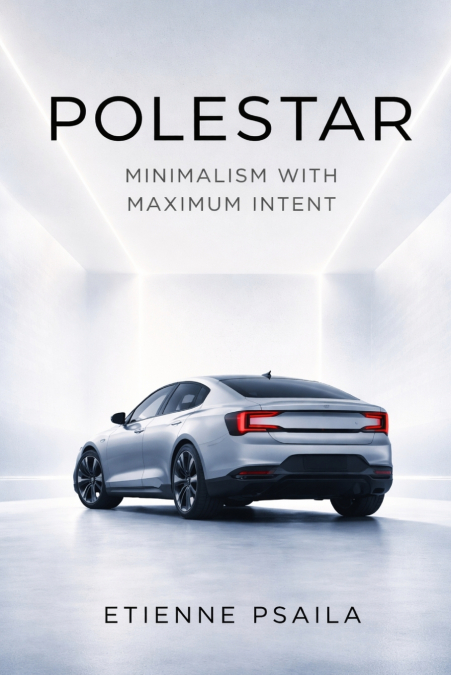
Polestar arrived in the premium EV era with a proposition that sounded almost contrarian: fewer gestures, clearer logic, and performance expressed through composure rather than spectacle. Built from the industrial realities of the Geely-Volvo network yet determined to speak in its own visual and technological language, the brand tried to prove that restraint could be a differentiator in a category defined by noise. This book follows Polestar’s evolution through decisions that can be documented-platform strategy, design rules, software direction, manufacturing geography, retail structure, and corporate finance-showing how identity is built when a company chooses coherence over constant reinvention.As the mid-2020s EV market shifted from hype to hard economics, Polestar faced pressures that tested every part of its operating model: tariffs and incentive rules that turned production origin into a pricing weapon; software expectations that made the cabin experience inseparable from update governance; and public-market scrutiny that exposed the capital intensity of scaling a premium brand. Rather than treating these as footnotes, the narrative tracks how they shaped product cadence, market choices, and restructuring actions, revealing the operational trade-offs behind a minimalist surface.Polestar: Minimalism with Maximum Intent is a fact-driven, narrative account of how a modern automaker tries to stay distinct without becoming loud-how design can function as strategy, and how strategy must survive real-world constraints. It is a story about premium competition in the EV era where the winners are increasingly defined not by a single headline feature, but by the ability to deliver a coherent ownership experience across product, software, manufacturing, and institutional stability.