
Inicio > Medicina > Medicina clínica e interna > Enfermedades y trastornos > Enfermedades infectocontagiosas > Playbook For Early Response To High-Consequence Emerging Infectious Disease Threats And Biological Incidents
Playbook For Early Response To High-Consequence Emerging Infectious Disease Threats And Biological Incidents

Playbook For Early Response To High-Consequence Emerging Infectious Disease Threats And Biological Incidents

National Security Council

31,54 €
IVA incluido
Consulta disponibilidad
Editorial:
W. Frederick Zimmerman
Año de edición:
2020
Materia
Enfermedades infectocontagiosas
ISBN:
9781608881864

Selecciona una librería:

  • Librería Samer Atenea
  • Librería Aciertas (Toledo)
  • Kálamo Books
  • Librería Perelló (Valencia)
  • Librería Elías (Asturias)
  • Donde los libros
  • Librería Kolima (Madrid)
  • Librería Proteo (Málaga)

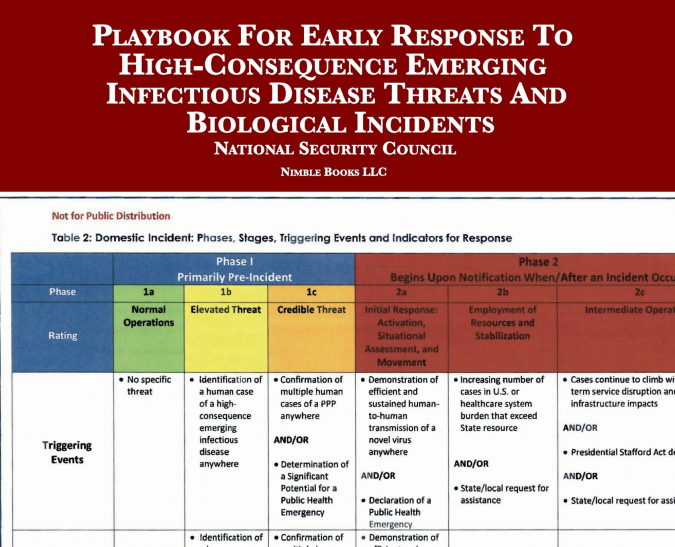
In March 2020 POLITICO reported that after the Ebola outbreak in 2014, the Obama Administration’s National Security Council had prepared a detailed, thorough 'pandemic playbook' that was available to Trump administration officials, who treated it dismissively and did not draw on it during the response to the coronavirus. The leaked 69-page PowerPoint is reproduced in full color in durable hardcover landscape format, a crucial resource for understanding the Trump administration’s response to COVID-19. The Playbook describes itself as follows: 'a decision-making tool that identifies: (1) questions to ask; (2) agency counterparts to consult for answers to each; and (3) key decisions which may require deliberation through the Presidential Policy Directive (PPD)-1 process or its successor National Security Council process.' This is a document with an optimistic view of its role in the world. It is not clear that policy leaders in any Administration are actually interested in outsourcing their decision-making to a tool developed by a previous admninistration. To the contrary, policy-makers typically place a great deal of emphasis on getting their own people in place to ask the right questions. The main body of the Playbook is comprised of two major sections, one for international events that have not yet reached the US and one for events with a US locus. For each, a 'Rubric' is provided that 'is not intended to serve as a comprehensive concept of operations or replace national or pre-existing U.S. Government response structures, but rather to serve as a proposed guide based on existing authorities, guidance, and response frameworks for staff monitoring emerging infectious disease threats and interagency planning and response, should the need arise in the future.' The key words are 'for staff monitoring emerging infectious disease threats...' -- in other words, this document was intended for use by staff who are monitoring things, rather than for policy makers who are deciding them. The Rubrics explicitly spell out key assumptions--for example, on the domestic side that 'the U.S. Government will use all powers at its disposal to prevent, slow, or mitigate the spread of an emerging infectious disease threat...' The drafters did not include any language such as 'unless it might hurt the stock market.' Both Rubrics contain exhaustive lists of important questions and decisions that correspond well with what we know now to have been important in the response to COVID-19.An Appendix contains several useful resources, including a laundrty list of 'declarations and mitigation options' -- things that the US government or other agencies can declare and do, specifically including pharmaceutical, medical, travel-related and community interventions. Some of the latter will seem remarkably familiar:a. Voluntary home isolation of the ill and home quarantine of the exposedb. Dismissal of students from schoolsc. Social distancing measures, such as teleworkd. Cancellation of large public gatherings; ande. Widespread use of personal protective devicesA section on Communications envisages the Secretary of HHS as the primary spokesperson. No mention is made of daily 5 pm press conferences with the President.Readers who enjoy works like THE GREAT INFLUENZA, CONTAGION, and THE ANDROMEDA STRAIN will find this a fascinating look behind the curtain. Also an ideal gift for that 'no masks' relative who just will not read the peer-reviewed science that you patiently email to them!
Artículos relacionados

  • The Hidden Zoo Inside You
    Allen Jones / Allen S Jones
    A primer about hundreds of infections, The Hidden Zoo Inside You provides the foundations of infectious disease required to understand pandemics through the use of humor, drawings, and even doodles. The entire book is handwritten and includes diagrams and sketches that explain, in layman’s terms, the origin, epidemiology, clinical features, public health concerns of various lif...
    Disponible

    30,97 €

  • ENFERMEDADES NOSOCOMIALES. MICROORGANISMOS CAUSALES
    JOSE ALBERTO ALARCÓN MARTÍNEZ
    El libro define una infección nosocomial, cómo se transmiten, tipos de infecciones que las causan, cómo prevenirlas y los principales agentes causales que las producen, ya sean bacterias, virus u hongos. ...
    Disponible

    16,44 €

  • The Demodex Solution
    Dr. Anna Ivakhnenko
    Wondering if your skin concerns like acne, rosacea, red nose, pimples, and a range of other conditions could be linked to Demodex mites? Discover the ultimate solution in this comprehensive guide to regain your skin’s health.Enter the microscopic world of Demodex mites and explore their potential connection to a myriad of skin conditions such as rosacea, blepharitis, seborrheic...
    Disponible

    39,81 €

  • Disease X
    Kate Kelland
    What if the next global pandemic isn’t a replay of COVID-19, but something faster, deadlier, and harder to stop? In 2018, the World Health Organization added a chilling new entry to its list of priority epidemic threats: 'Disease X' - a placeholder for the unknown pathogen that could trigger a serious international outbreak.In Disease X, science journalist and CEPI (Coalition f...
    Disponible

    22,80 €

  • Black Plague Demystified
    Dr. Ankita Kashyap / Prof. Krishna N. Sharma
    'Black Plague Demystified: Doctor’s Secret Guide' takes you on a profound journey through the historical roots, biological intricacies, and psychosocial dimensions of the infamous Black Plague. From its historical origins to modern-day implications, this guide offers a comprehensive exploration of symptoms, transmission, and risk factors. Demystify common misconceptions and del...
    Disponible

    10,74 €

  • The Black Plague Mastery Bible
    Dr. Ankita Kashyap / Prof. Krishna N. Sharma
    'The Black Plague Mastery Bible: Your Blueprint for Complete Black Plague Management' is an indispensable guide providing comprehensive insights into understanding, managing, and overcoming the historical scourge of the Black Plague. Delving into the pathophysiology, transmission, and epidemiology, this book offers a detailed exploration of recognizing early symptoms while debu...
    Disponible

    10,84 €

Otros libros del autor

  • National Strategy for Combating Terrorism, September 2006
    National Security Council
    National Strategy for Combating Terrorism, September 2006, has been considered an important book throughout the human history. So that this work is never forgotten we have made efforts in its preservation by republishing this book in a modern format for present and future generations. The whole book has been reformatted, retyped and designed. This book is not made of scanned co...
    Disponible

    13,32 €

  • NSSM 200 The Kissinger Report
    National Security Council
    In 1974, President Richard Nixon ordered his national security council, under the direction of Henry Kissinger, to study the implications of population growth to the interests of the United States and propose action. This classified study was called NSSM-200. The study was concluded later that year, but Nixon was otherwise occupied, and did not act on the study. His replacem...
    Disponible

    14,90 €

  • NSSM 200 The Kissinger Report
    National Security Council
    In 1974, President Richard Nixon ordered his national security council, under the direction of Henry Kissinger, to study the implications of population growth to the interests of the United States and propose action. This classified study was called NSSM-200. The study was concluded later that year, but Nixon was otherwise occupied, and did not act on the study. His replacement...