 Librería Samer Atenea
 Kálamo Books
 Librería Elías (Asturias)
 Librería Kolima (Madrid)
 Librería Proteo (Málaga)
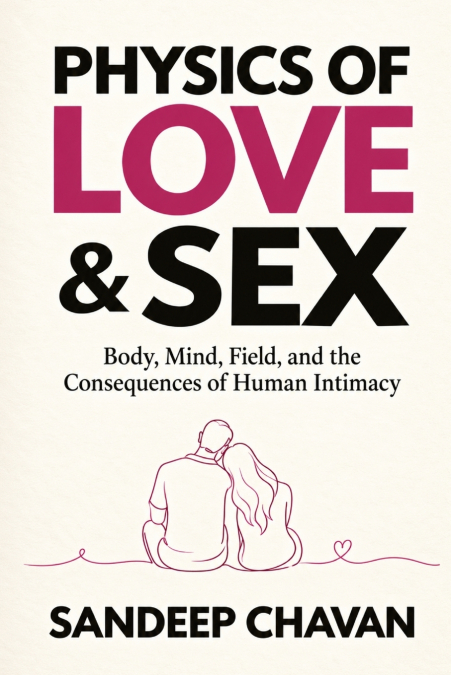
What actually happens when one person becomes unusually important to another?Why does attraction become desire, desire become attachment, attachment become love-or possession? Why can sex create intimacy in one context and emptiness, confusion, or fragmentation in another? Why does betrayal hurt beyond the act itself? And why has modern life increased contact without necessarily increasing connection?Physics of Love & Sex offers a structural exploration of one of the most powerful areas of human life: attraction, desire, attachment, love, sexuality, intimacy, and consequence.Sandeep Chavan moves beyond the usual reductions of love to chemistry, sex to biology, intimacy to morality, or romance to feeling. Through the language of Universal Energy Dynamics, the book treats love and sex as multi-layered consequence-events involving body, brain, memory, imagination, self, desire, relationship, culture, and future. The book develops a series of clear structural distinctions:Attraction is the first disturbance.Desire is directional energy.Attachment is emotional anchoring.Love is refined coherence.Sex is embodied consequence.Intimacy is shared field-access.Possession is attachment distorted into control.Betrayal is broken shared reality.Mature love is care without capture.Across twenty chapters, Chavan examines beauty and perception, bodily attraction, one-sided love, lust, projection, jealousy, sexual biology, synchronization, orgasm, sex with and without love, consent, forced sex, heartbreak, infidelity, pornography, loneliness, marriage, family, culture, and conscious intimacy.The book does not argue that love is merely mechanical or that sex can be reduced to one universal formula. Instead, it asks what structure is present in each event: What is moving? What is being sought? What is being attached? Is there mutual participation? Is freedom preserved? Is the other being recognized as a full person-or reduced to an object, source of validation, or emotional possession?A major concern of the book is the difference between contact and intimacy. Physical occurrence alone does not create union. Mutuality, willingness, trust, self-field participation, and consequence-awareness matter. The manuscript therefore treats forced or coerced sex as structurally opposite to intimacy: contact without reciprocal participation or alignment. The final sections expand intimacy beyond the couple to marriage, family, culture, technology, and the future. Chavan argues that every attraction creates a disturbance, every attachment creates vulnerability, every sexual act enters consequence, every betrayal breaks a shared reality, and every family transmits something forward.Written for readers interested in relationships, love, psychology, sexuality, intimacy, marriage, human behavior, and modern emotional life, Physics of Love & Sex offers neither a moral code nor a sexual manual. It offers a new structural question:How can human beings come close without capturing, desire without consuming, love without losing themselves, and unite without destroying freedom? 6