EPM Mavericks / SAJI MADAPAT / Tiger Rider
 Librería Samer Atenea
 Kálamo Books
 Librería Elías (Asturias)
 Librería Kolima (Madrid)
 Librería Proteo (Málaga)
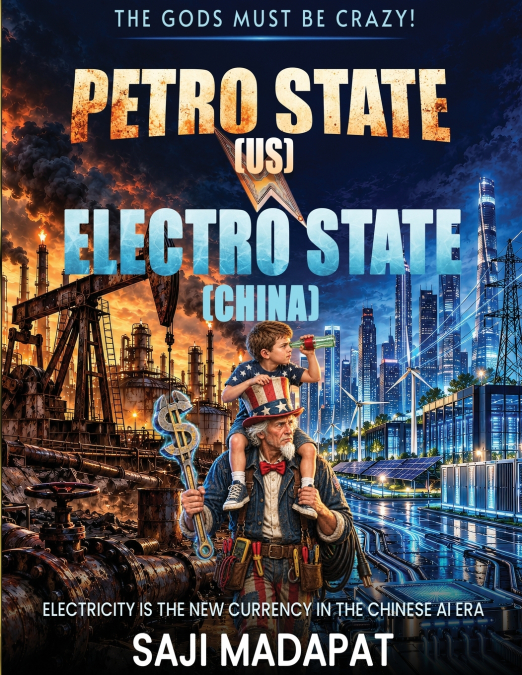
There are two electricity meters in this book, and they are customers of the same utility.One is on Saji Madapat’s house outside Memphis. In 2026 its bill went from $132 to $760; for fifty-one days the house never drew less than 3.3 kilowatts, even in its quietest half hour; and the utility’s engineers could not say why. The other is twenty miles away, at a former appliance plant where a company now pays for its own substations, ran gas turbines in the yard to cover the wait, and trains an AI it calls the most powerful in the world. Madapat will not tell you one meter moved the other. He will tell you what they share: a grid deciding, in public, what a kilowatt-hour costs and who pays for the next wire.That question has a currency, and Petro State (US) to Electro State (China) follows it. It begins in Kerala in 1992, where electricity was something you bought twice and a young man with a questionnaire learned that a kilowatt-hour is worth whatever its absence interrupts. It crosses to a China that added three Frances’ worth of generating capacity in a year and whose solar fleet passed its coal fleet in the summer of 2026; then it reads the second line on that cheap bill, a surcharge the book names Javert, and watches a green certificate sell for a third of a milk tea. It queues at the Twenty-Millisecond Border Crossing, where workloads are stamped instead of passports, finds the one thing cheap power cannot buy - the memory chips an embargo withholds - and watches the two largest American clouds rent a Chinese model to American enterprises.Then the war in the Gulf sends every oil importer looking for the exit, and the exit turns out to be electrical, and the equipment for it, overwhelmingly, Chinese. It follows the buyers: Santiago’s buses, Bengaluru’s kilometres, a barber’s clippers in Ogun state, a floating solar plant in Java with Indonesian and Emirati owners, Chinese engineers and Japanese, French and British banks. None of them wants to be somebody else’s customer forever.And America? Everybody is racing to own the future; somebody still has to connect it. Houston has read the AI memo and answered with wires, and gas to fill them. The country added a record 53 gigawatts in 2025 while its transformers were quoted at 128 weeks and 2,060 gigawatts waited in the interconnection queue. Ohio wrote data centers a prenuptial tariff; the Tennessee Valley Authority wrote a rate class for customers the size of cities; Memphis argued over a moratorium. He ends where Roosevelt’s first electrification began, with three commitments any city could make and a hearing - invented - at which a woman with a bill gets an answer.Satirical and scholarly, with McKinsey the Priest and Uncle Xi Economist attending and a Theyyam scholar’s rule for reading power - made gods are to be read, not worshipped - the latest in the Gods Must Be Crazy series sources every number, discloses the author’s own Chinese holdings, and names at the back the evidence that would prove it wrong.The petro-dollar is not dead. It is retired on a full pension and still invoicing. Long live the electro-dollar.The gods may keep the announcement. Let the rest of us use the future.