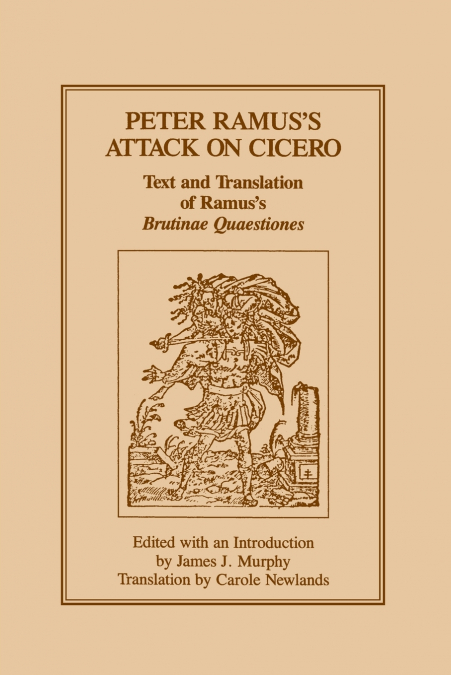

Peter Ramus’s Attack on Cicero

Peter Ramus’s Attack on Cicero


76,93 €
IVA incluido
Disponible
Editorial:
Taylor & Francis Ltd
Año de edición:
1995
Materia
Estudios de comunicación
ISBN:
9781880393017
76,93 €
IVA incluido
Disponible

Selecciona una librería:

  • Librería Samer Atenea
  • Librería Aciertas (Toledo)
  • Kálamo Books
  • Librería Perelló (Valencia)
  • Librería Elías (Asturias)
  • Donde los libros
  • Librería Kolima (Madrid)
  • Librería Proteo (Málaga)

Cicero had written seven books on rhetoric, but Ramus chose Orator for the attack which had been inevitable since his original denunciation of Cicero’s rhetoric in 1543. There are probably two reasons for this. The first is that he was thus able to enter into the widespread controversy over 'Ciceronianism.' More importantly, this choice enabled him to concentrate on the one Ciceronian work closest to his own personal view of rhetoric. For Ramus, rhetoric was a matter only of the exterior elements of style and delivery and Orator concentrates on style. It is set in the form of a letter to Cicero’s friend Marcus Junius Brutus responding to Brutus’s reaction to Cicero’s earlier history of Roman oratory -- titled Brutus after its dedicatee. None of Cicero’s other six works on rhetoric would have provided Ramus the same opportunity to fasten on questions of style the way he does in the Questions of Brutus. Ramus accuses Cicero of trying to prove that he is the 'perfect orator' about which Orator is written. He also accuses him of being merely an unthinking follower of Aristotle. The basic assault, however, is syllogistic. Ramus reduces Cicero’s ideas to syllogistic form to demonstrate their error and inconsistency. Throughout, Ramus continues to claim that Cicero does not know the true province of rhetoric. Moreover, he argues that what is found 'muddled and confused in unfathomable darkness' in this one book is also true of all of Cicero’s other books. Thus, The Questions of Brutus becomes a wide-ranging polemic like his attack on Aristotle. There are numerous rhetorical questions, apostrophes, exclamations, syllogistic analyses, and a great many digressions. Basically Ramus follows the order of Cicero’s Orator, though there are occasional backward-forward references as well. Ramus does not, however, use the quotation-plus-interpretation method employed in the commentaries on his orations. Instead he takes up concepts rather than quotations, usually using specific citations only when he wishes to attack Cicero’s language on some point. Therefore, this book is self-contained: Ramus states Cicero’s position, then his own.
Artículos relacionados

  • Analyzing Language and Humor in Online Communication
    Misunderstandings in technology-mediated communication can be due to a lack of tone and facial expression on the part of the speaker, which provide additional context clues into the meaning of the message beyond textual representation. As technology becomes more of a ubiquitous element in our interactions with one another, further study into the ways in which language and humor...
  • Defining Identity and the Changing Scope of Culture in the Digital Age
    Since the popularization of Internet technologies in the mid-1990s, human identity and collective culture has been dramatically shaped by our continued use of digital communication platforms and engagement with the digital world. Despite a plethora of scholarship on digital technology, questions remain regarding how these technologies impact personal identity and perceptions of...
  • Cyber Harassment and Policy Reform in the Digital Age
    Mary Schmeida / Ramona S. McNeal / Ramona SMcNeal / Susan M. Kunkle / Susan MKunkle
    ...
  • Sacrament Talk Mastery
    Michael D Callaghan
    Master Your Fears: Unleash Your Potential in Sacrament Talks Even When Nervous or ReluctantAre you a member of The Church of Jesus Christ of Latter-day Saints looking to improve your public speaking skills, specifically for giving sacrament talks, even when you’re feeling anxious? Sacrament Talk Mastery: How to Give a Sacrament Talk When You Really Don’t Want To is the perfect ...
    Disponible

    13,22 €

  • Works like a Charm
    Robert O. McDonald
    Breaks the spell of economic thought by interrogating the widespread language and logic of 'incentives' in public life from a Lacanian perspective.Works like a Charm addresses a simple question: Why are 'incentives' everywhere now? From inducements to work harder at our jobs to tax rebates for corporations, 'incentive' names a general theory of motivation-according to economist...
    Disponible

    49,70 €

  • Confession and Resistance
    Katherine C. Little
    In this study of Wycliffism (or Lollardy), Little explores the relation between confession and the language of medieval selfhood. She then reevaluates the impact of Wycliffite ideas in selections of medieval literature that include confession as a theme. ...