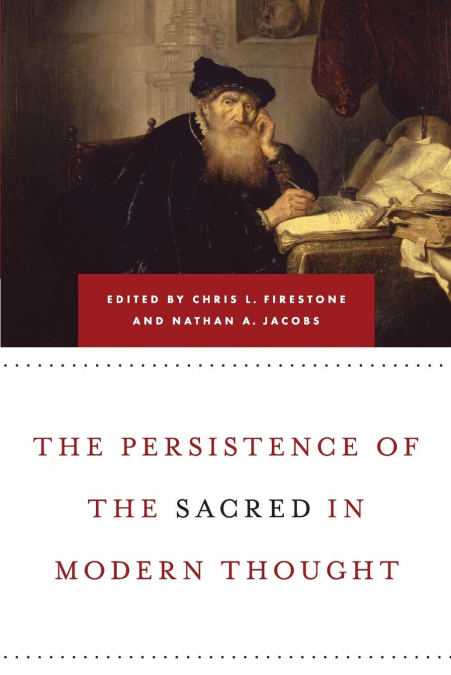

Persistence of the Sacred in Modern Thought

Persistence of the Sacred in Modern Thought

Persistence of the Sacred in Modern Thought


44,16 €
IVA incluido
Disponible
Editorial:
Longleaf - Univ of Notre Dame du Lac
Año de edición:
2012
Materia
Filosofía de la religión
ISBN:
9780268029067
Páginas:
264
Encuadernación:
Rústica
44,16 €
IVA incluido
Disponible

Selecciona una librería:

  • Librería Samer Atenea
  • Librería Aciertas (Toledo)
  • Kálamo Books
  • Librería Perelló (Valencia)
  • Librería Elías (Asturias)
  • Donde los libros
  • Librería Kolima (Madrid)
  • Librería Proteo (Málaga)

In The Persistence of the Sacred in Modern Thought, Chris L. Firestone, Nathan A. Jacobs, and thirteen other contributors examine the role of God in the thought of major European philosophers from the seventeenth to the nineteenth century. The philosophers considered are, by and large, not orthodox theists; they are highly influential freethinkers, emancipated by an age no longer tethered to the authority of church and state. While acknowledging this fact, the contributors are united in arguing that this is only one side of a complex story. To redress the imbalance of attention to secularism among crucial modern thinkers and to consolidate a more theologically informed view of modernity, they focus on the centrality of the sacred (theology and God) in the thought of these philosophers. The essays, each in its own way, argue that the major figures in modernity are theologically astute, bent not on removing God from philosophy but on putting faith and reason on a more sure footing in light of advancements in science and a perceived need to rethink the relationship between God and world.By highlighting and defending the theologically affirmative dimensions of thinkers such as Thomas Hobbes, Gottfried Leibniz, John Locke, Immanuel Kant, F. W. J. Schelling, G. W. F. Hegel, and others, the essayists present a forceful and timely correction of widely accepted interpretations of these philosophers. To ignore or downplay the theological dimensions of the philosophical works they address, they argue, distorts our understanding of modern thought.Contributors: Nicholas Adams, Hubert Bost, Philip Clayton, John Cottingham, Yolanda Estes, Chris L. Firestone, Lee Hardy, Peter C. Hodgson, Nathan A. Jacobs, Jacqueline Mariña, A. P. Martinich, Richard A. Muller, Myron B. Penner, Stephen D. Snobelen, Nicholas Wolterstorff.
Artículos relacionados

  • The Writings of Charles De Koninck
    Charles De Koninck
    The Writings of Charles De Koninck, volumes 1 and 2, present the first English editions of collected works of the Catholic Thomist philosopher Charles De Koninck (1906-1965). Ralph McInerny (1929-2010) was the project editor and prepared the excellent translations. Volume 1 contains writings ranging from De Koninck’s 1934 dissertation at the University of Louvain on the philoso...
  • The Constitution of Shambhala (Vol. 7B of a Treatise on Mind)
    Bodo Balsys
    The theme of the first of the two parts of this volume concerns the feminine deva hierarchy, their relation to Hierarchy and Shambhala. Many concepts are introduced that most seekers have little cognisance (e.g., the nature of the deva Lord Varuna). The Mother of the World’s role is revealed, and the feminine function in cosmos, (e.g., the Pleiades). Advanced teaching concernin...
    Disponible

    44,89 €

  • A Labyrinth Walk Of Life
    Lewis Tagliaferre
    Here is a collection of journaled essays leading to the inevitable belief in theological fatalism, aka Theofatalism. They include arguments from theology, psychology, politics, geology, technology, sociology, economics, history, cosmology and more. With this belief system, you can feel good inside no matter what happens outside. It may take several readings to get it, but anyth...
    Disponible

    13,41 €

  • Religion
    Arthur Schopenhauer
    Collected here are five short essays, A Dialogue, A Few Words on Pantheism, On Books and Reading, Physiognomy, and, Psychological Observations, by the world renowned philosopher Arthur Schopenhauer. ...
  • The Handbook
    Epictetus Epictetus
    No writings of Epictetus himself are really known. His discourses were transcribed and compiled by his pupil Arrian (author of the Anabasis Alexandri). The main work is The Discourses, four books of which have been preserved (out of an original eight). Arrian also compiled a popular digest, entitled the Enchiridion, or Handbook. In a preface to the Discourses, addressed to Luci...
  • The Origin Comes Alive
    Cale Rainer
    Believers and Atheists alike will get a firsthand look at the Divine Presence as it reveals the intimate behaviors and processes that compose a sense of GOD, and how this arose in social consciousness to inspire a global phenomenon known as Religion.The sense of life is taken to the limits of extreme perspective in this somewhat involved, yet intimate look into our social origi...
    Disponible

    9,92 €