José Augusto 1882- Sánchez Pérez
 Librería Samer Atenea
 Kálamo Books
 Librería Elías (Asturias)
 Librería Kolima (Madrid)
 Librería Proteo (Málaga)
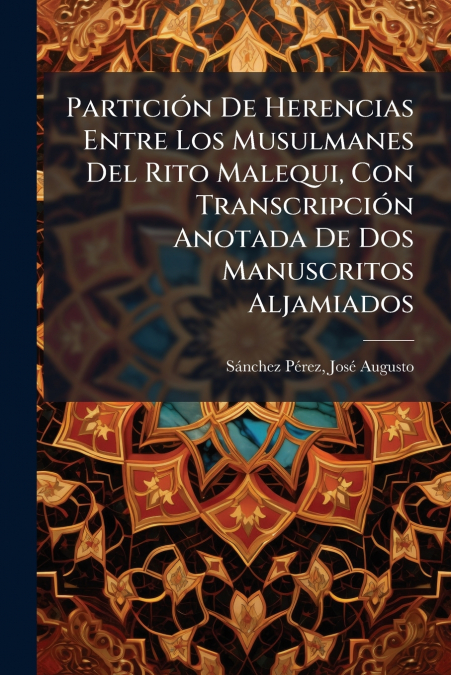
Partición De Herencias Entre Los Musulmanes Del Rito Malequi, Con Transcripción Anotada De Dos Manuscritos Aljamiados (Partition of Inheritances Among Muslims of the Maliki Rite, with Annotated Transcription of Two Aljamiado Manuscripts) offers a detailed exploration of Islamic inheritance laws according to the Maliki school of thought. Authored by José Augusto Sánchez Pérez and originally published in 1914, this work delves into the intricacies of inheritance distribution among Muslims, providing valuable insights into historical legal practices. This book features a transcription and annotation of two Aljamiado manuscripts, making it a significant resource for scholars interested in the study of Aljamiado literature and its contributions to understanding Islamic legal traditions in historical contexts. The text sheds light on the cultural and legal interactions that shaped Muslim communities. It remains an important reference for those studying Islamic law, the history of Islamic legal practices, and the linguistic and cultural heritage preserved in Aljamiado texts.This work has been selected by scholars as being culturally important, and is part of the knowledge base of civilization as we know it. This work was reproduced from the original artifact, and remains as true to the original work as possible. Therefore, you will see the original copyright references, library stamps (as most of these works have been housed in our most important libraries around the world), and other notations in the work.This work is in the public domain in the United States of America, and possibly other nations. Within the United States, you may freely copy and distribute this work, as no entity (individual or corporate) has a copyright on the body of the work.As a reproduction of a historical artifact, this work may contain missing or blurred pages, poor pictures, errant marks, etc. Scholars believe, and we concur, that this work is important enough to be preserved, reproduced, and made generally available to the public. We appreciate your support of the preservation process, and thank you for being an important part of keeping this knowledge alive and relevant.