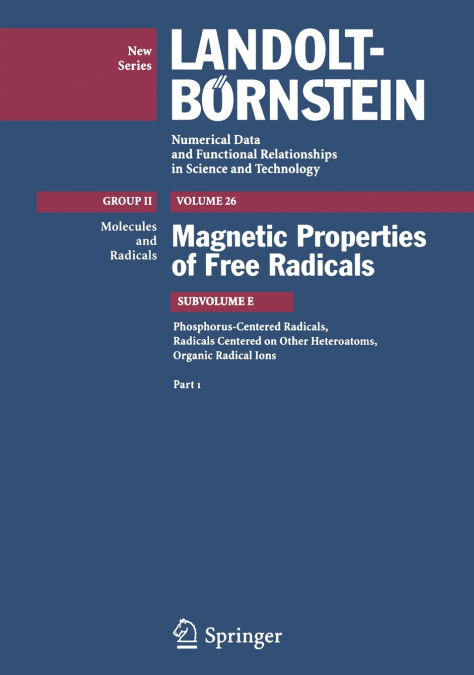

Part 1

Part 1


677,42 €
IVA incluido
Consulta disponibilidad
Editorial:
Springer Nature B.V.
Año de edición:
2008
Materia
Física atómica y molecular
ISBN:
9783540432746

Selecciona una librería:

  • Librería Samer Atenea
  • Librería Aciertas (Toledo)
  • Kálamo Books
  • Librería Perelló (Valencia)
  • Librería Elías (Asturias)
  • Donde los libros
  • Librería Kolima (Madrid)
  • Librería Proteo (Málaga)

I General introduction.- III General symbols and abbreviations.- 13.1 Introduction.- 13.2 Phosphinyl radicals X2P• and related species.- 13.3 Phosphonyl (X2P•=O) and thiophosphonyl (X2P•=S) radicals.- 13.4 Phosphoranyl radicals X4P•, including related species.- 13.5 Phosphoniumyl cation radicals X3P•+, phosphine dimer cation radicals X3P•P+X3, phosphate anion radicals, and related species.- 13.6 Miscellaneous.- 14 Radicals centered on other heteroatoms.- 14.2.1 Thiyl radicals of the type RS•, R-S•R, R-S•-R2.- 14.2.2 Sulfinyl radicals of the type R-S•=O.- 14.2.3 Sulfonyl radicals of the type RS•O2.- 14.2.4 Sulfuranyl radicals of the type X-S•-R2, X2-S•-R, S•X3, S•X4.- 14.2.5 Disulfide radicals of the type R-S-S•.- 14.2.6 Cation radicals.- 14.2.7 Anion radicals.- 14.3.1 Silyl radicals X3Si•.- 14.3.2 Silyl radicals from polysilanes.- 14.3.3 Silicon-centered anion radicals.- 14.3.4 Silicon-centered anion radicals from polysilanes.- 14.3.5 Silicon-centered cation radicals.- 14.4.1 Germyl radicals X3Ge•.- 14.4.2 Germanium-centered anion radicals.- 14.4.3 Germanium-centered cation radicals.- 14.5.1 Stannyl radicals X3Sn•.- 14.5.2 Tin-centered anion radicals.- 14.5.3 Tin-centered cation radicals.- 14.6.1 Boryl radicals X3B•.- 14.6.2 Boron-centered anion radicals.- 14.6.3 Boron-centered cation radicals.- 14.7.1 Aluminum-centered neutral radicals.- 14.7.2 Aluminum-centered anion radicals.- 14.8.1 Gallium-centered neutral radicals.- 14.8.2 Gallium-centered radical anions.- 14.9.1 Cation radicals.- 15.1 Introduction.- 15.2.1 Hydrocarbon radical anions.- 15.2.2 Substituted compounds.- 15.3.1 Oxygen containing heterocycles.- 15.3.2 Nitrogen containing heterocycles.- 15.3.3 Sulphur containing heterocycles.- 15.3.4 Phosphorus containing heterocycles.- 15.3.5 Selenium and tellurium containing heterocycles.- 15.3.6 Heterocycles with two or more different heteroatoms.- 15.4 Anion radicals from nitro compounds.- 15.5.1 Esters and thioesters.- 15.5.2 Aldehydes, ketones and their thio analogs.- 15.5.3 Semidiones.- 15.5.4 Acid anhydrides and derivatives.- 15.6.1 Aliphatic azoalkenes.- 15.6.2 Benzo[c]cinnolines and azobenzene derivatives.- 15.6.3 Arylazophosphonates.- 15.6.4 Bidiazines.- 15.6.5 Tetrazines.- 15.7.1 Sulphides and sulphones.- 15.7.2 Imines and imides.- 15.7.3 Fullerenes.- 15.7.4 Tetracyanoquinodimethanes.- 15.7.5 Phenylcarbonitriles.- 15.7.6 Phosphaalkenes.- 15.7.7 Silanes.
Artículos relacionados

  • LECT ON QUANTUM MECH (2ND ED-V1)
    BERTHOLD-GEORG ENGLERT / ENGLERT BERTHOLD-GEORG
    Basic Matters is a first introduction to quantum mechanics that does not assume any prior knowledge of the subject. The emphasis is on the general structure as the necessary foundation of any understanding. Starting from the simplest quantum phenomenon, the Stern-Gerlach experiment with its choice between two discrete outcomes, and ending with one-dimensional continuous systems...
  • LECT ON QUANTUM MECH (2ND ED-V2)
    BERTHOLD-GEORG ENGLERT / ENGLERT BERTHOLD-GEORG
    Basic Matters is a first introduction to quantum mechanics that does not assume any prior knowledge of the subject. The emphasis is on the general structure as the necessary foundation of any understanding. Starting from the simplest quantum phenomenon, the Stern-Gerlach experiment with its choice between two discrete outcomes, and ending with one-dimensional continuous systems...
  • LECT ON QUANTUM MECH (2ND ED-V3)
    BERTHOLD-GEORG ENGLERT / ENGLERT BERTHOLD-GEORG
    Basic Matters is a first introduction to quantum mechanics that does not assume any prior knowledge of the subject. The emphasis is on the general structure as the necessary foundation of any understanding. Starting from the simplest quantum phenomenon, the Stern-Gerlach experiment with its choice between two discrete outcomes, and ending with one-dimensional continuous systems...
  • LECT ON QUANTUM MECH (2ND ED-V1)
    BERTHOLD-GEORG ENGLERT / ENGLERT BERTHOLD-GEORG
    Basic Matters is a first introduction to quantum mechanics that does not assume any prior knowledge of the subject. The emphasis is on the general structure as the necessary foundation of any understanding. Starting from the simplest quantum phenomenon, the Stern-Gerlach experiment with its choice between two discrete outcomes, and ending with one-dimensional continuous systems...
    Disponible

    57,66 €

  • LECT ON QUANTUM MECH (2ND ED-V2)
    BERTHOLD-GEORG ENGLERT / ENGLERT BERTHOLD-GEORG
    Basic Matters is a first introduction to quantum mechanics that does not assume any prior knowledge of the subject. The emphasis is on the general structure as the necessary foundation of any understanding. Starting from the simplest quantum phenomenon, the Stern-Gerlach experiment with its choice between two discrete outcomes, and ending with one-dimensional continuous systems...
    Disponible

    57,79 €

  • LECT ON QUANTUM MECH (2ND ED-V3)
    BERTHOLD-GEORG ENGLERT / ENGLERT BERTHOLD-GEORG
    Basic Matters is a first introduction to quantum mechanics that does not assume any prior knowledge of the subject. The emphasis is on the general structure as the necessary foundation of any understanding. Starting from the simplest quantum phenomenon, the Stern-Gerlach experiment with its choice between two discrete outcomes, and ending with one-dimensional continuous systems...
    Disponible

    57,79 €