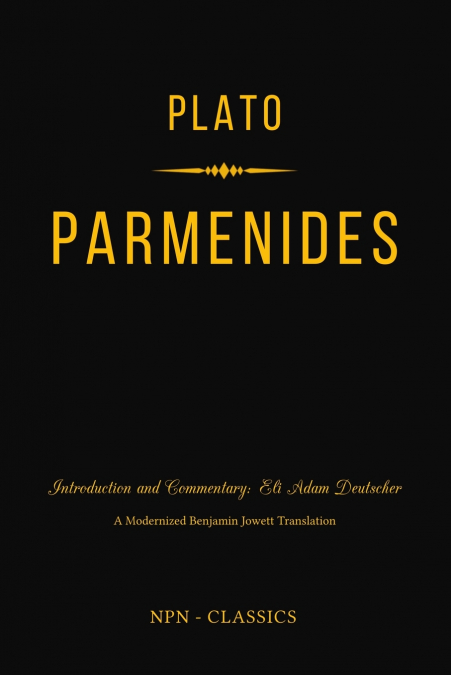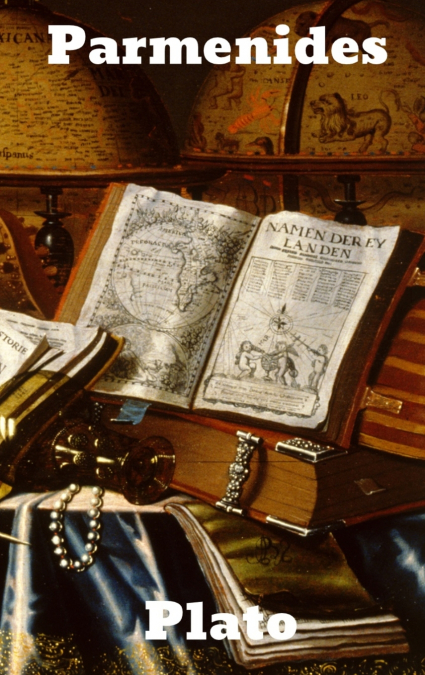

Parmenides

Parmenides

Parmenides

Plato

19,82 €
IVA incluido
Consulta disponibilidad
Editorial:
Brian Westland
Año de edición:
1912
Materia
Filosofía de la religión
ISBN:
9781774414163

Selecciona una librería:

  • Librería Samer Atenea
  • Kálamo Books
  • Librería Elías (Asturias)
  • Librería Kolima (Madrid)
  • Librería Proteo (Málaga)

Parmenides is one of the dialogues of Plato. It is widely considered to be one of the more, if not the most, challenging and enigmatic of Plato's dialogues. The Parmenides purports to be an account of a meeting between the two great philosophers of the Eleatic school, Parmenides and Zeno of Elea, and a young Socrates. The occasion of the meeting was the reading by Zeno of his treatise defending Parmenidean monism against those partisans of plurality who asserted that Parmenides' supposition that there is a one gives rise to intolerable absurdities and contradictions.The heart of the dialogue opens with a challenge by Socrates to the elder and revered Parmenides and Zeno. Employing his customary method of attack, the reductio ad absurdum, Zeno has argued that if as the pluralists say things are many, then they will be both like and unlike; but this is an impossible situation, for unlike things cannot be like, nor like things unlike. But this difficulty vanishes, says Socrates, if we are prepared to make the distinction between sensibles on one hand and Forms, in which sensibles participate, on the other. Thus one and the same thing can be both like and unlike, or one and many, by participating in the Forms of Likeness and Unlikeness, of Unity and Plurality; I am one man, and as such partake of the Form of Unity, but I also have many parts and in this respect I partake of the Form of Plurality. There is no problem in demonstrating that sensible things may have opposite attributes; what would cause consternation, and earn the admiration of Socrates, would be if someone were to show that the Forms themselves were capable of admitting contrary predicates.At this point, Parmenides takes over as Socrates' interlocutor and dominates the remainder of the dialogue. After establishing that Socrates himself has made the distinction between Forms and sensibles, Parmenides asks him what sorts of Form he is prepared to recognize. Socrates replies that he has no doubt about the existence of mathematical, ethical and aesthetic Forms (e.g., Unity, Plurality, Goodness, Beauty), but is unsure of Forms of Man, Fire and Water; he is almost certain, though admits to some reservations, that undignified objects like hair, mud and dirt do not have Forms. Parmenides suggests that when he is older and more committed to philosophy, he will consider all the consequences of his theory, even regarding seemingly insignificant objects like hair and mud.
Artículos relacionados

  • The Writings of Charles De Koninck
    Charles De Koninck
    The Writings of Charles De Koninck, volumes 1 and 2, present the first English editions of collected works of the Catholic Thomist philosopher Charles De Koninck (1906-1965). Ralph McInerny (1929-2010) was the project editor and prepared the excellent translations. Volume 1 contains writings ranging from De Koninck’s 1934 dissertation at the University of Louvain on the philoso...
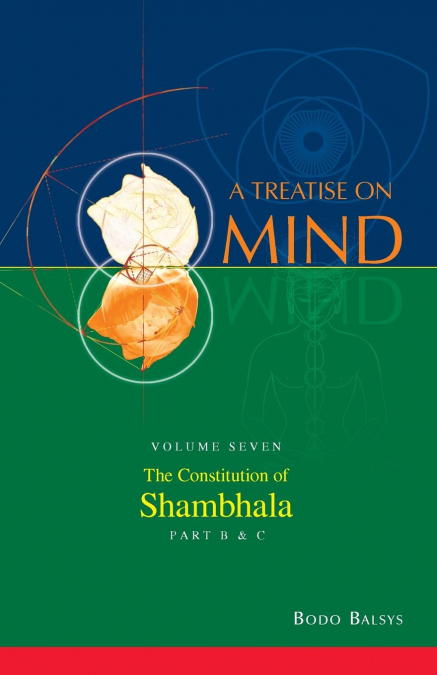
  • The Constitution of Shambhala (Vol. 7B of a Treatise on Mind)
    Bodo Balsys
    The theme of the first of the two parts of this volume concerns the feminine deva hierarchy, their relation to Hierarchy and Shambhala. Many concepts are introduced that most seekers have little cognisance (e.g., the nature of the deva Lord Varuna). The Mother of the World’s role is revealed, and the feminine function in cosmos, (e.g., the Pleiades). Advanced teaching concernin...
    Disponible

    44,89 €

  • A Labyrinth Walk Of Life
    Lewis Tagliaferre
    Here is a collection of journaled essays leading to the inevitable belief in theological fatalism, aka Theofatalism. They include arguments from theology, psychology, politics, geology, technology, sociology, economics, history, cosmology and more. With this belief system, you can feel good inside no matter what happens outside. It may take several readings to get it, but anyth...
    Disponible

    13,41 €

  • Religion
    Arthur Schopenhauer
    Collected here are five short essays, A Dialogue, A Few Words on Pantheism, On Books and Reading, Physiognomy, and, Psychological Observations, by the world renowned philosopher Arthur Schopenhauer. ...
  • The Handbook
    Epictetus Epictetus
    No writings of Epictetus himself are really known. His discourses were transcribed and compiled by his pupil Arrian (author of the Anabasis Alexandri). The main work is The Discourses, four books of which have been preserved (out of an original eight). Arrian also compiled a popular digest, entitled the Enchiridion, or Handbook. In a preface to the Discourses, addressed to Luci...
  • The Origin Comes Alive
    Cale Rainer
    Believers and Atheists alike will get a firsthand look at the Divine Presence as it reveals the intimate behaviors and processes that compose a sense of GOD, and how this arose in social consciousness to inspire a global phenomenon known as Religion.The sense of life is taken to the limits of extreme perspective in this somewhat involved, yet intimate look into our social origi...
    Disponible

    9,92 €

Otros libros del autor

  • Petticoat Rule
    Plato
    A hush falls over a grand drawing room, where the flicker of candlelight reveals more than polite conversation and delicate manners. Beneath the surface of refined British society, forces of ambition, wit, and subtle rebellion stir, challenging the boundaries of tradition and the roles assigned to women. Within this landscape, questions of power and influence are not only whisp...
    Disponible

    22,97 €

  • Timaeus
    Plato
    Timaeus by Plato is a seminal philosophical dialogue that explores the nature of the physical world, the creation of the universe, and the principles underlying existence. In this work, Plato presents a detailed cosmology, discussing the formation of the cosmos, the role of the divine craftsman (Demiurge), the structure of the physical and metaphysical realms, and the relations...
    Disponible

    21,08 €

  • The Republic
    Plato
    The Republic by Plato is one of the most influential works in the history of Western philosophy and political theory. Presented as a Socratic dialogue, this classical masterpiece explores the nature of justice, the structure of the ideal state, the role of education, and the responsibilities of rulers and citizens. Through the famous allegory of the cave, the theory of forms, a...
    Disponible

    43,44 €

  • Parmenides
    Plato
    Stop looking for a hidden mystical doctrine in Plato’s hardest dialogue. It isn’t a puzzle-it is a structural trap.Plato’s Parmenides is widely considered the most difficult, grueling, and baffling text in the Western canon. For centuries, readers have drowned in the dialogue’s second half, while traditional scholars have offered little help-either softening the brutal logic in...
    Disponible

    17,59 €

  • Apology, Crito, and Phaedo of Socrates
    Plato
    Apology, Crito, and Phaedo of Socrates by Plato brings together three of the most powerful and influential dialogues in the history of Western philosophy, presenting a moving portrait of Socrates at the end of his life. In the Apology, Socrates defends his pursuit of truth and moral inquiry before the Athenian court, affirming the primacy of conscience over public opinion. Crit...
    Disponible

    18,97 €

  • The Philosophy of Plato
    Plato
    'The Philosophy of Plato' offers a comprehensive exploration into the foundational thoughts and dialogues of one of Western civilization’s most influential thinkers. This collection delves into the profound metaphysical and ethical inquiries that have shaped the course of intellectual history for millennia. From the allegorical depths of the Cave to the rigorous pursuit of just...
    Disponible

    31,81 €