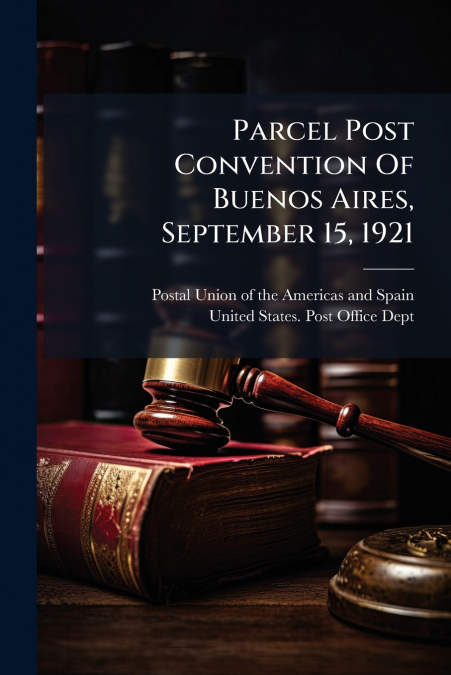
Postal Union of the Americas and Spain / United States. Post Office Dept
 Librería Samer Atenea
 Kálamo Books
 Librería Elías (Asturias)
 Librería Kolima (Madrid)
 Librería Proteo (Málaga)
This volume contains the complete text of the Parcel Post Convention signed in Buenos Aires on September 15, 1921, along with the detailed regulations for its execution. An essential resource for those involved in international postal services and legal frameworks, this convention outlines the agreements between the member nations of the Postal Union of the Americas and Spain. It provides a comprehensive understanding of the rules and procedures governing the exchange of parcels across borders during this period.Focusing on the standardization of parcel post operations, this document facilitates efficient and reliable international mail services. A valuable historical record, ’Parcel Post Convention Of Buenos Aires, September 15, 1921’ offers insights into the complexities of international agreements and postal administration in the early 20th century.This work has been selected by scholars as being culturally important, and is part of the knowledge base of civilization as we know it. This work was reproduced from the original artifact, and remains as true to the original work as possible. Therefore, you will see the original copyright references, library stamps (as most of these works have been housed in our most important libraries around the world), and other notations in the work.This work is in the public domain in the United States of America, and possibly other nations. Within the United States, you may freely copy and distribute this work, as no entity (individual or corporate) has a copyright on the body of the work.As a reproduction of a historical artifact, this work may contain missing or blurred pages, poor pictures, errant marks, etc. Scholars believe, and we concur, that this work is important enough to be preserved, reproduced, and made generally available to the public. We appreciate your support of the preservation process, and thank you for being an important part of keeping this knowledge alive and relevant.