 Librería Samer Atenea
 Kálamo Books
 Librería Elías (Asturias)
 Librería Kolima (Madrid)
 Librería Proteo (Málaga)
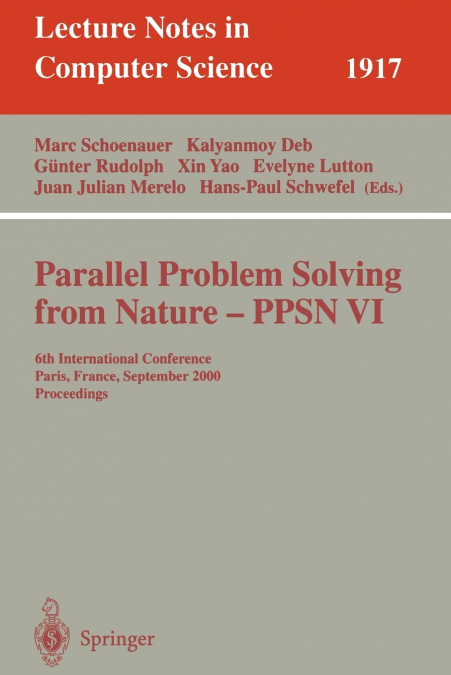
We are proud to introduce the proceedings of the Sixth International Conference on Parallel Problem Solving from Nature, PPSN VI, held in Paris, Prance, on 18-20 September 2000. PPSN VI was organized in association with the Genetic and Evolutionary Computing Conference (GECCO’2000) and the Congress on Evolutionary Computation (CEC’2000), reflecting the beneficial interaction between the conference activities in Europe and in the USA in the field of natural computation. Starting in 1990 in Dortmund, Germany (Proceedings, LNCS vol. 496, Sprin ger, 1991), this biannual meeting has been held in Brussels, Belgium (Procee dings, Elsevier, 1992), Jerusalem, Israel (Proceedings, LNCS vol. 866, Springer, 1994), Berlin, Germany (Proceedings, LNCS vol. 1141, Springer, 1996), and Amsterdam, The Netherlands (Proceedings, LNCS vol. 1498, Springer, 1998), where it was decided that Paris would be the location of the 2000 conference with Marc Schoenauer as the general chair. The scientific content of the PPSN conference focuses on problem solving pa radigms gleaned from a natural models. Characteristic for Natural Computing is the metaphorical use of concepts, principles and mechanisms underlying natural systems, such as evolutionary processes involving mutation, recombination, and selection in natural evolution, annealing or punctuated equilibrium processes of many-particle systems in physics, growth processes in nature and economics, collective intelligence in biology, DNA-based computing in molecular chemistry, and multi-cellular behavioral processes in neural and immune networks.