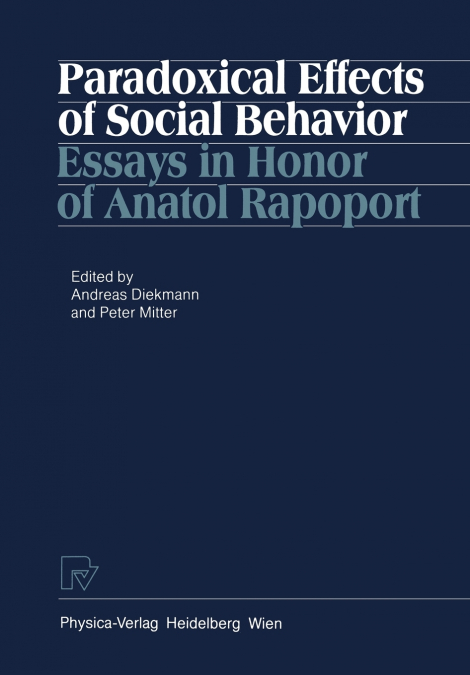

Paradoxical Effects of Social Behavior

Paradoxical Effects of Social Behavior


133,59 €
IVA incluido
Disponible
Editorial:
Springer Nature B.V.
Año de edición:
1986
Materia
Políticas del Gobierno central
ISBN:
9783790803501
133,59 €
IVA incluido
Disponible

Selecciona una librería:

  • Librería Samer Atenea
  • Librería Aciertas (Toledo)
  • Kálamo Books
  • Librería Perelló (Valencia)
  • Librería Elías (Asturias)
  • Donde los libros
  • Librería Kolima (Madrid)
  • Librería Proteo (Málaga)

In the history of science 'paradoxes' are not only amusing puzzles and chal­ lenges to the human mind but also driving forces of scientific development. The notion of 'paradox' is intimately related to the notion of 'contradiction'. Logi­ cal paradoxes allow for the derivation of contradictory propositions (e.g. 'Rus­ sell’s set of all sets not being members of themselves' or the ancient problem with propositions like 'I am lying' 1), normative paradoxes deal with contradic­ tions among equally well accepted normative postulates (Arrow’s 'impossibility theorem', Sen’s 'Impossibility of a Paretian Liberal') and 'factual' paradoxes refer to conflicts between conventional opinion based on an accepted empirical theory and contradictory empirical evidence (e.g. the 'St. Petersburg paradox' or the 'Allais paradox' in decision theory2). Paradoxes, either logical, normative or factual, also contradict our intui­ tions. The counter-intuitive property which seems to be a common feature of all paradoxes plays an important part in the empirical social sciences, particularly in the old research tradition of scrutinizing the unintended consequences of pur­ posive actions. Expectations based on naive theories ignoring interdependencies between individual actions are very often in conflict with 'surprising' empirical evidence on collective results of social behavior. Examples are numerous reach­ ing from panic situations, the individual struggle for status gains resulting in collective deprivation, the less than optimal supply of collective goods etc. to global problems of the armament race and mismanagement of common resources.


Artículos relacionados

  • Managing E-Government Projects
    Stephen Kwamena Aikins
    E-government promises efficient communication, streamlined operations, citizen involvement, improved services, and increased transparency. However, despite huge investments in e-government, evidence suggests numerous e-government projects are late, over budget, and inadequate. Managing E-Government Projects: Concepts, Issues, and Best Practices collects the work of some of the ...
  • Trumplandia
    Tiberiu Dianu
    Trumplandia: Populist Nationalism in America is a collection of essays about the transformation of America, which has turned from a united nation to one more divided than ever under the presidency of Donald Trump. Some pundits predict that if things don’t change another civil war could occur. Have we reached a point of no return? Author and attorney Tiberiu Dianu writes in the ...
  • STRATEGIC CURRENTS
    JAMES CHAR BERNARD F W LOO / LOO BERNARD F W
    The advent of the 4th Industrial Revolution amidst the increasingly intensified global competition between the United States and China promises to be a major inflection point in human history. The authors assembled in this volume provide a sober assessment of this techno-nationalist contest and their implications for the rest of the world. ...
  • At a Turning Point
    Australia is at a much-needed turning point in work, care and family policy. Australian women, families and communities are struggling to manage the complex demands of work and care.Rapid social and demographic change, alongside new workplace, labour market trends and the aftermath of the COVID-19 pandemic, requires a policy revamp that will allow all Australians to work, care ...
    Disponible

    25,96 €

  • Shadows of Catastrophe
    Richard Skiba
    This book explores the concept of S-Risks, or suffering risks, and delves into their significance, distinguishing them from conspiracy theories and alarmism. It categorizes S-Risks into agential, natural, and incidental types, discussing the disjunctive nature and various factors influencing them. Examining technological progress, the existence of powerful agents, and unintende...
    Disponible

    22,35 €

  • The Economic Theory of Eminent Domain
    Thomas J. Miceli
    ...
    Disponible

    47,12 €