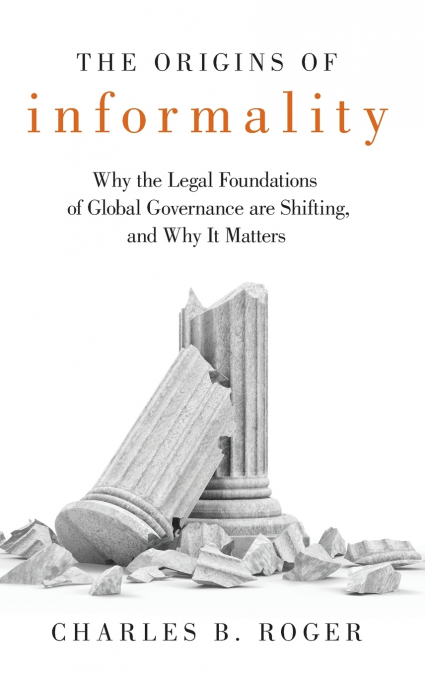

Origins of Informality

Origins of Informality

Charles B. Roger

141,07 €
IVA incluido
Consulta disponibilidad
Editorial:
Oxford University Press
Año de edición:
2020
Materia
Relaciones internacionales
ISBN:
9780190947965

Selecciona una librería:

  • Librería Samer Atenea
  • Librería Aciertas (Toledo)
  • Kálamo Books
  • Librería Perelló (Valencia)
  • Librería Elías (Asturias)
  • Donde los libros
  • Librería Kolima (Madrid)
  • Librería Proteo (Málaga)

The legal foundations of global governance are shifting. In addition to traditional instruments for resolving cross-border problems, such as treaties and formal international organizations, policy-makers are turning increasingly to informal agreements and organizations like the Group of Twenty, the Financial Stability Board, and the Asia Pacific Economic Cooperation. A growing number of policy-makers view such weakly-legalized organizations as promising new tools of governance, arguing that informal bodies are faster and more flexible than their formal counterparts, and better-suited to the complex problems raised by deepening interdependence. Yet, equally, political scientists have puzzled over these international organizations. At present, we still know relatively little about these bodies, why they have become so important, and whether they are indeed capable of addressing the immense challenges faced by the global community. In The Origins of Informality, Charles Roger offers a new way of thinking about informal organizations, presents new data revealing their extraordinary growth over time and across regions, and advances a novel theory to explain these patterns. In contrast with existing approaches, he locates the drivers of informality within the internal politics of states, explaining how major shifts within the domestic political arenas of the great powers have projected outwards and reshaped the legal structure of the global system. Informal organizations have been embraced because they allow bureaucrats in powerful states to maintain autonomy over their activities, and can help politicians to circumvent domestic opponents of their foreign policies. Drawing on original quantitative data, interviews, and archival research, the book analyzes some of the most important institutions governing the global economy, showing how informality has helped domestic actors to achieve their narrow political goals-even when this comes at the expense of the institutions they eventually create. Ultimately, Roger claims, the shift towards informality has allowed the number of multilateral institutions to rapidly increase in response to global problems. But, at the same time, it has coincided with a decline in their quality, leaving us less prepared for the next global crisis.

Artículos relacionados

  • Realism in Practice
    The purpose of this book is to appraise the current relevance and validity of realism as an interpretative tool in contemporary International Relations. All chapters of the book are animated by a theoretical effort to define the conceptual aspects of realism and attempt to establish whether the tradition still provides the necessary conceptual tools to scholars.The chapters add...
    Disponible

    20,36 €

  • Predicting gender violence in India
    Shritha K Vasudevan
    In this provocative new book, Shritha Vasudevan argues that feminist international relations (IR) theory has inadvertently resulted in a biased worldview, the very opposite of what feminist IR set out to try to rectify. This book contests theoretical presumptions of Western feminist IR and attempts to reformulate it in contexts of non-Western cultures. Vasudevan deftly utilizes...
  • Contemporary security issues in Africa
    Isiaka Alani Badmus / Lere Amusan
    In volume, an emerging generation of African scholars examines specific states in Africa where instability is the order of the day. Considerations of African instability are highly relevant in today’s world, where one examines the types of regimes that were put in place after the Cold War and their effects on Africa. Multiparty systems introduced in Africa, rather than bringing...
  • Chronicles of the first and second chechen wars
    Ilya Milyukov
    Presented by Russian author and attorney Ilya Milyukov, Chronicles of the First and Second Chechen War presents the main events of the First (1994-1996) and Second (1999-2009) Wars in Chechnya, Russia’s deadliest conflicts since World War II. The First War began in December 1994 and lasted for one year and nine months, ending in August 1996. There were two major urban battles -...
  • Political instability in Africa
    Isiaka Alani Badmus / Lere Amusan
    This book offers broad-gauged analyses of the causes, nature, and changing patterns of armed conflict in Africa as well as the reasons for these patterns. It also situates conflicts that have been haunting the African continent since the time of decolonization within the various theoretical schools such as 'new war,' 'economic war,' 'neo-patrimonial,' and 'globalization.' It be...
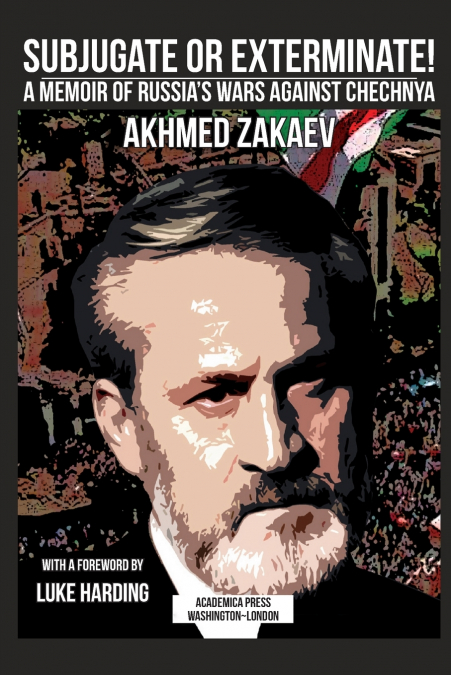
  • Subjugate or exterminate!
    Akhmed Zakaev / Arch Tait
    Foreword by Luke HardingAkhmed Zakaev is a symbol of the indomitable will of the Chechen nation. In this important memoir, he tells the story of the Chechen struggle as he experienced it, describing the conflict in human terms and providing a detailed documentary record of little known or badly understood events that will be of benefit to historians for generations to come.- Da...
    Disponible

    41,63 €