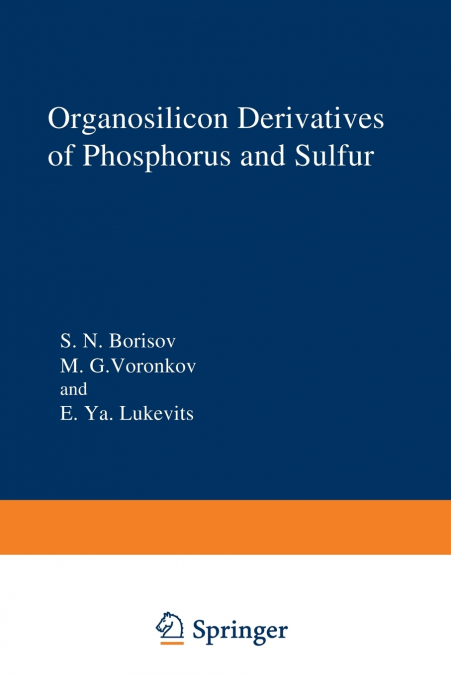

Organosilicon Derivatives of Phosphorus and Sulfur

Organosilicon Derivatives of Phosphorus and Sulfur

S. Borisov

133,59 €
IVA incluido
Disponible
Editorial:
Springer Nature B.V.
Año de edición:
2012
ISBN:
9781468407297
133,59 €
IVA incluido
Disponible

Selecciona una librería:

  • Librería Samer Atenea
  • Librería Aciertas (Toledo)
  • Kálamo Books
  • Librería Perelló (Valencia)
  • Librería Elías (Asturias)
  • Donde los libros
  • Librería Kolima (Madrid)
  • Librería Proteo (Málaga)

One of the characteristics of the development of chemical science in the middle of the present century is the vigorous pro­ gress of the 'third chemistry,' which is often named now the chemistry of heteroorganic compounds. Then in the last decade, among specialists in this field there has been a marked increase in interest in heteroatomic organic derivatives of silicon, i. e. , heteroorganic silicon compounds. However, until recently this new class of chemical substances, which is extremely interesting theoretically and practically, has been without a single specialized monograph which systematizes and generalizes all progress in the heteroorganic chemistry of silicon. The first attempt in this direction was our book 'Heteroorganic Compounds of Silicon' [42 (F), 17 (S) *], which appeared at the end of 1966 and was published as an English translation in the USA in 1969. However, as follows from its subtitle 'Derivatives of Inorganic Elements,' this mono­ graph could not cover the whole broad field of the chemistry of heteroorganic compounds of silicon. The main reason for this was above all the abundance and variety of original investigations of organosilicon derivatives of inorganic elements, which was un­ expected even to the authors themselves. As a result of this the planned length of the book compelled us to omit the sections on organosilicon compounds of phosphorus and sulfur, which had al­ ready been prepared for publication.

Artículos relacionados

  • Recycled Polymers
    Didier Perrin
    The efficient ecodesign of secondary raw materials from recycled multiphase polymer systems is performed through the study of various things, such as:The compatibility of mixtures of recycled polymers where work on knowledge of the miscibility of mixtures depends on the different rates and the nature of the constituents;The aging of recycled polymers in terms of the structuring...
  • Advanced Nanoscale Materials for Thermoelectric Applications
    This Special Issue covers preparations, measurements, devices, and applications based on thermoelectric nanomaterials and summarizes the latest developments towards highly efficient thermoelectric nanomaterials and thermoelectric devices. ...
  • Repair and Strengthening of Existing Reinforced Concrete Structures
    Andreas Lampropoulos
    It is crucial that we strengthen existing structures worldwide, especially in earthquake-prone areas. Recent earthquakes have highlighted the inadequacy of many existing structures, which have been damaged from previous powerful earthquakes and have been designed without code provisions or according to old code provisions that are now obsolete. Furthermore, the majority of exis...
  • Sol-Gel Technology Applied to Materials Science
    Aleksej Zarkov
    Rapid advances in technologies around the globe necessitate the development of new materials, nanostructures, and multicomponent composites with specific chemical and physical properties that can meet the requirements of modern technologies. Using appropriate synthetic approaches is crucial for the preparation of inorganic materials with designed microstructure and properties. ...
  • Functional Polymer Composites
    Functional polymer composites are showing increasing potential as materials in chemistry and materials science. Polymer composites, including nanocomposites, are made via the incorporation of fillers in polymer matrices and offer many advantages. The properties of polymer composites are further improved via the surface modification of fillers or the matrix phase. Currently, the...
  • Feature Papers in Section Biosensors 2023
    Evgeny Katz
    This reprint, based on the Special Issue, provides a general overview of different biosensors, briefly explaining the general approaches to identifying them, their construction, and their performance. A discussion concerning how the required components of biosensors are combined to perform analytical work is presented. Different signal-transducing mechanisms are discussed, part...