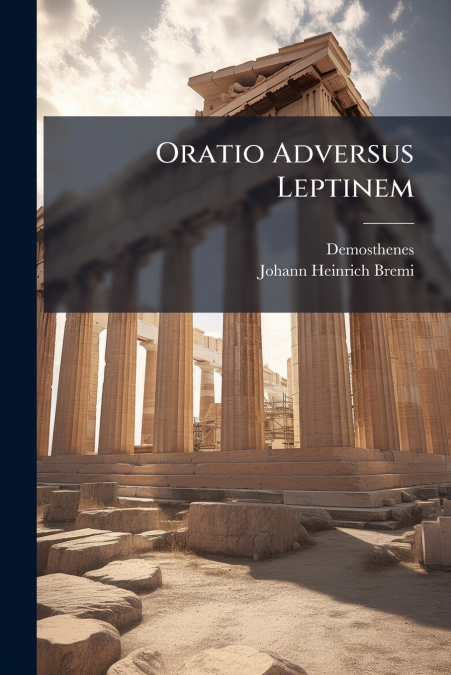
Demosthenes / Johann Heinrich Bremi
 Librería Samer Atenea
 Kálamo Books
 Librería Elías (Asturias)
 Librería Kolima (Madrid)
 Librería Proteo (Málaga)
Oratio Adversus Leptinem, by Demosthenes, is a powerful example of classical Greek oratory. Delivered in the Athenian assembly, this speech argues against a law proposed by Leptines that sought to revoke existing exemptions from public service. Demosthenes skillfully defends the established customs and rights of Athenian citizens, emphasizing the importance of fairness and the potential for abuse inherent in the proposed legislation. This edition allows contemporary readers to appreciate Demosthenes’ rhetorical prowess and gain insight into the legal and political intricacies of ancient Athens. The themes of justice, civic duty, and the protection of individual rights remain relevant, making this work a valuable resource for students of history, law, and political science. Demosthenes’ masterful use of language and argumentation offers a timeless lesson in the art of persuasion.This work has been selected by scholars as being culturally important, and is part of the knowledge base of civilization as we know it. This work was reproduced from the original artifact, and remains as true to the original work as possible. Therefore, you will see the original copyright references, library stamps (as most of these works have been housed in our most important libraries around the world), and other notations in the work.This work is in the public domain in the United States of America, and possibly other nations. Within the United States, you may freely copy and distribute this work, as no entity (individual or corporate) has a copyright on the body of the work.As a reproduction of a historical artifact, this work may contain missing or blurred pages, poor pictures, errant marks, etc. Scholars believe, and we concur, that this work is important enough to be preserved, reproduced, and made generally available to the public. We appreciate your support of the preservation process, and thank you for being an important part of keeping this knowledge alive and relevant.