Gaius Plinius Caecilius Secundus
 Librería Samer Atenea
 Kálamo Books
 Librería Elías (Asturias)
 Librería Kolima (Madrid)
 Librería Proteo (Málaga)
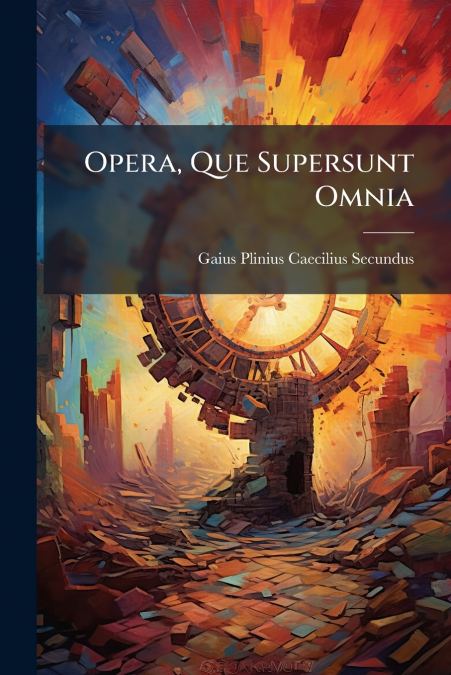
Opera, Que Supersunt Omnia presents the complete surviving works attributed to Gaius Plinius Caecilius Secundus, commonly known as Pliny the Younger. This comprehensive collection offers invaluable insights into Roman society, politics, and culture during the late 1st and early 2nd centuries AD. Pliny’s letters, renowned for their elegant style and vivid descriptions, provide a first-hand account of significant historical events, including the eruption of Mount Vesuvius in 79 AD, which destroyed Pompeii and Herculaneum. This volume allows readers to explore Pliny’s correspondence with emperors, senators, and other prominent figures, shedding light on the daily life, legal proceedings, and intellectual pursuits of the Roman elite. The enduring appeal of Pliny’s writings lies in their timeless exploration of human nature and their meticulous record of a pivotal era in Western civilization. ’Opera, Que Supersunt Omnia’ remains an essential resource for scholars and anyone interested in understanding the classical world.This work has been selected by scholars as being culturally important, and is part of the knowledge base of civilization as we know it. This work was reproduced from the original artifact, and remains as true to the original work as possible. Therefore, you will see the original copyright references, library stamps (as most of these works have been housed in our most important libraries around the world), and other notations in the work.This work is in the public domain in the United States of America, and possibly other nations. Within the United States, you may freely copy and distribute this work, as no entity (individual or corporate) has a copyright on the body of the work.As a reproduction of a historical artifact, this work may contain missing or blurred pages, poor pictures, errant marks, etc. Scholars believe, and we concur, that this work is important enough to be preserved, reproduced, and made generally available to the public. We appreciate your support of the preservation process, and thank you for being an important part of keeping this knowledge alive and relevant.