

 Librería Samer Atenea
 Kálamo Books
 Librería Elías (Asturias)
 Librería Kolima (Madrid)
 Librería Proteo (Málaga)
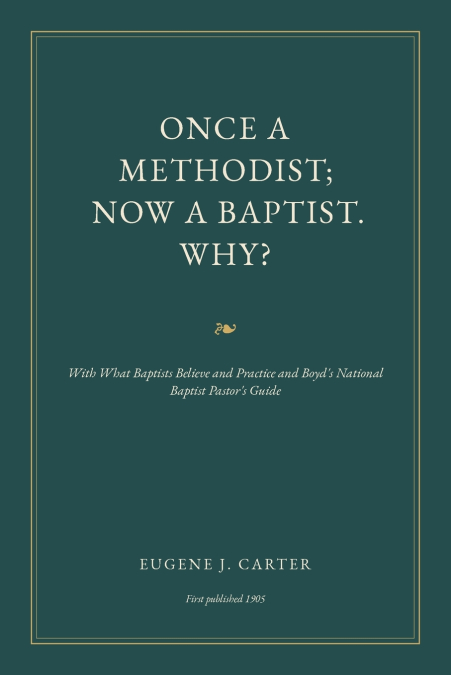
Eugene J. Carter was born at Butler’s Springs, Alabama, on November 20, 1861, joined the A. M. E. Zion Church at seventeen, and served its churches in Alabama, North Carolina, Tennessee, Florida, Pennsylvania and Ohio, three years of them as Presiding Elder of the Memphis District. In December 1903 he was baptized into the First Baptist Church of Selma, Alabama, and he became pastor of the First Baptist Church of Evergreen and the Mt. Moriah Baptist Church at Charity. 'I have written this book,' he says, 'because ever since I have been baptized into the Church of Jesus Christ, I have felt it my duty to say why I have ceased to be a Methodist and why I have become a Baptist.'In Part One Carter tells his own story and sets out, in strong and daring language, his case against the polity of the Methodist churches, above all the power of their bishops over ministers and congregations. In Part Two he argues for believer’s baptism by immersion and for the Baptist doctrine of the Lord’s Supper.The National Baptist Publishing Board bound with Carter’s book a short manual of Baptist faith and practice: R. H. Boyd’s What Baptists Believe and Practice, with a church covenant and articles of faith, a chapter on Christian baptism by J. T. Brown and one on the Lord’s Supper by E. M. Brawley; and Boyd’s National Baptist Pastor’s Guide, with directions for organizing a church, receiving members, ordaining deacons and ministers, calling a pastor, conducting the ordinances, marriages and funerals, and model letters and certificates. The volume closes with 'The Negro’s Place in Ancient History and in American Life at the Present Day,' the last paper of Carter’s son Neander, a soldier of the 10th United States Cavalry who died at Fort Robinson, Nebraska, in June 1905. An introduction by R. T. Pollard, President of Selma University, opens the book.This edition is newly typeset from the first edition (Nashville: National Baptist Publishing Board, 1905), with its portraits of E. J. Carter, R. T. Pollard, R. H. Boyd and Neander N. Carter and its Bible scenes, reproduced from the Documenting the American South images.





