 Librería Samer Atenea
 Kálamo Books
 Librería Elías (Asturias)
 Librería Kolima (Madrid)
 Librería Proteo (Málaga)
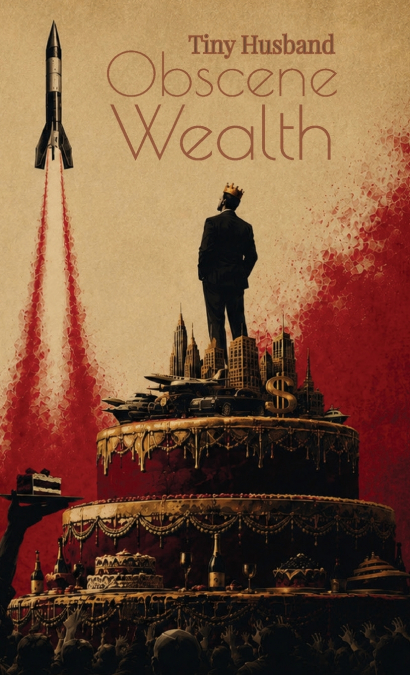
Great wealth did not simply grow obscene. It slipped beyond reach.For years, something has felt wrong with the arithmetic of ordinary life. Wages that no longer stretch to a home. Work that no longer guarantees security. A cost of living that climbs and climbs while, on the same glowing screens, a handful of private fortunes swell past every figure the mind can hold. In 2026 the world acquired its first trillionaire. In the same season, people in steady work queued at food banks.Obscene Wealth argues that these are not separate misfortunes.Drawing on the work of economists and historians, public data and financial disclosure, leaked records and the long history of inequality itself, Jack Rebbick examines how wealth has concentrated to a degree without modern precedent, slipped beyond the reach of the states that might have shared it, and left no workable plan for everyone else. He follows a trail from the cost-of-living crisis and the first trillion-dollar fortune, through the tax havens, the automation of work and the private ownership of public infrastructure, to the buying of democratic politics and the theatre of great philanthropy, and at last to what the historical record says about how concentrations like this have always, in the end, come down.This is not a book about envy, nor about wicked individuals. It is a book about a system, and a broken bargain.Its central argument concerns that bargain: the unwritten promise underwriting any tolerable society, that those who work will live, that the powerful will answer to the common law, and that the wealth of the whole will not be engrossed without limit by the few. That promise, the book argues, has been broken in every clause, and the institutions that once enforced it have been outgrown, outbought, or quietly retired. The most disquieting part of the case is historical: that concentrations of wealth on this scale have, in the past, been undone only by catastrophe, and almost never by peaceful design.Part history, part investigation and part political economy, Obscene Wealth explores:the scale of modern wealth, set against a global cost-of-living crisis;tax, havens, and the fortunes that have escaped the state;automation, artificial intelligence and the future of work;the private ownership of the infrastructure on which states depend;the capture of democratic politics and the limits of philanthropy;the social science of upheaval and the historical price of levelling.At its heart, though, this is a book about something older and simpler. It is about the limit beyond which a difference in wealth becomes a difference in kind, and a shared society quietly stops being one. The old understanding that those who hold the most owe something to the order that allowed them to hold it. The belief that a person’s dignity does not depend on their bank balance. The fragile sense that, in the end, we are all part of the same story.What happens to a society when that limit is passed, the bargain is broken, and no one is left who is both able and willing to repair it? Perfect for readers interested in economics, inequality, wealth and power, billionaires, tax and capital, capitalism, political economy, the cost-of-living crisis, artificial intelligence and work, the history of revolutions, democracy, modern Britain, and the future of the Western world.