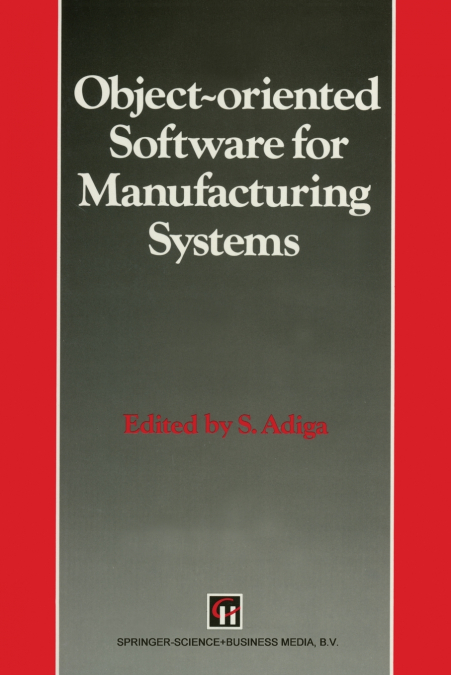

Object-oriented Software for Manufacturing Systems

Object-oriented Software for Manufacturing Systems

S. Adiga

119,07 €
IVA incluido
Consulta disponibilidad
Editorial:
Springer Nature B.V.
Año de edición:
1998
ISBN:
9780412397509

Selecciona una librería:

  • Librería Samer Atenea
  • Librería Aciertas (Toledo)
  • Kálamo Books
  • Librería Perelló (Valencia)
  • Librería Elías (Asturias)
  • Donde los libros
  • Librería Kolima (Madrid)
  • Librería Proteo (Málaga)

1 Introduction.- 1.1 Objects and object-oriented software.- 1.2 Objective and target audience of the book.- 1.3 Organization of the book.- 1.4 Conclusion.- References.- One Conceptual Background.- 2 Object-oriented software systems: Concepts.- 2.1 Introduction.- 2.2 Key concepts.- 2.3 Object communication.- 2.4 Comparison with structured analysis and design.- 2.5 Software life cycle benefits.- 2.6 Prototyping and software evolution.- 2.7 Software reuse.- 2.8 Potential limitations.- 2.9 Conclusion.- References.- 3 Object-oriented software: Relevance to manufacturing.- 3.1 Introduction.- 3.2 Software development aspects of CIM.- 3.3 Communication issues.- 3.4 Integration problems.- 3.5 Conclusion.- References.- Summary: Part One.- Two Design and Implementation Techniques.- 4 Towards an object-oriented architecture for CIM systems.- 4.1 Introduction.- 4.2 A conceptual framework.- 4.3 Description of the modules.- 4.4 Communication between modules (and the plant).- 4.5 Special concerns.- 4.6 Implementation perspective.- 4.7 Working with existing applications and future extensions.- 4.8 Related work of interest.- 4.9 Limitations.- 4.10 Conclusion.- References.- 5 Prototyping object systems and reusable object libraries.- 5.1 Introduction.- 5.2 Review of existing design methods.- 5.3 Rationale for our approach.- 5.4 Our design approach.- 5.5 An example manufacturing facility.- 5.6 Object-oriented library for modeling the facility.- 5.7 State transition diagrams.- 5.8 Conclusion.- References.- 6 Object-oriented databases.- 6.1 Needs of the engineering/manufacturing domains.- 6.2 Towards an object model for database management.- 6.3 Object identity.- 6.4 Schema evolution.- 6.5 Versioning.- 6.6 Storage.- 6.7 Querying.- 6.8 Commercial OODMBS.- 6.9 Conclusion.- References.- 7 Comparing object-oriented programming languages.- 7.1 Introduction.- 7.2 Smalltalk.- 7.3 Object-oriented extensions to Lisp.- 7.4 Object-oriented extensions to C.- 7.5 C++.- 7.6 Objective-C.- 7.7 Comparing Objective-C and C++.- 7.8 Other object-oriented programming languages.- 7.9 Summary and conclusion.- References.- Summary: Part Two.- Three Manufacturing Applications.- 8 FlowStream: An object-oriented plant-floor management system.- 8.1 FlowStream as a plant-floor management system.- 8.2 Rationale for object-oriented development.- 8.3 The FlowStream object architecture.- 8.4 Assessing the object-oriented approach.- 8.5 Summary.- Reference.- 9 OOPS in real-time control applications.- 9.1 Introduction.- 9.2 The kitting cell.- 9.3 The glass line.- 9.4 Conclusion.- References.- Summary: Part Three.- Four Management and Organizational Issues.- 10 Management issues in adopting object-oriented technology.- 10.1 Introduction.- 10.2 Object-oriented software development.- 10.3 Managing reusability.- 10.4 Resourcing and staffing.- 10.5 Supplier management.- 10.6 Planning and budgeting.- 10.7 Conclusion.- References.- 11 Concluding remarks.- 11.1 Where is the OO industry headed?.- 11.2 Growth in the manufacturing area.- 11.3 Final words.- References.- Appendix A: OO resources Paul Worhach.
Artículos relacionados

  • Industrial Dynamics, Innovation Policy, and Economic Growth through Technological Advancements
    Yetkiner
    By harnessing technological progress, good innovation policies can help enhance economic growth. New research offers additional insights into the design and application of such innovative policies. Industrial Dynamics, Innovation Policy, and Economic Growth through Technological Advancements examines the nature of the process of technological change in different sectors of an a...
  • Handbook of Research on Advanced Intelligent Control Engineering and Automation
    Ahmad Taher Azar / Sundarapandian Vaidyanathan
    In industrial engineering and manufacturing, control of individual processes and systems is crucial to developing a quality final product. Rapid developments in technology are pioneering new techniques of research in control and automation with multi-disciplinary applications in electrical, electronic, chemical, mechanical, aerospace, and instrumentation engineering. The Handbo...
  • Infrastructure Possibilities and Human-Centered Approaches With Industry 5.0
    Infrastructure Possibilities and Human-Centered Approaches With Industry 5.0 is a research book that serves as a comprehensive exploration of the potential impact of Industry 5.0 and the research opportunities presented by it, a new era of industrial revolution that integrates advanced technologies with human expertise and creativity. This book delves into the transformative ef...
  • Rules and Practice for Adjusting Watches
    Walter J. Kleinlein
    Rules and Practice for Adjusting Watches, is a classical and a rare book, that has been considered important throughout the human history, and so that this work is never forgotten we at Alpha Editions have made efforts in its preservation by republishing this book in a modern format for present and future generations. This whole book has been reformatted, retyped and redesigned...
    Disponible

    21,44 €

  • Industry Applications of Thrust Manufacturing
    In manufacturing, entrenched challenges like costly maintenance, operational inefficiencies, and product defects loom large, casting shadows over industry progress. Despite the promise of Industry 4.0 and the proliferation of data-driven technologies, many enterprises need help to effectively harness the transformative power of artificial intelligence (AI). The gap between AI’s...
    Disponible

    360,06 €

  • Industry Applications of Thrust Manufacturing
    In manufacturing, entrenched challenges like costly maintenance, operational inefficiencies, and product defects loom large, casting shadows over industry progress. Despite the promise of Industry 4.0 and the proliferation of data-driven technologies, many enterprises need help to effectively harness the transformative power of artificial intelligence (AI). The gap between AI’s...

Otros libros del autor

  • Object-oriented Software for Manufacturing Systems
    S. Adiga
    I must confess that I stumbled upon the object-oriented (00) world view during my explorations into the world of artificial intelligence (AI) in search of a new solution to the problem of building computer-integrated manufacturing systems (CIM). In 00 computing, I found the constructs to model the manufacturing enterprise in terms of information, a re...
    Disponible

    66,31 €