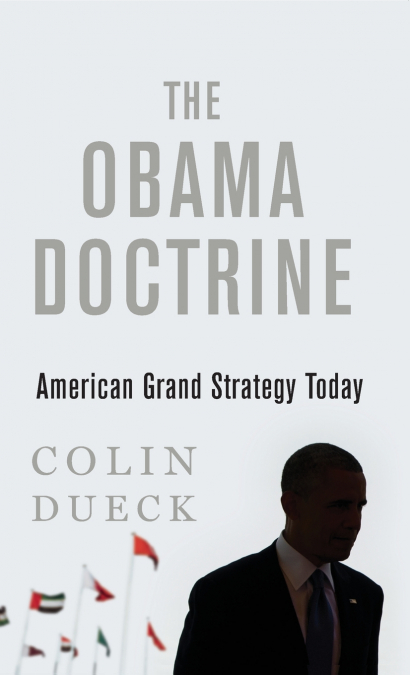

Obama Doctrine

Obama Doctrine

Colin Dueck

23,84 €
IVA incluido
Consulta disponibilidad
Editorial:
Oxford University Press
Año de edición:
2015
Materia
Relaciones internacionales
ISBN:
9780190202620

Selecciona una librería:

  • Librería Samer Atenea
  • Librería Aciertas (Toledo)
  • Kálamo Books
  • Librería Perelló (Valencia)
  • Librería Elías (Asturias)
  • Donde los libros
  • Librería Kolima (Madrid)
  • Librería Proteo (Málaga)

By mid-2015, the Obama presidency will be entering its final stages, and the race among the successors in both parties will be well underway. And while experts have already formed a provisional understanding of the Obama administration’s foreign policy goals, the shape of the 'Obama Doctrine' is finally coming into full view. It has been consistently cautious since Obama was inaugurated in 2009, but recent events in the Middle East, Eastern Europe, and the Far East have led an increasingly large number of foreign policy experts to conclude that caution has transformed into weakness. In The Obama Doctrine, Colin Dueck analyzes and explains what the Obama Doctrine in foreign policy actually is, and maps out the competing visions on offer from the Republican Party. Dueck, a leading scholar of US foreign policy, contends it is now becoming clear that Obama’s policy of international retrenchment is in large part a function of his emphasis on achieving domestic policy goals. There have been some successes in the approach, but there have also been costs. For instance, much of the world no longer trusts the US to exert its will in international politics, and America’s adversaries overseas have asserted themselves with increasing frequency. The Republican Party will target these perceived weaknesses in the 2016 presidential campaign and develop competing counter-doctrines in the process. Dueck explains that within the Republican Party, there are two basic impulses vying with each other: neo-isolationism and forceful internationalism. Dueck subdivides each impulse into the specific agenda of the various factions within the party: Tea Party nationalism, neoconservatism, conservative internationalism, and neo-isolationism. He favors a realistic but forceful US internationalism, and sees the willingness to disengage from the world by some elements of the party as dangerous. After dissecting the various strands, he articulates an agenda of forward-leaning American realism--that is, a policy in which the US engages with the world and is willing to use threats of force for realist ends. The Obama Doctrine not only provides a sharp appraisal of foreign policy in the Obama era; it lays out an alternative approach to marshaling American power that will help shape the foreign policy debate in the run-up to the 2016 elections.

Artículos relacionados

  • Realism in Practice
    The purpose of this book is to appraise the current relevance and validity of realism as an interpretative tool in contemporary International Relations. All chapters of the book are animated by a theoretical effort to define the conceptual aspects of realism and attempt to establish whether the tradition still provides the necessary conceptual tools to scholars.The chapters add...
    Disponible

    20,36 €

  • Predicting gender violence in India
    Shritha K Vasudevan
    In this provocative new book, Shritha Vasudevan argues that feminist international relations (IR) theory has inadvertently resulted in a biased worldview, the very opposite of what feminist IR set out to try to rectify. This book contests theoretical presumptions of Western feminist IR and attempts to reformulate it in contexts of non-Western cultures. Vasudevan deftly utilizes...
  • Contemporary security issues in Africa
    Isiaka Alani Badmus / Lere Amusan
    In volume, an emerging generation of African scholars examines specific states in Africa where instability is the order of the day. Considerations of African instability are highly relevant in today’s world, where one examines the types of regimes that were put in place after the Cold War and their effects on Africa. Multiparty systems introduced in Africa, rather than bringing...
  • Chronicles of the first and second chechen wars
    Ilya Milyukov
    Presented by Russian author and attorney Ilya Milyukov, Chronicles of the First and Second Chechen War presents the main events of the First (1994-1996) and Second (1999-2009) Wars in Chechnya, Russia’s deadliest conflicts since World War II. The First War began in December 1994 and lasted for one year and nine months, ending in August 1996. There were two major urban battles -...
  • Political instability in Africa
    Isiaka Alani Badmus / Lere Amusan
    This book offers broad-gauged analyses of the causes, nature, and changing patterns of armed conflict in Africa as well as the reasons for these patterns. It also situates conflicts that have been haunting the African continent since the time of decolonization within the various theoretical schools such as 'new war,' 'economic war,' 'neo-patrimonial,' and 'globalization.' It be...
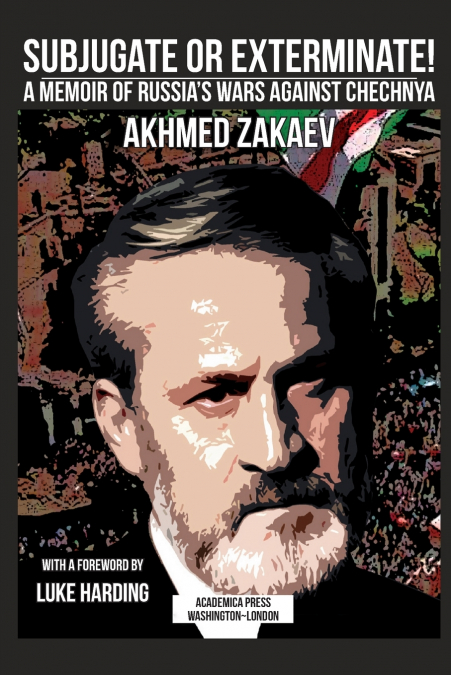
  • Subjugate or exterminate!
    Akhmed Zakaev / Arch Tait
    Foreword by Luke HardingAkhmed Zakaev is a symbol of the indomitable will of the Chechen nation. In this important memoir, he tells the story of the Chechen struggle as he experienced it, describing the conflict in human terms and providing a detailed documentary record of little known or badly understood events that will be of benefit to historians for generations to come.- Da...
    Disponible

    41,63 €

Otros libros del autor

  • Obama Doctrine
    Colin Dueck
    By mid-2015, the Obama presidency will be entering its final stages, and the race among the successors in both parties will be well underway. And while experts have already formed a provisional understanding of the Obama administration's foreign policy goals, the shape of the "Obama Doctrine" is finally coming into full view. It has been consistently cautious since Obama wa...
    Disponible

    20,80 €

  • Reluctant Crusaders
    Colin Dueck
    In Reluctant Crusaders, Colin Dueck examines patterns of change and continuity in American foreign policy strategy by looking at four major turning points: the periods following World War I, World War II, the Cold War, and the 9/11 terrorist attacks. He shows how American cultural assumptions regarding liberal foreign policy goals, together with international pressures, have ac...
    Disponible

    54,36 €