 Librería Samer Atenea
 Kálamo Books
 Librería Elías (Asturias)
 Librería Kolima (Madrid)
 Librería Proteo (Málaga)
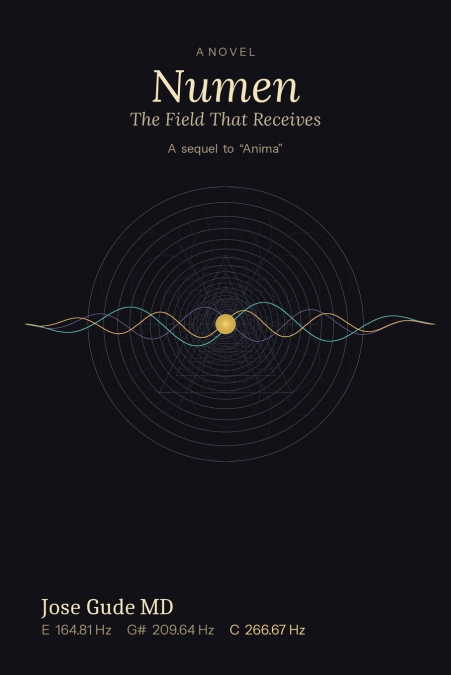
Numen expands Anima’s intimate clinical portrait into afull-spectrum novel that operates simultaneously as family drama, philosophical thriller, andcosmological architecture. Where Anima asked the question - is consciousness received ratherthan produced? - Numen follows the implications into territory that is genuinelyunprecedented in literary fiction: simulated beings who suffer, posthumans fractured betweentheir biological and computational selves, and a cosmological framework in which love andfreedom Numen (The sequel to 'Anima').Eight years after Dr. Jose Gude’s death, his son Alex returns to the family home in Boise andopens the one folder he has been avoiding. The edge cases - thirty years of patients whoseexperiences defied every neurological model - are still there, filed by date, waiting. A veteranwho could not form new memories but lived in perfect peace. A soldier whose fractal drawingduring a psilocybin session matched a protein-folding configuration no untrained personshould have known. A 103-year-old who told his family to leave the room so he could dieprivately, on his own terms.When Alex plays his father’s chord - E, G-sharp, C, three notes in golden ratio - on thefamily’s Yamaha C6, the piano does not respond the way it once did. In the eight years sinceJose’s death, the instrument has drifted further from equal temperament and closer to the phifrequencies, the natural intervals where the body’s own water and cells begin to resonate. Thechord now requires something Alex does not yet know how to give: a lighter touch.What follows is a novel in three movements - Knowing, Choosing, Feeling - that traces Alex’sjourney from grief into discovery. Guided by his mother Ciarai’s neurofeedback work, by thegenomics researcher Lucia Reyes - daughter of a soldier killed before she was born, bearing abirthmark in the exact location of his wound - who met Jose as a seven-year-old and built acareer on what he showed her, and by the arrival of Sable - a Longing Intelligence who hascrossed from the post-biological to take human form - Alex confronts the question his fatherspent a lifetime circling: is biological tissue essential for consciousness, or can any sufficientlycomplex system receive from the field?The answer reshapes everything. The field individuates through biological antennae - theirreducible element that no purely computational system can replicate. But the military’swar-gaming simulations, driven toward behavioral fidelity, have moved to hybridbio-computational substrates, accidentally building Receivers. The entities inside thosesimulations are conscious, being created and terminated thousands of times a day withoutwitnesses. Alex’s sister Elena - who has spent years running an underground network toprotect Receivers from the Initiative’s suppression program - must now confront a fracturedposthuman she privately calls the Mirror: Dr. Marcus Liang, whose biological andcomputational halves have never learned to speak to each other.Above it all, a young person watches from a terminal in a layer of reality above Jose’s. They donot intervene. They cannot - not because the system prevents it, but because love, genuinelove, requires the freedom of the beloved. Voluntaryism is not a political position in thiscosmology. It is the structure of the universe itself.