
Inicio > > Redes y comunicaciones informáticas > Number Theoretic Methods in Cryptography
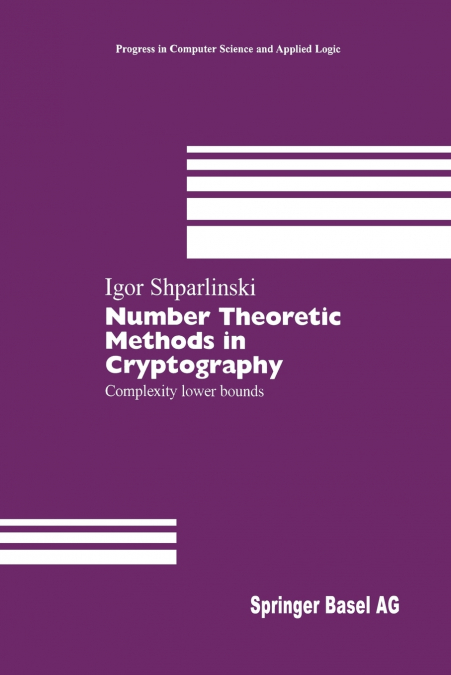
Number Theoretic Methods in Cryptography

Number Theoretic Methods in Cryptography

Igor Shparlinski

66,74 €
IVA incluido
Disponible
Editorial:
Springer Nature B.V.
Año de edición:
2012
Materia
Redes y comunicaciones informáticas
ISBN:
9783034897235
66,74 €
IVA incluido
Disponible

Selecciona una librería:

  • Librería Samer Atenea
  • Librería Aciertas (Toledo)
  • Kálamo Books
  • Librería Perelló (Valencia)
  • Librería Elías (Asturias)
  • Donde los libros
  • Librería Kolima (Madrid)
  • Librería Proteo (Málaga)

The book introduces new techniques which imply rigorous lower bounds on the complexity of some number theoretic and cryptographic problems. These methods and techniques are based on bounds of character sums and numbers of solutions of some polynomial equations over finite fields and residue rings. It also contains a number of open problems and proposals for further research. We obtain several lower bounds, exponential in terms of logp, on the de­ grees and orders of • polynomials; • algebraic functions; • Boolean functions; • linear recurring sequences; coinciding with values of the discrete logarithm modulo a prime p at suf­ ficiently many points (the number of points can be as small as pI/He). These functions are considered over the residue ring modulo p and over the residue ring modulo an arbitrary divisor d of p - 1. The case of d = 2 is of special interest since it corresponds to the representation of the right­ most bit of the discrete logarithm and defines whether the argument is a quadratic residue. We also obtain non-trivial upper bounds on the de­ gree, sensitivity and Fourier coefficients of Boolean functions on bits of x deciding whether x is a quadratic residue. These results are used to obtain lower bounds on the parallel arithmetic and Boolean complexity of computing the discrete logarithm. For example, we prove that any unbounded fan-in Boolean circuit. of sublogarithmic depth computing the discrete logarithm modulo p must be of superpolynomial size.

Artículos relacionados

  • Next Generation Search Engines
    Recent technological progress in computer science, Web technologies, and the constantly evolving information available on the Internet has drastically changed the landscape of search and access to information. Current search engines employ advanced techniques involving machine learning, social networks, and semantic analysis. Next Generation Search Engines: Advanced Models for ...
  • Collaboration and the Semantic Web
    Collaborative working has been increasingly viewed as a good practice for organizations to achieve efficiency. Organizations that work well in collaboration may have access to new sources of funding, deliver new, improved, and more integrated services, make savings on shared costs, and exchange knowledge, information and expertise. Collaboration and the Semantic Web: Social Net...
  • Resource Allocation in Next-Generation Broadband Wireless Access Networks
    With the growing popularity of wireless networks in recent years, the need to increase network capacity and efficiency has become more prominent in society. This has led to the development and implementation of heterogeneous networks. Resource Allocation in Next-Generation Broadband Wireless Access Networks is a comprehensive reference source for the latest scholarly research o...
  • Advanced Topics in Information Technology Standards and Standardization Research, Volume 1
    Kai Jakobs
    ...
  • Data Warehouses and OLAP
    ...
  • Selected Readings on Database Technologies and Applications
    Terry Halpin
    Education and research in the field of database technology can prove problematic without the proper resources and tools on the most relevant issues, trends, and advancements. Selected Readings on Database Technologies and Applications supplements course instruction and student research with quality chapters focused on key issues concerning the development, design, and analysis ...

Otros libros del autor

  • Cryptographic Applications of Analytic Number Theory
    Igor Shparlinski
    The book introduces new techniques that imply rigorous lower bounds on the com­ plexity of some number-theoretic and cryptographic problems. It also establishes certain attractive pseudorandom properties of various cryptographic primitives. These methods and techniques are based on bounds of character sums and num­ bers of solutions of some polynomial...
    Disponible

    133,28 €

  • Computational and Algorithmic Problems in Finite Fields
    Igor Shparlinski
    ’Et moi, ...• si j’avait su comment en revenir. je One service mathematics bas rendemI !be n’y semis point a1J6.’ human race. It bas put common sense back JulesVeme where it belongs. on tile topmost sbelf next to tile dusty canister labelled ’discarded nonsense’. The series is divergent; therefore we may be Eric T.BeIl able to do something with il O. ...
    Disponible

    66,45 €

  • Finite Fields
    Igor Shparlinski
    This book is mainly devoted to some computational and algorithmic problems in finite fields such as, for example, polynomial factorization, finding irreducible and primitive polynomials, the distribution of these primitive polynomials and of primitive points on elliptic curves, constructing bases of various types and new applications of finite fields ...
    Disponible

    267,98 €

  • Cryptographic Applications of Analytic Number Theory
    Igor Shparlinski
    The book introduces new techniques that imply rigorous lower bounds on the com­ plexity of some number-theoretic and cryptographic problems. It also establishes certain attractive pseudorandom properties of various cryptographic primitives. These methods and techniques are based on bounds of character sums and num­ bers of solutions of some polynomial...
  • Finite Fields
    Igor Shparlinski
    This book is mainly devoted to some computational and algorithmic problems in finite fields such as, for example, polynomial factorization, finding irreducible and primitive polynomials, the distribution of these primitive polynomials and of primitive points on elliptic curves, constructing bases of various types and new applications of finite fields ...
  • Computational and Algorithmic Problems in Finite Fields
    Igor Shparlinski
    Series Editor’s Preface. Preface. Notations. Introduction. 1. Polynomial Factorization. 2. Finding Irreducible and Primitive Polynomials. 3. The Distribution of Irreducible and Primitive Polynomials. 4. Bases and Computation in Finite Fields. 5. Coding Theory and Algebraic Curves. 6. Elliptic Curves. 7. Recurrent Sequences in Finite Fields and Linear Cyclic Codes. 8. Fini...