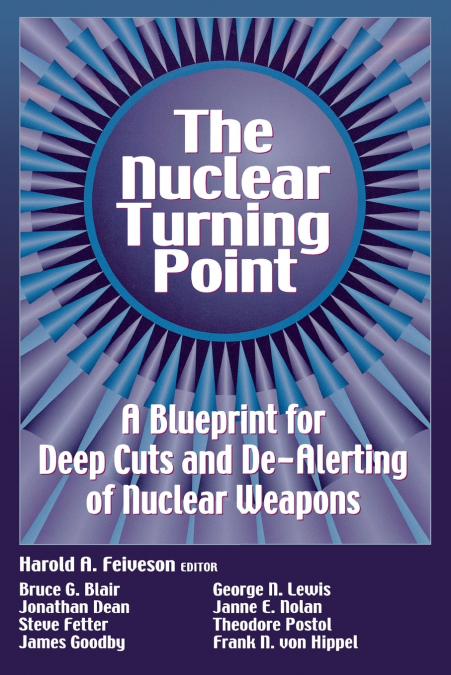

Nuclear Turning Point

Nuclear Turning Point

Harold A. Feiveson

36,24 €
IVA incluido
Disponible
Editorial:
Bloomsbury Publishing plc
Año de edición:
1999
Materia
Diplomacia
ISBN:
9780815709534
36,24 €
IVA incluido
Disponible

Selecciona una librería:

  • Librería Samer Atenea
  • Librería Aciertas (Toledo)
  • Kálamo Books
  • Librería Perelló (Valencia)
  • Librería Elías (Asturias)
  • Donde los libros
  • Librería Kolima (Madrid)
  • Librería Proteo (Málaga)

'Despite the ongoing drawdown of strategic forces under the terms of START, both the United States and Russia maintain large arsenals of nuclear weapons poised for immediate launch. Under the most optimistic current scenarios, these arsenals will remain very large and launch-ready for more than a decade. This book, by a distinguished group of coauthors, critically evaluates the current policy of retaining and operating large nuclear arsenals. It reviews U.S. nuclear doctrine and strategy, and the role of nuclear weapons in deterring aggression by former Cold War adversaries and other countries with weapons of mass destruction. The risks of inadvertent as well as deliberate nuclear attack are assessed. The authors argue that small arsenals (low hundreds) on low alert satisfy all justifiable requirements for nuclear weapons. They present a blueprint for making deep cuts in U.S. and Russian deployments, and for lowering their alert level. They explain the implications of shifting to small arsenals for further constraining anti-ballistic missile defenses, strengthening verification, and capping or reducing the nuclear arsenals of China, France, and Britain as well as the threshold nuclear states. The political challenges and opportunities, both domestic and international, for achieving deep reductions in the size and readiness of nuclear forces are analyzed by the authors and by distinguished experts from other countries. The coauthors are Bruce Blair, Jonathan Dean, James Goodby, Steve Fetter, Hal Feiveson, George Lewis, Janne Nolan, Theodore Postol, and Frank von Hippel. An appendix with international perspectives by Li Bin (China), Alexei Arbatov (Russia), Therese Delpech (France), Pervez Hoodbhoy (Pakistan), Shai Feldman (Israel), Harald Mueller (Germany), and Zia Mian and M.V. Ramana (South Asia). '


Artículos relacionados

  • How Statesmen Think
    Robert Jervis
    Robert Jervis has been a pioneering leader in the study of the psychology of international politics for more than four decades. How Statesmen Think presents his most important ideas on the subject from across his career. This collection of revised and updated essays applies, elaborates, and modifies his pathbreaking work. The result is an indispensable book for students and sch...
    Disponible

    43,09 €

  • Tower of Babble
    Dore Gold
    ...
    Disponible

    16,40 €

  • The Diplomatic Relations of the United States with Haiti, 1776-1891
    Rayford W. Logan
    The relations of the United States with Haiti have been different from American relations with any other nation; they have been vital and at times even dramatic. They climaxed in 1891 when the United States failed to make Haiti lease her Mole St. Nicolas. This failure constitutes an amazing episode in American diplomatic hostory. Recounting the story of Haiti’s struggle for ind...
    Disponible

    76,25 €

  • Diplomacy. the Written Art
    Ozichi Alimole
    The author seeks to redefine written diplomacy in its true meaning: the art of learning to write in a particular kind of language and mood. He seeks to refocus attention on the significance of diplomatic communication as one of the defining characteristics of diplomacy. A wide variety of correspondence encountered by diplomats is explained, with an analysis of each form of corr...
    Disponible

    57,94 €

  • West Africa’s Trouble Spots and the Impe
    Osita Agbu
    This monograph highlights the necessity for taking preventive measures in the form of peace-building as a sustainable and long-term solution to conflicts in West Africa, with a special focus on the Mano River Union countries. Apart from the Mano River Union countries, efforts at resolving other conflicts in say, Guinea Bissau, Senegal, Côte d’Ivoire and Nigeria, have suffered f...
    Disponible

    58,17 €

  • The Evolution Of UAE Foreign Policy
    GEW Intelligence Unit
    The research background of this book focuses on the historical evolution and strategic development of the United Arab Emirates’ (UAE) foreign policy from its formation to the present day.u2029The research methodology proposed in this book includes a historical analysis of the UAE’s foreign policy, examining key events and strategies that have shaped its current principles and g...
    Disponible

    28,96 €