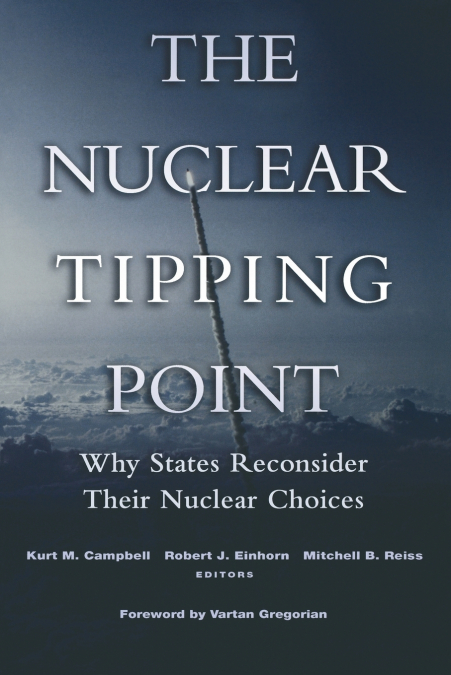

Nuclear Tipping Point

Nuclear Tipping Point


39,00 €
IVA incluido
Disponible
Editorial:
Bloomsbury Publishing plc
Año de edición:
2004
Materia
Diplomacia
ISBN:
9780815713319
39,00 €
IVA incluido
Disponible

Selecciona una librería:

  • Librería Samer Atenea
  • Librería Aciertas (Toledo)
  • Kálamo Books
  • Librería Perelló (Valencia)
  • Librería Elías (Asturias)
  • Donde los libros
  • Librería Kolima (Madrid)
  • Librería Proteo (Málaga)

'More than half a century after the advent of the nuclear age, is the world approaching a tipping point that will unleash an epidemic of nuclear proliferation? Today many of the building blocks of a nuclear arsenal—scientific and engineering expertise, precision machine tools, software, design information—are more readily available than ever before. The nuclear pretensions of so-called rogue states and terrorist organizations are much discussed. But how firm is the resolve of those countries that historically have chosen to forswear nuclear weapons? A combination of changes in the international environment could set off a domino effect, with countries scrambling to develop nuclear weapons so as not to be left behind—or to develop nuclear ''hedge'' capacities that would allow them to build nuclear arsenals relatively quickly, if necessary. Th e Nuclear Tipping Point examines the factors, both domestic and transnational, that shape nuclear policy. The authors, distinguished scholars and foreign policy practitioners with extensive government experience, develop a framework for understanding why certain countries may originally have decided to renounce nuclear weapons—and pinpoint some more recent country-specific factors that could give them cause to reconsider. Case studies of eight long-term stalwarts of the nonproliferation regime—Egypt, Germany, Japan, Saudi Arabia, South Korea, Syria, Turkey, and Taiwan—flesh out this framework and show how even these countries might be pushed over the edge of a nuclear tipping point. The authors offer prescriptions that would both prevent such countries from reconsidering their nuclear option and avert proliferation by others. The stakes are enormous and success is far from assured. To keep the tipping point beyond reach, the authors argue, the international community will have to act with unity, imagination, and strength, and Washington's leadership will be essential. Contributors include Leon Feurth, George Wash'


Artículos relacionados

  • How Statesmen Think
    Robert Jervis
    Robert Jervis has been a pioneering leader in the study of the psychology of international politics for more than four decades. How Statesmen Think presents his most important ideas on the subject from across his career. This collection of revised and updated essays applies, elaborates, and modifies his pathbreaking work. The result is an indispensable book for students and sch...
    Disponible

    43,09 €

  • Tower of Babble
    Dore Gold
    ...
    Disponible

    16,40 €

  • The Diplomatic Relations of the United States with Haiti, 1776-1891
    Rayford W. Logan
    The relations of the United States with Haiti have been different from American relations with any other nation; they have been vital and at times even dramatic. They climaxed in 1891 when the United States failed to make Haiti lease her Mole St. Nicolas. This failure constitutes an amazing episode in American diplomatic hostory. Recounting the story of Haiti’s struggle for ind...
    Disponible

    76,25 €

  • Diplomacy. the Written Art
    Ozichi Alimole
    The author seeks to redefine written diplomacy in its true meaning: the art of learning to write in a particular kind of language and mood. He seeks to refocus attention on the significance of diplomatic communication as one of the defining characteristics of diplomacy. A wide variety of correspondence encountered by diplomats is explained, with an analysis of each form of corr...
    Disponible

    57,94 €

  • West Africa’s Trouble Spots and the Impe
    Osita Agbu
    This monograph highlights the necessity for taking preventive measures in the form of peace-building as a sustainable and long-term solution to conflicts in West Africa, with a special focus on the Mano River Union countries. Apart from the Mano River Union countries, efforts at resolving other conflicts in say, Guinea Bissau, Senegal, Côte d’Ivoire and Nigeria, have suffered f...
    Disponible

    58,17 €

  • The Evolution Of UAE Foreign Policy
    GEW Intelligence Unit
    The research background of this book focuses on the historical evolution and strategic development of the United Arab Emirates’ (UAE) foreign policy from its formation to the present day.u2029The research methodology proposed in this book includes a historical analysis of the UAE’s foreign policy, examining key events and strategies that have shaped its current principles and g...
    Disponible

    28,96 €