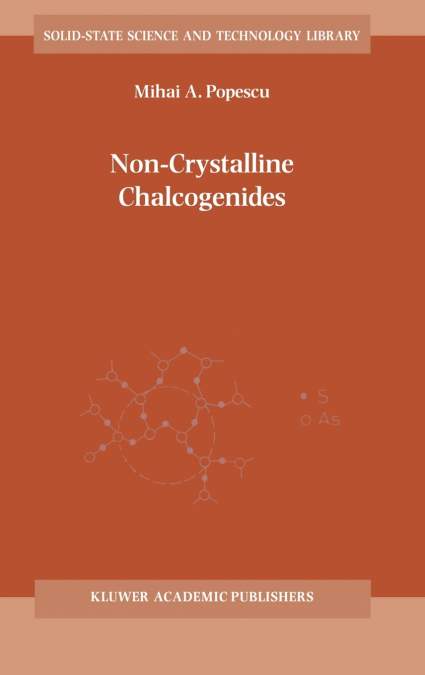

Non-Crystalline Chalcogenicides

Non-Crystalline Chalcogenicides

M.A. Popescu

207,24 €
IVA incluido
Disponible
Editorial:
Springer Nature B.V.
Año de edición:
2001
ISBN:
9781402003592
207,24 €
IVA incluido
Disponible

Selecciona una librería:

  • Librería Samer Atenea
  • Librería Aciertas (Toledo)
  • Kálamo Books
  • Librería Perelló (Valencia)
  • Librería Elías (Asturias)
  • Donde los libros
  • Librería Kolima (Madrid)
  • Librería Proteo (Málaga)

The earliest experimental data on an oxygen-free glass have been published by Schulz-Sellack in 1870 [1]. Later on, in 1902, Wood [2], as well as Meier in 1910 [3], carried out the first researches on the optical properties of vitreous selenium. The interest in the glasses that exhibit transparency in the infrared region of the optical spectrum rose at the beginning of the twentieth century. Firstly were investigated the heavy metal oxides and the transparency limit was extended from (the case of the classical oxide glasses) up to wavelength. In order to extend this limit above the scientists tried the chemical compositions based on the elements of the sixth group of the Periodic Table, the chalcogens: sulphur, selenium and tellurium. The systematic research in the field of glasses based on chalcogens, called chalcogenide glasses, started at the middle of our century. In 1950 Frerichs [4] investigated the glass and published the paper: 'New optical glasses transparent in infrared up to 12 . Several years later he started the study of the selenium glass and prepared several binary glasses with sulphur [5]. Glaze and co-workers [6] developed in 1957 the first method for the preparation of the glass at the industrial scale, while Winter-Klein [7] published reports on numerous chalcogenides prepared in the vitreous state.


Artículos relacionados

  • Recycled Polymers
    Didier Perrin
    The efficient ecodesign of secondary raw materials from recycled multiphase polymer systems is performed through the study of various things, such as:The compatibility of mixtures of recycled polymers where work on knowledge of the miscibility of mixtures depends on the different rates and the nature of the constituents;The aging of recycled polymers in terms of the structuring...
  • Advanced Nanoscale Materials for Thermoelectric Applications
    This Special Issue covers preparations, measurements, devices, and applications based on thermoelectric nanomaterials and summarizes the latest developments towards highly efficient thermoelectric nanomaterials and thermoelectric devices. ...
  • Repair and Strengthening of Existing Reinforced Concrete Structures
    Andreas Lampropoulos
    It is crucial that we strengthen existing structures worldwide, especially in earthquake-prone areas. Recent earthquakes have highlighted the inadequacy of many existing structures, which have been damaged from previous powerful earthquakes and have been designed without code provisions or according to old code provisions that are now obsolete. Furthermore, the majority of exis...
  • Sol-Gel Technology Applied to Materials Science
    Aleksej Zarkov
    Rapid advances in technologies around the globe necessitate the development of new materials, nanostructures, and multicomponent composites with specific chemical and physical properties that can meet the requirements of modern technologies. Using appropriate synthetic approaches is crucial for the preparation of inorganic materials with designed microstructure and properties. ...
  • Functional Polymer Composites
    Functional polymer composites are showing increasing potential as materials in chemistry and materials science. Polymer composites, including nanocomposites, are made via the incorporation of fillers in polymer matrices and offer many advantages. The properties of polymer composites are further improved via the surface modification of fillers or the matrix phase. Currently, the...
  • Feature Papers in Section Biosensors 2023
    Evgeny Katz
    This reprint, based on the Special Issue, provides a general overview of different biosensors, briefly explaining the general approaches to identifying them, their construction, and their performance. A discussion concerning how the required components of biosensors are combined to perform analytical work is presented. Different signal-transducing mechanisms are discussed, part...

Otros libros del autor

  • Non-Crystalline Chalcogenicides
    M.A. Popescu
    The earliest experimental data on an oxygen-free glass have been published by Schulz-Sellack in 1870 [1]. Later on, in 1902, Wood [2], as well as Meier in 1910 [3], carried out the first researches on the optical properties of vitreous selenium. The interest in the glasses that exhibit transparency in the infrared region of the optical spectrum rose a...