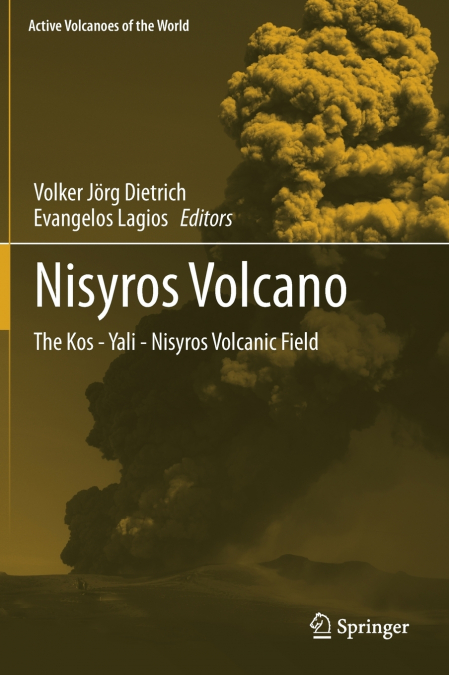

Nisyros Volcano

Nisyros Volcano


259,26 €
IVA incluido
Consulta disponibilidad
Editorial:
Springer Nature B.V.
Año de edición:
2017
Materia
Geología y la litosfera
ISBN:
9783319554587

Selecciona una librería:

  • Librería Samer Atenea
  • Librería Aciertas (Toledo)
  • Kálamo Books
  • Librería Perelló (Valencia)
  • Librería Elías (Asturias)
  • Donde los libros
  • Librería Kolima (Madrid)
  • Librería Proteo (Málaga)

This book presents the first compilation of scientific research on the island of Nisyros, involving various geoscientific disciplines. Presenting a wealth of illustrations and maps, including a geological map of the volcano, it also provides valuable insights into the geothermal potential of Greece. The island of Nisyros is a Quaternary volcano located at the easternmost end of the South Aegean Volcanic Arc. The island is nearly circular, with an average diameter of 8 km, and covers an area of approximately 42 km2. It lies above a base of Mesozoic limestone and a thin crust, with the mantle-crust transition located at a depth of approximately 27 km. The volcanic edifice of Nisyros comprises a succession of calc-alkaline lavas and pyroclastic rocks, as well as a summit caldera with an average diameter of 4 km. Nisyros marks the most recent volcano in the large prehistoric volcanic field between Kos-Yali-Strongyli-Pyrgousa-Pachia-Nisyros, where the largest eruption ('Kos Plateau Tuff') in the history of the eastern Mediterranean devastated the Dodecanese islands 161,000 years ago. Although the last volcanic activity on Nisyros dates back at least 20,000 to 25,000 years, it encompasses an active hydrothermal system underneath the volcano with temperatures of roughly 100°C at the Lakki plain, the present-day caldera floor and 350°C at a depth of 1,550 m. A high level of seismic unrest, thermal waters and fumarolic gases bear testament to its continuous activity, which is due to a large volume of hot rocks and magma batches at greater depths, between 3,000 and 8,000 m. Violent hydrothermal eruptions accompanied by major earthquakes occurred in 1873 and 1888 and left behind large, 'world-wide unique' explosion craters in the old caldera. Through diffuse soil degassing, the discharge of all hydrothermal craters in the Lakki plain releases 68 tons of hydrothermal-volcanic derived CO2 and 42 MW of thermal energy per day. This unique volcanic and hydrothermal environment is visited daily by hundreds of tourists.
Artículos relacionados

  • Exploration Science
    Dr Peter T Scott
    About Exploration ScienceHave you wondered what the science of geology is all about?Together we will explore of the surface and sub-surface of the Earth, the sub-branches of geology, including mineralogy, petrology (rocks), palaeontology (fossils), geochemistry, seismology (earthquakes), engineering geology, and many more.The scientific method used by all scientists as well as ...
    Disponible

    30,12 €

  • Fossils, Dinosaurs and Cave Men
    Patrick Nurre
    This textbook is a high school, semester study of the differences between the Biblcal and secular views of fossils, dinosaurs, and cave men.  Topics include the cause and mechanism for a global flood, the geologic time table, living fossils, the Tower of Babel, modern classification of dinosaurs, and more.  Students will also learn to interpret the geologic column from a Biblic...
    Disponible

    43,86 €

  • Adventures in Earth Science
    Dr Peter T Scott
    ADVENTURES in EARTH SCIENCE is not just an in-depth textbook but a series of adventures across seven continents and beyond in the sciences of astronomy, geology, meteorology and oceanography. It has been written with over forty years of experience in studying, researching and teaching earth science. Whilst it has been designed for senior high school and junior university or col...
    Disponible

    142,25 €

  • Timefulness
    Marcia Bjornerud
    Why an awareness of Earth’s temporal rhythms is critical to our planetary survivalFew of us have any conception of the enormous timescales in our planet’s long history, and this narrow perspective underlies many of the environmental problems we are creating for ourselves. The passage of nine days, which is how long a drop of water typically stays in Earth’s atmosphere, is somet...
  • The Long Thaw
    David Archer
    Why a warmer climate may be humanity’s longest-lasting legacyThe human impact on Earth’s climate is often treated as a hundred-year issue lasting as far into the future as 2100, the year in which most climate projections cease. In The Long Thaw, David Archer, one of the world’s leading climatologists, reveals the hard truth that these changes in climate will be 'locked in,' ess...
    Disponible

    24,10 €

  • THE EPEMBE CARBONATITE DYKE, NORTH-WEST NAMIBIA
    Kamuhitua Humavindu
    This book gives a bright perspective on the nature of carbonatites along with different magmatic and hydrothermal processes that affect the distribution of these dykes. In the past there has been several debates on the enrichment mechanisms of rare-earth elements, making it a significant book especially now with the increase in technology. The research is filled with exciting f...
    Disponible

    75,64 €