
Inicio > > Redes y comunicaciones informáticas > Nested Relations and Complex Objects in Databases
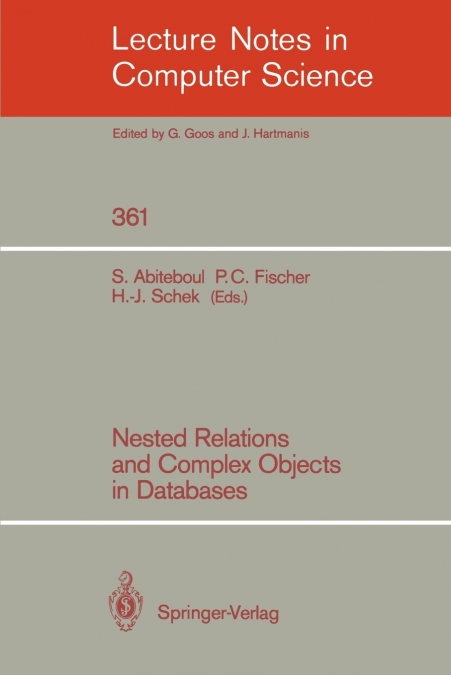
Nested Relations and Complex Objects in Databases

Nested Relations and Complex Objects in Databases


66,07 €
IVA incluido
Disponible
Editorial:
Springer Nature B.V.
Año de edición:
1989
Materia
Redes y comunicaciones informáticas
ISBN:
9783540511717
66,07 €
IVA incluido
Disponible

Selecciona una librería:

  • Librería Samer Atenea
  • Librería Aciertas (Toledo)
  • Kálamo Books
  • Librería Perelló (Valencia)
  • Librería Elías (Asturias)
  • Donde los libros
  • Librería Kolima (Madrid)
  • Librería Proteo (Málaga)

This volume was primarily intended to present selected papers from the workshop on Theory and Applications of Nested Relations and Complex Objects, held in Darmstadt, FRG, from April 6-8, 1987. Other papers were solicited in order to provide a picture of the field as general as possible. Research on nested relations and complex objects originates in the late seventies. The motivation was to obtain data models and systems which would provide support for so-called complex objects or molecular structures, i.e., for hierarchically organized data, thereby overcoming severe shortcomings of the relational model. This theme of research is now maturing. Systems based on those ideas are beginning to be available. Languages of various natures (algebras, calculi, graphical, logic-oriented) have been designed and a theory is slowly emerging. Finally, new developments in database technology and research are incorporating features of models involving complex objects. A variety of approaches is represented in this volume. The first three papers give overviews of major pioneering implementation efforts. The fourth paper is devoted to the important issue of implementation of storage structures. The next three papers propose excursions in the foundations of nested relations and complex objects. The following six contributions are all devoted to modeling of complex objects. The area of database design is represented by the last four papers.
Artículos relacionados

  • Next Generation Search Engines
    Recent technological progress in computer science, Web technologies, and the constantly evolving information available on the Internet has drastically changed the landscape of search and access to information. Current search engines employ advanced techniques involving machine learning, social networks, and semantic analysis. Next Generation Search Engines: Advanced Models for ...
  • Collaboration and the Semantic Web
    Collaborative working has been increasingly viewed as a good practice for organizations to achieve efficiency. Organizations that work well in collaboration may have access to new sources of funding, deliver new, improved, and more integrated services, make savings on shared costs, and exchange knowledge, information and expertise. Collaboration and the Semantic Web: Social Net...
  • Resource Allocation in Next-Generation Broadband Wireless Access Networks
    With the growing popularity of wireless networks in recent years, the need to increase network capacity and efficiency has become more prominent in society. This has led to the development and implementation of heterogeneous networks. Resource Allocation in Next-Generation Broadband Wireless Access Networks is a comprehensive reference source for the latest scholarly research o...
  • Advanced Topics in Information Technology Standards and Standardization Research, Volume 1
    Kai Jakobs
    ...
  • Data Warehouses and OLAP
    ...
  • Selected Readings on Database Technologies and Applications
    Terry Halpin
    Education and research in the field of database technology can prove problematic without the proper resources and tools on the most relevant issues, trends, and advancements. Selected Readings on Database Technologies and Applications supplements course instruction and student research with quality chapters focused on key issues concerning the development, design, and analysis ...