Inicio > Derecho > Derecho internacional > Necessity and Proportionality and the Right of Self-Defence in International Law
Necessity and Proportionality and the Right of Self-Defence in International Law

Necessity and Proportionality and the Right of Self-Defence in International Law

Chris O’Meara

173,77 €
IVA incluido
Consulta disponibilidad
Editorial:
Oxford University Press
Año de edición:
2021
Materia
Derecho internacional
ISBN:
9780198863403

Selecciona una librería:

  • Librería Samer Atenea
  • Librería Aciertas (Toledo)
  • Kálamo Books
  • Librería Perelló (Valencia)
  • Librería Elías (Asturias)
  • Donde los libros
  • Librería Kolima (Madrid)
  • Librería Proteo (Málaga)

States invariably justify using force extraterritorially by reference to their right of self-defence. In doing so, they accept that the exercise of this right is conditioned by the customary international law requirements of necessity and proportionality. However, these requirements are notorious for being normatively indeterminate and operationally complex. As a breach of either requirement renders ostensibly defensive action unlawful, increased determinacy regarding their scope and substance is crucial to how international law constrains military force. This book examines the conceptual meaning, content, and practical application of necessity and proportionality as they relate to the right of self-defence following the adoption of the UN Charter in 1945. It provides a coherent and up-to-date description of the applicable contemporary international law and proposes an analytical framework to guide its operation and appraisal. This book argues that necessity and proportionality are conceptually distinct and must be applied in the foregoing order to avoid an insufficient ’catch-all’ description of legality or illegality. Necessity determines whether defensive force may be used to respond to an armed attack and where it must be directed. Proportionality governs how much total force is permissible and prohibits excessive responses. Both requirements are shown to apply on an ongoing basis throughout the duration of an armed conflict prompted by self-defence. Compliance with necessity and proportionality ensures that the purposes ofself-defence are met, and nothing more, and that defensive force is not unduly disruptive to third party interests and to international peace and security.
Artículos relacionados

  • Comparative regulation, economic analysis, and applications of private equity in the united states and european union
    Irini Liakopoulou
    The present work examines the economics and legal doctrine of private equity. After a consideration of private equity’s origins, the book will explore the evolution of private equity in the United States and Europe. The reference economic model then will be reconstructed, with particular attention to financial flows to and from private equity firms and funds. This reconstructio...
  • Complicity in International Law
    Dimitris Liakopoulous
    Complicity in International Law aims to analyze questions arising from a state’s complicity in conflict with another state or an international organization. On the basis of international legal provisions, a state that assists the illicit fact of another state or an international organization in turn commits an offense if it is aware of the main fact and is bound by the same obl...
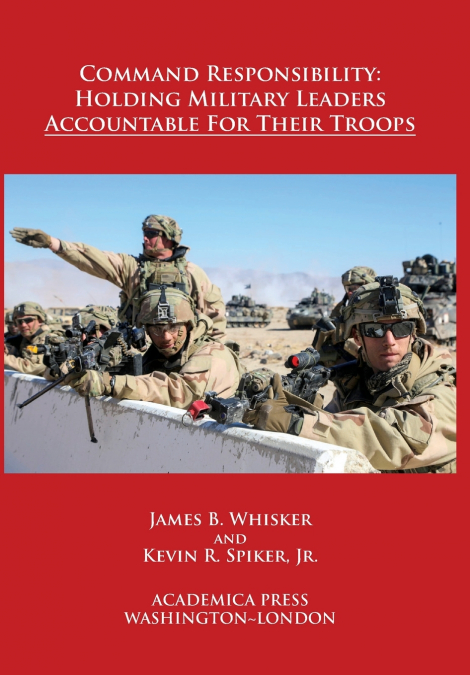
  • Command responsibility
    James B Whisker / Kevin R Spiker
    Command responsibility, or executive accountability, assumes that leaders are responsible for the actions of their subordinates. If subordinates misbehave, violate basic moral laws, transgress international law, or thwart international standards of behavior, their leader may be called before to justice. Standards that set the boundaries of human action have been evolving for ma...
  • International Organizations and Reparations
    Dimitris Liakopoulos
    In the first part of this book, noted legal scholar Dimtris Liakopoulos deals with reconstructing the legal regulatory framework governing human rights violations in the activities of organizations. After identifying rules that are generally applicable to organizations’ offenses and govern the profile of reparations, this study assesses primary rules that guarantee the right to...
  • International Organizations and Legal Sanctions Against Governments
    Dimitris Liakopoulos
    This book examines the relationship between governments and international organizations under international law. After surveying the policing powers of international organizations under international law, it illustrates some normative aspects of law that distinguish regulation from enforcement via study of recent legal cases before international judicial bodies. According to Di...
  • The EU Foreign Subsidies Regulation
    Andreas Reindl / Isabelle Van Damme
    'The EU Foreign Subsidies Regulation' is a pioneering manual authored by legal experts Andreas Reindl and Isabelle Van Damme. This essential guide, the first of its kind, is tailored for legal practitioners, offering a thorough exploration of the tools and mechanisms embedded within this novel European regulatory framework. The authors meticulously dissect the EU Foreign Subsid...