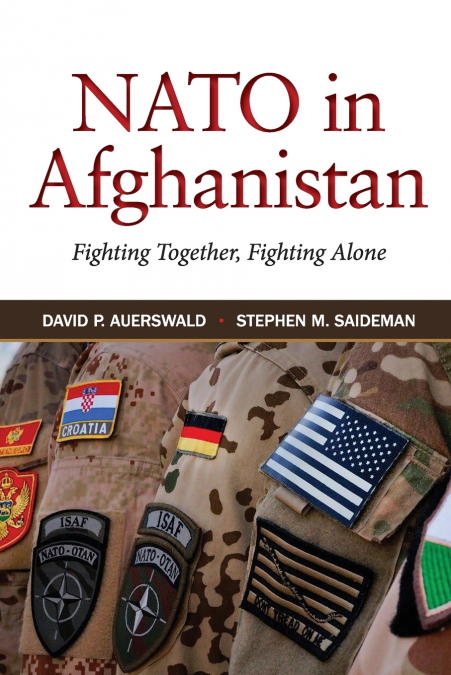
NATO in Afghanistan

NATO in Afghanistan

David P. Auerswald / David PAuerswald / Stephen M. Saideman / Stephen MSaideman

33,43 €
IVA incluido
Disponible
Editorial:
Princeton University Press
Año de edición:
2016
Materia
Historia militar
ISBN:
9780691170879
33,43 €
IVA incluido
Disponible

Selecciona una librería:

  • Librería Samer Atenea
  • Librería Aciertas (Toledo)
  • Kálamo Books
  • Librería Perelló (Valencia)
  • Librería Elías (Asturias)
  • Donde los libros
  • Librería Kolima (Madrid)
  • Librería Proteo (Málaga)

Modern warfare is almost always multilateral to one degree or another, requiring countries to cooperate as allies or coalition partners. Yet as the war in Afghanistan has made abundantly clear, multilateral cooperation is neither straightforward nor guaranteed. Countries differ significantly in what they are willing to do and how and where they are willing to do it. Some refuse to participate in dangerous or offensive missions. Others change tactical objectives with each new commander. Some countries defer to their commanders while others hold them to strict account. NATO in Afghanistan explores how government structures and party politics in NATO countries shape how battles are waged in the field. Drawing on more than 250 interviews with senior officials from around the world, David Auerswald and Stephen Saideman find that domestic constraints in presidential and single-party parliamentary systems--in countries such as the United States and Britain respectively--differ from those in countries with coalition governments, such as Germany and the Netherlands. As a result, different countries craft different guidelines for their forces overseas, most notably in the form of military caveats, the often-controversial limits placed on deployed troops. Providing critical insights into the realities of alliance and coalition warfare, NATO in Afghanistan also looks at non-NATO partners such as Australia, and assesses NATO’s performance in the 2011 Libyan campaign to show how these domestic political dynamics are by no means unique to Afghanistan.

Artículos relacionados

  • Waterloo Betrayed
    Stephen M. Beckett / Stephen MBeckett
    THIS BOOK HAS BEEN SUPERCEDEDSee Operations of the Armée du Nord : 1815, The Analysis for the definitive guide of French operations in 1815.   Discover why Napoleon really lost the Waterloo Campaign Napoleon was betrayed during 1815 There is no doubt of this. The Traitors admitted as much, and the Allied powers documented their acts. In the immediate aftermath of Napoleon's...
  • The Price They Paid
    Michael Putzel
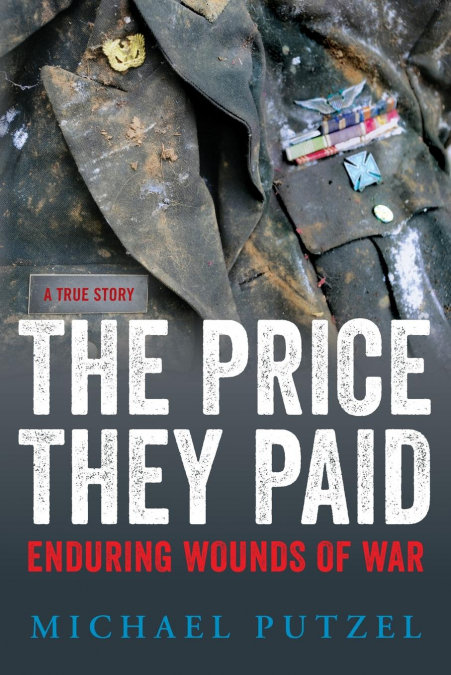
    The Price They Paid is the stunning and dramatic true story of a legendary helicopter commander in Vietnam and the flight crews that followed him into the most intensive helicopter warfare ever-and how that brutal experience has changed their lives in the forty years since the war ended. ...
    Disponible

    11,07 €

  • Uniforms of Russian army during the Napoleonic war vol.17
    Aleksandr Vasilevich Viskovatov / Mark Conrad
    This volume is related to the Russian Army during the zar Alexander I era, and are about the Guard cavalry regiments (part 1). Compiled at Saint Petersburg during the year from 1837 and 1851, the Historical Description of the Clothing and Arms of the Russian Army has had an enormous impact and great importance for the study on the history of Russian costume and uniformology dev...
    Disponible

    40,78 €

  • Cyber Warfare and Cyber Terrorism
    ...
  • Armed Robotic Systems Emergence
    Robert j. Bunker / Robert jBunker
    The fielding of armed robotic systems--droids and drones that are teleoperated, semi-autonomous, and even autonomous--has been slowly but surely transitioning from pure science fiction into military reality on the battlefields of the early 21st century. These systems currently have no artificial intelligence (AI) whatsoever and, in most cases, are simply operated by soldiers (a...
    Disponible

    8,64 €

  • SNIPER ONE
    DAN MILLS
    ...
    Disponible

    18,71 €