
NATO, Civilisation and Individuals

NATO, Civilisation and Individuals

Sarah da Mota

157,47 €
IVA incluido
Disponible
Editorial:
Springer Nature B.V.
Año de edición:
2019
Materia
Relaciones internacionales
ISBN:
9783030089849
157,47 €
IVA incluido
Disponible

Selecciona una librería:

  • Librería Samer Atenea
  • Librería Aciertas (Toledo)
  • Kálamo Books
  • Librería Perelló (Valencia)
  • Librería Elías (Asturias)
  • Donde los libros
  • Librería Kolima (Madrid)
  • Librería Proteo (Málaga)

1. Chapter 1/Introduction. Seeking alternative connections between civilisation and security1.1. The unconscious question1.2. Questioning NATO’s change1.3. The problem of time1.4. The argument2. Chapter 2. IR’s disciplinary connections with Western civilisation3. Chapter 3. Individualising civilisation: the Civilised Subject of Security3.1. The civilised habitus3.2. The unconscious dimension of security4. Chapter 4. Standards of Civilisation: architecting security, order, and hierarchy5. Chapter 5. NATO’s deep origins (1939-1949): unbreaking the civilised habitus?5.1. World War II: barbarism unleashed5.2. The never civilised Soviet Union?5.3. A 'spiritual union': a tool for self-restraint?5.4. Rearranging security, repositioning power: the process of rebuilding interdependence among the civilised6. Chapter 6. NATO’s Cold War evolution: civilisation from referent object to standard 6.1. The Treaty: making a new standard, continuing the civilised habitus6.2. The 1950’s - 1960’s: 'the peril from disunity'6.3. The 1970’s - 1980’s: 'the pace of change is accelerating'7. Chapter 7. Post-Cold War NATO: new ways and reasons for coexistence7.1. The new Strategic Concept (1991): continuity amidst the new (in)security environment7.2. ’The promise of democracy is for the civilised only’: setting the standards for Partners and new members8. Chapter 8. The Individualisation of Security: a new architecture for international security8.1. The Individualisation of Security as the consecration of a value-based system8.2. The Individualisation of Security in the hands of the military: reproducing civilising power9. Chapter 9. The Individualisation of Security within NATO9.1. Bosnia: from 'Denying Flight' to 'Deliberate Force'9.2. Kosovo: the 'Allied Force'9.3. Afghanistan: taking command of ISAF10. Chapter 10. Conclusion

Artículos relacionados

  • Realism in Practice
    The purpose of this book is to appraise the current relevance and validity of realism as an interpretative tool in contemporary International Relations. All chapters of the book are animated by a theoretical effort to define the conceptual aspects of realism and attempt to establish whether the tradition still provides the necessary conceptual tools to scholars.The chapters add...
    Disponible

    20,36 €

  • Predicting gender violence in India
    Shritha K Vasudevan
    In this provocative new book, Shritha Vasudevan argues that feminist international relations (IR) theory has inadvertently resulted in a biased worldview, the very opposite of what feminist IR set out to try to rectify. This book contests theoretical presumptions of Western feminist IR and attempts to reformulate it in contexts of non-Western cultures. Vasudevan deftly utilizes...
  • Contemporary security issues in Africa
    Isiaka Alani Badmus / Lere Amusan
    In volume, an emerging generation of African scholars examines specific states in Africa where instability is the order of the day. Considerations of African instability are highly relevant in today’s world, where one examines the types of regimes that were put in place after the Cold War and their effects on Africa. Multiparty systems introduced in Africa, rather than bringing...
  • Chronicles of the first and second chechen wars
    Ilya Milyukov
    Presented by Russian author and attorney Ilya Milyukov, Chronicles of the First and Second Chechen War presents the main events of the First (1994-1996) and Second (1999-2009) Wars in Chechnya, Russia’s deadliest conflicts since World War II. The First War began in December 1994 and lasted for one year and nine months, ending in August 1996. There were two major urban battles -...
  • Political instability in Africa
    Isiaka Alani Badmus / Lere Amusan
    This book offers broad-gauged analyses of the causes, nature, and changing patterns of armed conflict in Africa as well as the reasons for these patterns. It also situates conflicts that have been haunting the African continent since the time of decolonization within the various theoretical schools such as 'new war,' 'economic war,' 'neo-patrimonial,' and 'globalization.' It be...
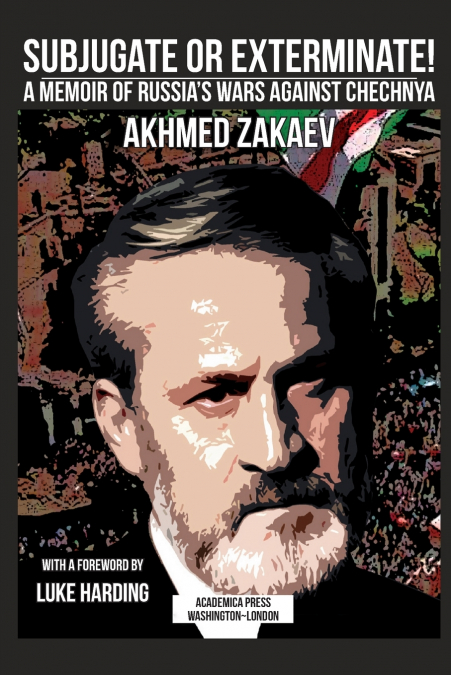
  • Subjugate or exterminate!
    Akhmed Zakaev / Arch Tait
    Foreword by Luke HardingAkhmed Zakaev is a symbol of the indomitable will of the Chechen nation. In this important memoir, he tells the story of the Chechen struggle as he experienced it, describing the conflict in human terms and providing a detailed documentary record of little known or badly understood events that will be of benefit to historians for generations to come.- Da...
    Disponible

    41,63 €

Otros libros del autor

  • NATO, Zivilisation und Individuen
    Sarah da Mota
    Dieses Buch setzt sich kritisch mit den beiden wichtigsten Sicherheitsreferenzen der NATO auseinander: der Zivilisation und den Menschen. Durch ein Überdenken der scheinbar selbstverständlichen Annahme dieser beiden Referenzobjekte wird die erkenntnistheoretische Bedeutung einer unbewussten Dimension für das Verständnis von Bedeutungsbildung und Verhaltensänderung in der intern...
  • NATO, Civilisation and Individuals
    Sarah da Mota
    This book critically engages with NATO’s two main referent objects of security: civilisation and individuals. By rethinking the seemingly natural assumption of these two referent objects, it suggests the epistemological importance of an unconscious dimension to understand meaning formation and behaviour change in international security. The book provides a historicised and gene...