

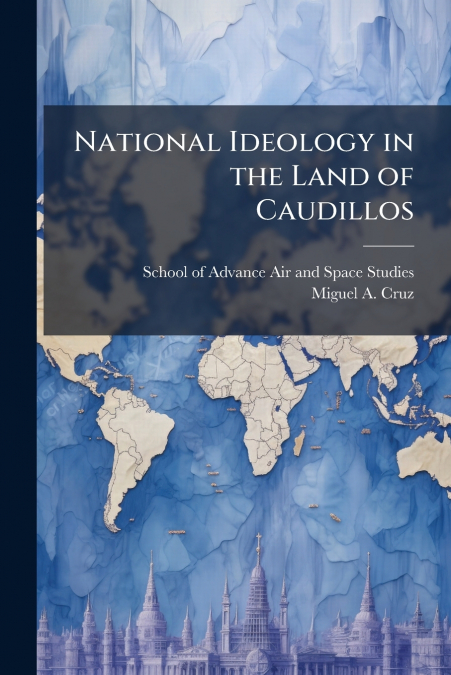
Miguel A. Cruz / School of Advance Air and Space Studies
 Librería Samer Atenea
 Kálamo Books
 Librería Elías (Asturias)
 Librería Kolima (Madrid)
 Librería Proteo (Málaga)
Does ideology matter in international relations? Throughout history, states have used ideological rationales to justify war, appeal for cooperation, or promote peace. Despite the importance ideology plays in the fields of psychology, political science, sociology, history, anthropology, and philosophy, theorists in these areas have failed to produce a generally acceptable definition of the term. Furthermore, conventional wisdom in international politics either overemphasizes or underestimates the role of ideology in state behavior. Thus we are left with a concept that historically has been difficult to articulate in spite of the myriad effects it is claimed to have produced. Despite their common ancestry, Latin American countries display a myriad of ideologies, values, and beliefs; some of which can often prompt conflict among its states. This examination advances the argument that ideology can play a strong role in the behavior of states and can also help explain differences in their policy decisions. Colombia and Venezuela offer a perfect opportunity to test this assertion. However, it is the author’s contention, that while ideology does influence political decision making, it does not determine it. Only a close examination of context and background distilled from close historical observation can help discern the true role of ideology in the behavior of the countries in question. In this vein, the author defines the concept of national ideology as composed of three interconnected components: social, political, and philosophical. From here, the author examines how the most predominant theories of international politics explain the role of ideology in the context of Colombia and Venezuela. Then, he offers a journey through the often intertwined history of these two countries in an effort to define their respective national ideologies, culminating with an explanation of how they have shaped their contemporary relations. The end result is not a new theory of internatiThis work has been selected by scholars as being culturally important, and is part of the knowledge base of civilization as we know it. This work was reproduced from the original artifact, and remains as true to the original work as possible. Therefore, you will see the original copyright references, library stamps (as most of these works have been housed in our most important libraries around the world), and other notations in the work.This work is in the public domain in the United States of America, and possibly other nations. Within the United States, you may freely copy and distribute this work, as no entity (individual or corporate) has a copyright on the body of the work.As a reproduction of a historical artifact, this work may contain missing or blurred pages, poor pictures, errant marks, etc. Scholars believe, and we concur, that this work is important enough to be preserved, reproduced, and made generally available to the public. We appreciate your support of the preservation process, and thank you for being an important part of keeping this knowledge alive and relevant.





