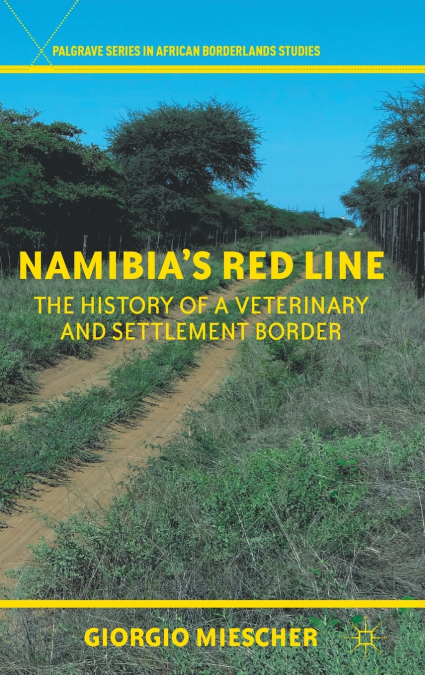

Namibia’s Red Line

Namibia’s Red Line

Giorgio Miescher

64,71 €
IVA incluido
Consulta disponibilidad
Editorial:
Springer Nature B.V.
Año de edición:
2012
Materia
Antropología social y cultural, etnografía
ISBN:
9780230337480

Selecciona una librería:

  • Librería Samer Atenea
  • Librería Aciertas (Toledo)
  • Kálamo Books
  • Librería Perelló (Valencia)
  • Librería Elías (Asturias)
  • Donde los libros
  • Librería Kolima (Madrid)
  • Librería Proteo (Málaga)

Based on archival sources and oral history, this book reconstructs a border-building process in Namibia that spanned more than sixty years. The process commenced with the establishment of a temporary veterinary defence line against rinderpest by the German colonial authorities in the late nineteenth century and ended with the construction of a continuous two-metre-high fence by the South African colonial government sixty years later. This 1250-kilometre fence divides northern from central Namibia even today. The book combines a macro and a micro-perspective and differentiates between cartographic and physical reality. The analysis explores both the colonial state’s agency with regard to veterinary and settlement policies and the strategies of Africans and Europeans living close to the border. The analysis also includes the varying perceptions of individuals and populations who lived further north and south of the border and describes their experiences crossing the border as migrant workers, African traders, European settlers and colonial officials. The Red Line’s history is understood as a gradual process of segregating livestock and people, and of constructing dichotomies of modern and traditional, healthy and sick, European and African.
Artículos relacionados

  • Investigating Prehistoric Hunter-Gatherer Identities
    Edited by H. L. Cobb, F. Coward, L. Grimshaw and S. Price.This volume stems from sessions at the 2004 Theoretical Archaeology Conference at Glasgow University, entitled "Hunter-Gatherers in Early Prehistory" and "Hunting for Meaning: Interpretive Approaches to the Mesolithic". The sessions came about as a response to a continuing lack of appreciation of new developments in theo...
    Disponible

    60,70 €

  • Tea and Tourism
    Lee Jolliffe
    The global production, marketing and consumption of tea present a resource for tea-related tourism. Tea and Tourism: Tourists, Traditions and Transformations profiles tea cultures and examines the social, political and developmental contexts of using related traditions for touristic purposes. This volume views tourism related to tea from differing disciplinary perspectives, and...
  • An Archive of Possibilities
    Rachel Marie Niehuus
    In An Archive of Possibilities, anthropologist and surgeon Rachel Marie Niehuus explores possibilities of healing and repair in the eastern Democratic Republic of Congo against a backdrop of 250 years of Black displacement, enslavement, death, and chronic war. Niehuus argues that in a context in which violence characterizes everyday life, Congolese have developed innovative and...
  • An Archive of Possibilities
    Rachel Marie Niehuus
    In An Archive of Possibilities, anthropologist and surgeon Rachel Marie Niehuus explores possibilities of healing and repair in the eastern Democratic Republic of Congo against a backdrop of 250 years of Black displacement, enslavement, death, and chronic war. Niehuus argues that in a context in which violence characterizes everyday life, Congolese have developed innovative and...
    Disponible

    34,38 €

  • Christmas Island
    Simone Dennis
    Christmas Island is a small territory of Australia located in the Indian Ocean. It is home to three main ethnic groups, the smallest of which are European Australians. Christmas Island is also where those who arrive 'illegally' to seek asylum in Australia are accommodated. Christmas Island has played a key role in Australian security, located as it is at the northern extremity ...
  • The Chinese of Indonesia and Their Search for Identity
    Aimee Dawis
    This book examines how the Indonesian Chinese who were born after 1966 negotiate meanings about their culture and identity through their collective memory of growing up in a restrictive media environment that specifically curtailed Chinese language and culture. The restrictive media environment was the result of a series of policies administered during the Suharto era (1965-199...