
Inicio > > Programación informática/desarrollo de software > Music Representation and Transformation in Software
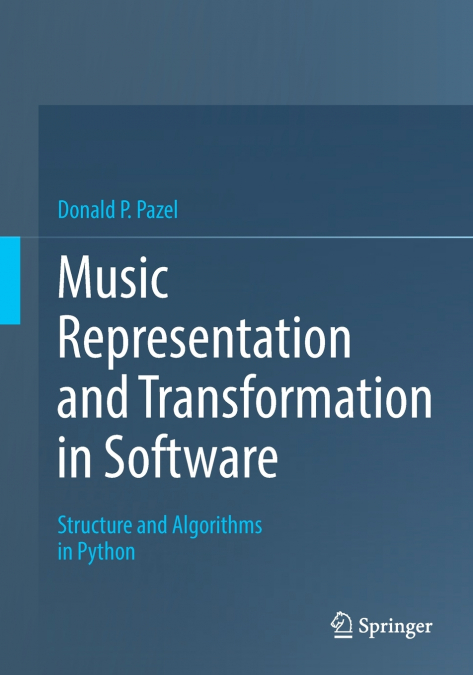
Music Representation and Transformation in Software

Music Representation and Transformation in Software

Donald P. Pazel

74,44 €
IVA incluido
Disponible
Editorial:
Springer Nature B.V.
Año de edición:
2022
Materia
Programación informática/desarrollo de software
ISBN:
9783030974718
74,44 €
IVA incluido
Disponible

Selecciona una librería:

  • Librería Samer Atenea
  • Librería Aciertas (Toledo)
  • Kálamo Books
  • Librería Perelló (Valencia)
  • Librería Elías (Asturias)
  • Donde los libros
  • Librería Kolima (Madrid)
  • Librería Proteo (Málaga)

This book takes the reader on a journey through music concepts in an organized approach that develops music essentials from the concepts of tone, pitch, and time, through notes, intervals, chords, and scores while at the same time interpreting these elements as software artifacts. Close attention is paid to the organization of and relationships amongst these concepts and their representation as Python classes and objects, to learn about music from a software design viewpoint.The first part of the book focuses on software representation of the main elements found in music theory. Its objective is to provide direction to students on how to build a music software model from basic concepts and grow towards more complex concepts. Chapter by chapter, music concepts are introduced, and each is broken apart into related data properties and methods with the goal that by the end of this section, the reader will have developed a relatively complete library of music elements in software. The second part takes on the task of applying that foundation to the subject of 'music transformations'. The focus is on localized transformations, that is, transformations isolated to a few measures. After a general introduction, the discussion includes topics of pitch assignment, key change, melodic inversion, melodic shaping, harmonic transcription, retrograde, melodic search and dilation. This textbook is designed as a principal or supplemental source for computer science, software engineering, and programming courses. It can also be used as a main textbook for advanced computer music courses or electronic music courses. Computer music software professionals interested in learning how to model the complexities of music theory artifacts, or music students who want to learn advanced programming techniques in their domain will also find the book helpful.
Artículos relacionados

  • SPARK 2014 Reference Manual
    AdaCore / Altran UK Ltd
    SPARK 2014 is a programming language and a set of verification tools designed to meet the needs of high-assurance software development. SPARK 2014 is based on Ada 2012, both subsetting the language to remove features that defy verification, but also extending the system of contracts and aspects to support modular, formal verification.This manual is available online for free at ...
    Disponible

    19,91 €

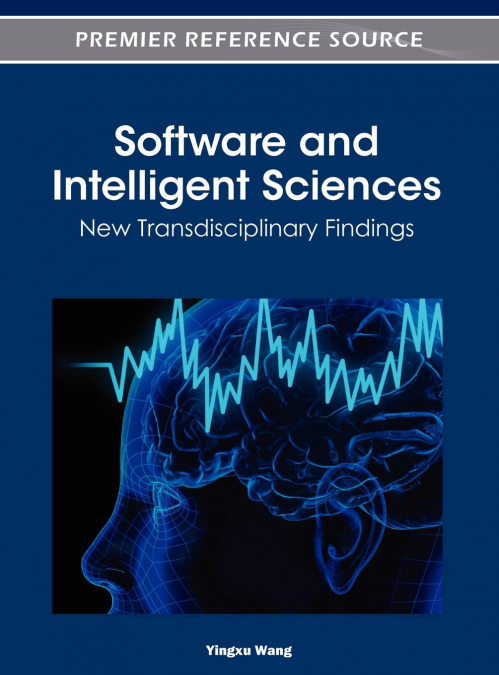
  • Software and Intelligent Sciences
    Yingxu Wang
    The junction of software development and engineering combined with the study of intelligence has created a bustling intersection of theory, design, engineering, and conceptual thought. Software and Intelligent Sciences: New Transdisciplinary Findings sits at a crossroads and informs advanced researchers, students, and practitioners on the developments in computer science, theor...
  • Power System Planning Technologies and Applications
    Fawwaz Elkarmi / Nazih Abu Shikhah / Nazih Abu-Shikhah
    Planning is an important function of the management of any business, providing knowledge of future prospects and enabling prudent and appropriate decision-making. Planning is especially critical for power systems, since electricity is a fundamental part of modern societies and many conventional electrical energy resources currently in use are limited. Power System Planning Tech...
  • Concept Parsing Algorithms (CPA) for Textual Analysis and Discovery
    Masha Etkind / Uri Shafrir
    Text analysis tools aid in extracting meaning from digital content. As digital text becomes more and more complex, new techniques are needed to understand conceptual structure. Concept Parsing Algorithms (CPA) for Textual Analysis and Discovery: Emerging Research and Opportunities provides an innovative perspective on the application of algorithmic tools to study unstructured d...
  • Model-Based Design for Effective Control System Development
    Wei Wu
    Control systems are an integral aspect of modern society and exist across numerous domains and applications. As technology advances more and more, the complexity of such systems continues to increase exponentially. Model-Based Design for Effective Control System Development is a critical source of scholarly information on model-centric approaches and implementations for control...
  • Verification, Validation and Testing in Software Engineering
    ...