
Morgenröthe

Morgenröthe

FRIEDRICH NIETZSCHE

25,63 €
IVA incluido
Disponible
Editorial:
e-artnow
Año de edición:
2017
Materia
Ética y filosofía moral
ISBN:
9788026856795
25,63 €
IVA incluido
Disponible

Selecciona una librería:

  • Librería Samer Atenea
  • Kálamo Books
  • Librería Elías (Asturias)
  • Librería Kolima (Madrid)
  • Librería Proteo (Málaga)

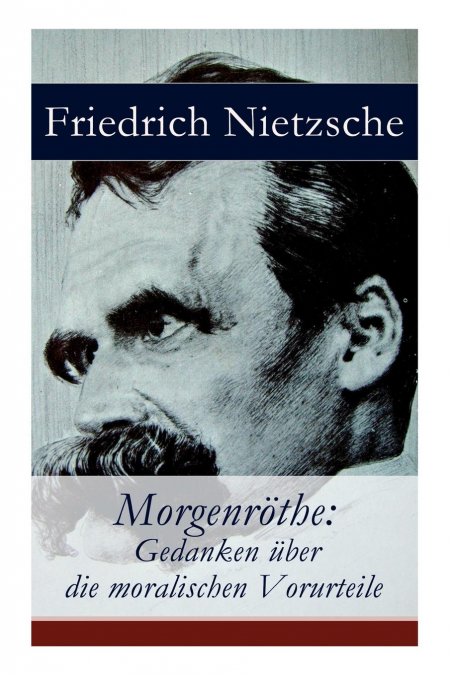
Morgenröte: Gedanken über die moralischen Vorurteile ist ein Anfang Juli 1881 erschienenes philosophisches Werk Friedrich Nietzsches. In dem aus Aphorismen unterschiedlicher Länge bestehenden Buch hinterfragte Nietzsche die Entstehung und den Wahrheitsgehalt moralischer und religiöser Systeme. Dabei setzte er dem tragischen Pathos einer christlichen Existenz das kontemplative Glück eines Erkennenden gegenüber und interpretierte die Glaubensekstase als psychopathologisches Phänomen. Die Moral als Grundlage der Kultur erscheint als Kirke, als 'Meisterin der Verführung.' So schickte sich Nietzsche an, 'in die Tiefe zu steigen' und 'unser Vertrauen zur Moral zu untergraben.' In der Morgenröte skizzierte Nietzsche erstmals Umrisse der Formel vom Willen zur Macht, die später von Zarathustra in aller Deutlichkeit vorgetragen wurde. Friedrich Wilhelm Nietzsche (1844-1900) war ein deutscher klassischer Philologe, der posthum als Philosoph zu Weltruhm kam. Er stellte den Wert der Wahrheit überhaupt in Frage und wurde damit Wegbereiter postmoderner philosophischer Ansätze. Auch Nietzsches Konzepte des 'Übermenschen', des 'Willens zur Macht' oder der 'ewigen Wiederkunft' geben bis heute Anlass zu Deutungen und Diskussionen.

Artículos relacionados

  • Ka Ab Ba Building The Lighted Temple
    Dr Terri R. Nelson / Dr Terri RNelson
    The book KaAbBa Building The Lighted Temple/Metaphysical Keys to the Tree of Life draws a circle that is inclusive of the Afrikan origin of the Ancient Kemetic/Egyptian wisdom. It reveals the undeniable root and link of Ancient Africa to all the religious systems that would develop worldwide. This book is explosive in its power to convey the meaning of KaAbBa, the Medu Neter  (...
    Disponible

    37,41 €

  • Technoethics and the Evolving Knowledge Society
    Rocci Luppicini
    Recently, there has been a major push to rediscover the ethical dimension of technology across the sciences, social sciences, and humanities. Technoethics and the Evolving Knowledge Society: Ethical Issues in Technological Design, Research, Development, and Innovation examines human processes and practices connected to technology embedded within social, political, and moral sph...
  • Kant
    Immanuel Kant
    Kant’s Groundwork of the Metaphysics of Morals is one of the most important works in modern moral philosophy. It belongs beside Plato, Aristotle, Machiavelli, and Hobbes. Here Kant sets out to articulate and defend the Categorical Imperative - the fundamental principle that underlies moral reasoning - and to lay the foundation for a comprehensive account of justice and human vi...
  • On the Duty of Civil Disobedience
    HENRY DAVID THOREAU
    Civil Disobedience argues that citizens should not permit their governments to overrule their consciences, and that they have a duty to avoid allowing their acquiescence to enable the government to make them the agents of injustice. Thoreau was motivated in part by his disgust with slavery and the Mexican-American War, but the sentiments he expresses here are just as pertinent ...
  • Beyond Good and Evil
    Friedrich Nietzsche
    Nietzsche, though primarily a philosopher, wrote widely on art, philology, history, religion, tragedy, culture, and science.  In 1886, at the height of his powers, he published Beyond Good and Evil.  Here he examines much of the best of human thought--dogmatic philosophy, Judeo-Christian morality, science and democracy – and finds it lacking.  Rejecting “slave-morality” he pres...
  • Beyond Good and Evil
    Friedrich Nietzsche
    Nietzsche, though primarily a philosopher, wrote widely on art, philology, history, religion, tragedy, culture, and science.  In 1886, at the height of his powers, he published Beyond Good and Evil.  Here he examines much of the best of human thought--dogmatic philosophy, Judeo-Christian morality, science and democracy – and finds it lacking.  Rejecting “slave-morality” he pres...
    Disponible

    9,99 €

Otros libros del autor

  • Beyond Good and Evil
    Friedrich Nietzsche
    Nietzsche, though primarily a philosopher, wrote widely on art, philology, history, religion, tragedy, culture, and science.  In 1886, at the height of his powers, he published Beyond Good and Evil.  Here he examines much of the best of human thought--dogmatic philosophy, Judeo-Christian morality, science and democracy – and finds it lacking.  Rejecting “slave-morality” he pres...
  • Beyond Good and Evil
    Friedrich Nietzsche
    Nietzsche, though primarily a philosopher, wrote widely on art, philology, history, religion, tragedy, culture, and science.  In 1886, at the height of his powers, he published Beyond Good and Evil.  Here he examines much of the best of human thought--dogmatic philosophy, Judeo-Christian morality, science and democracy – and finds it lacking.  Rejecting “slave-morality” he pres...
    Disponible

    9,99 €

  • The Twilight of the Idols
    Friedrich Nietzsche
    NA ...
    Disponible

    15,68 €

  • Twilight of the Idols, The Antichrist, Ecce Homo by Friedrich Nietzsche | Modern Philosophy | Existentialism
    Friedrich Nietzsche
    NA ...
    Disponible

    29,64 €

  • Ecce Homo
    Friedrich Nietzsche
    NA ...
    Disponible

    18,93 €

  • On the Genealogy of Morals
    Friedrich Nietzsche
    NA ...
    Disponible

    17,90 €