
Moral Punishment Instinct

Moral Punishment Instinct

Jan-Willem Van Prooijen

140,97 €
IVA incluido
Consulta disponibilidad
Editorial:
Oxford University Press
Año de edición:
2018
Materia
Ética y filosofía moral
ISBN:
9780190609979

Selecciona una librería:

  • Librería Samer Atenea
  • Librería Aciertas (Toledo)
  • Kálamo Books
  • Librería Perelló (Valencia)
  • Librería Elías (Asturias)
  • Donde los libros
  • Librería Kolima (Madrid)
  • Librería Proteo (Málaga)

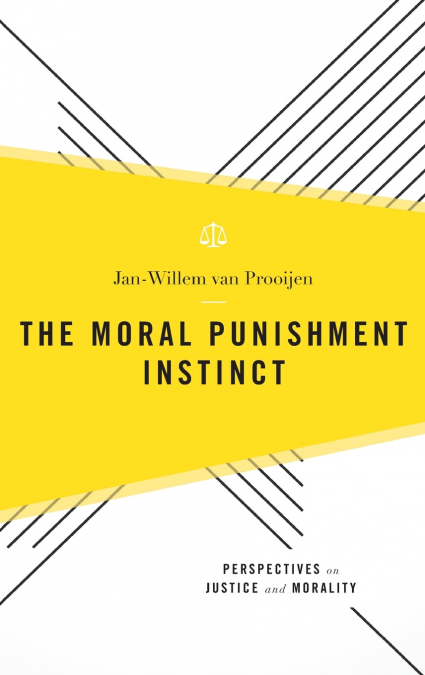
Punishment of offenders is one of the most universal features of human behavior. Across time and cultures it has been common for people to punish offenders, and one can easily find examples of punishment among ancient hunter-gatherers, in holy scriptures, in popular culture, and in contemporary courts of law. Punishment is not restricted to criminal offenders, but emerges within all spheres of our social life, including corporations, public institutions, traffic, sports matches, schools, parenting, and more. Punishment strongly influences what we think, how we feel, and what we do. The Moral Punishment Instinct asserts that people possess a hard-wired tendency to aggress against those who violate the norms of their group. We have evolved this instinct because of its power to control behavior by curbing selfishness and free-riding, thereby providing incentives to stimulate the mutual cooperation that ancient hunter-gatherers needed in order to survive in challenging natural environments. In this book, Jan-Willem van Prooijen methodically describes how punishment originates from moral emotions, stimulates cooperation, and shapes the social life of human beings. Guided by a host of recognizable and relatable examples, this book illuminates how the moral punishment instinct manifests itself among a variety of modern human cultures, children, tribes of hunter-gatherers, and even non-human animals-all while accounting for the role of this instinct in religion, war, racial bias, restorative justice, gossip, torture, and radical terrorism.


Artículos relacionados

  • Ka Ab Ba Building The Lighted Temple
    Dr Terri R. Nelson / Dr Terri RNelson
    The book KaAbBa Building The Lighted Temple/Metaphysical Keys to the Tree of Life draws a circle that is inclusive of the Afrikan origin of the Ancient Kemetic/Egyptian wisdom. It reveals the undeniable root and link of Ancient Africa to all the religious systems that would develop worldwide. This book is explosive in its power to convey the meaning of KaAbBa, the Medu Neter  (...
    Disponible

    37,41 €

  • Technoethics and the Evolving Knowledge Society
    Rocci Luppicini
    Recently, there has been a major push to rediscover the ethical dimension of technology across the sciences, social sciences, and humanities. Technoethics and the Evolving Knowledge Society: Ethical Issues in Technological Design, Research, Development, and Innovation examines human processes and practices connected to technology embedded within social, political, and moral sph...
  • Kant
    Immanuel Kant
    Kant’s Groundwork of the Metaphysics of Morals is one of the most important works in modern moral philosophy. It belongs beside Plato, Aristotle, Machiavelli, and Hobbes. Here Kant sets out to articulate and defend the Categorical Imperative - the fundamental principle that underlies moral reasoning - and to lay the foundation for a comprehensive account of justice and human vi...
  • On the Duty of Civil Disobedience
    HENRY DAVID THOREAU
    Civil Disobedience argues that citizens should not permit their governments to overrule their consciences, and that they have a duty to avoid allowing their acquiescence to enable the government to make them the agents of injustice. Thoreau was motivated in part by his disgust with slavery and the Mexican-American War, but the sentiments he expresses here are just as pertinent ...
  • Beyond Good and Evil
    Friedrich Nietzsche
    Nietzsche, though primarily a philosopher, wrote widely on art, philology, history, religion, tragedy, culture, and science.  In 1886, at the height of his powers, he published Beyond Good and Evil.  Here he examines much of the best of human thought--dogmatic philosophy, Judeo-Christian morality, science and democracy – and finds it lacking.  Rejecting “slave-morality” he pres...
  • Beyond Good and Evil
    Friedrich Nietzsche
    Nietzsche, though primarily a philosopher, wrote widely on art, philology, history, religion, tragedy, culture, and science.  In 1886, at the height of his powers, he published Beyond Good and Evil.  Here he examines much of the best of human thought--dogmatic philosophy, Judeo-Christian morality, science and democracy – and finds it lacking.  Rejecting “slave-morality” he pres...
    Disponible

    9,99 €

Otros libros del autor

  • The Psychology of Political Polarization
    Jan-Willem van Prooijen
    The Psychology of Political Polarization was inspired by the notion that to understand the momentum of radical political movements, it is important to understand the attitudes of individual citizens who support such movements. ...
    Disponible

    77,63 €

  • The Psychology of Conspiracy Theories
    Jan-Willem van Prooijen
    Who believes in conspiracy theories, and why are some people more susceptible to them than others?What are the consequences of such beliefs?Has a conspiracy theory ever turned out to be true?The Psychology of Conspiracy Theories debunks the myth that conspiracy theories are a modern phenomenon, exploring their broad social contexts, from politics to the workplace. The book expl...