 Librería Samer Atenea
 Kálamo Books
 Librería Elías (Asturias)
 Librería Kolima (Madrid)
 Librería Proteo (Málaga)
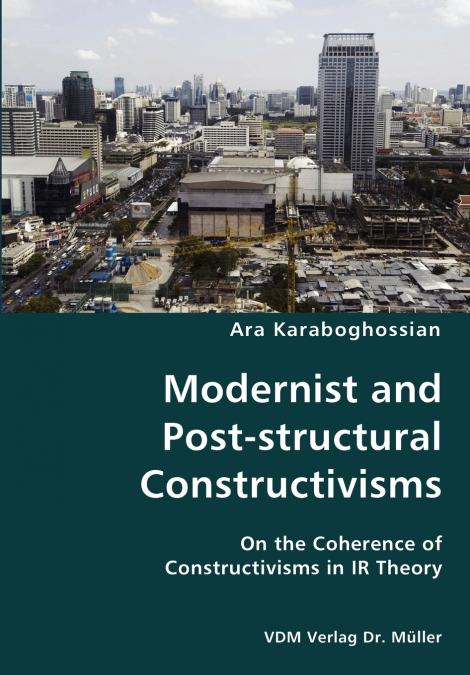
Realist/neo-realist and neo-liberal institutional approaches of international relations(IR) theory, which take a rationalist/systemic approach using the stateas a primary unit of analysis, have come under fire. Due to this ’critical turn’,the discipline of IR seems to have congealed around seemingly intractableconceptualizations of theorizing and research: structural vs. post-structural,and positivist vs. post-positivist.The first part of this book is concerned with assessing some constructivistcritiques of the dominant theories. Since not all constructivists are classifiedor classify themselves as post-structuralist and/or post-positivist, the secondpart attempts to unpack the category of IR constructivism.By comparing and contrasting two diametrically opposed constructiviststrands - modernist and post-structural - on the central constructivist themesof intersubjectivity, identity, and representation, the text attempts to verifywhether a common core of principles exists between the opposing strands.The modernist work of Alexander Wendt (supplemented by Emanuel Adlerand John Gerard Ruggie) is compared to the post-structural position of DavidCampbell (supplemented by Richard K. Ashley and R.B.J Walker). The result ofthe analysis demonstrates that, even within the diametrically opposedstrands, a common core of constructivist principles does exist.