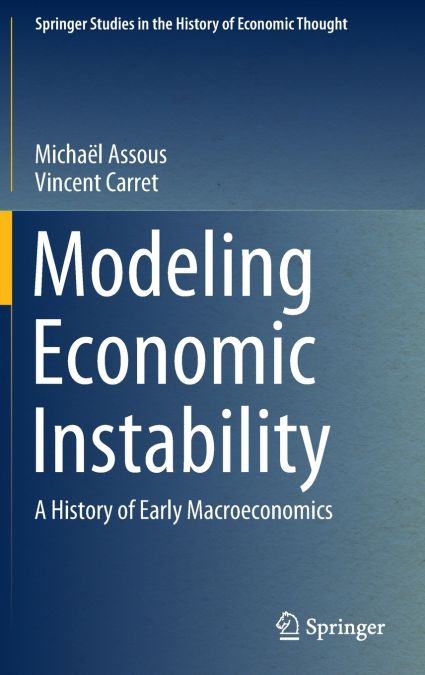
Modeling Economic Instability

Modeling Economic Instability

Michaël Assous / Vincent Carret

48,00 €
IVA incluido
Disponible
Editorial:
Springer Nature B.V.
Año de edición:
2022
Materia
Macroeconomía
ISBN:
9783030903114
48,00 €
IVA incluido
Disponible

Selecciona una librería:

  • Librería Samer Atenea
  • Librería Aciertas (Toledo)
  • Kálamo Books
  • Librería Perelló (Valencia)
  • Librería Elías (Asturias)
  • Donde los libros
  • Librería Kolima (Madrid)
  • Librería Proteo (Málaga)

This book offers a fresh perspective on the early history of macroeconomics, by examining the macro-dynamic models developed from the late 1920s to the late 1940s, and their treatment of economic instability. It first explores the differences and similarities between the early mathematical business cycle models developed by Ragnar Frisch, Michal Kalecki, Jan Tinbergen and others, which were presented at meetings of the Econometric Society and discussed in private correspondence. By doing so, it demonstrates the diversity of models representing economic phenomena and especially economic crises and instability. Jan Tinbergen emerged as one of the most original and pivotal economists of this period, before becoming a leader of the macro-econometric movement, a role for which he is better known. His emphasis on economic policy was later mirrored in the United States in Paul Samuelson’s early work on business cycles analysis, which, drawing on Alvin Hansen, aimed at interpreting the 1937-1938 recession. The authors then show that the subsequent shift in Samuelson’s approach, from the study of business cycle trajectories to the comparison of equilibrium points, provided a response to the econometricians’ critique of early Keynesian models. In the early 1940s, Samuelson was able to link together the tools that had been developed by the econometricians and the economic content that was at the heart of the so-called Keynesian revolution. The problem then shifted from business cycle trajectories to the disequilibrium between economic aggregates, and the issues raised by the global stability of full employment equilibrium. This was addressed by Oskar Lange, who presented an analysis of market coordination failures, and Lawrence Klein, Samuelson’s first PhD student, who pursued empirical work in this direction.  The book highlights the various visions and approaches that were embedded in these macro-dynamic models, and that their originality is of interestto today’s model builders as well as to students and anyone interested in how new economic ideas come to be developed.
Artículos relacionados

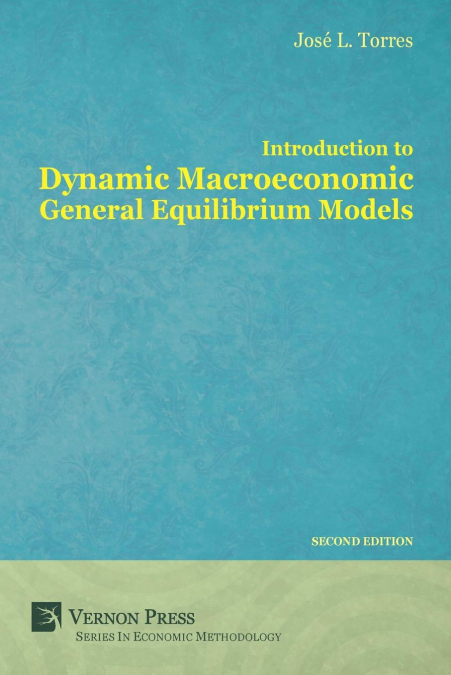
  • Introduction to Dynamic Macroeconomic General Equilibrium Models
    José Luis Torres Chacon
    This book offers an introductory step-by-step course in Dynamic Stochastic General Equilibrium modelling. Modern macroeconomic analysis is increasingly concerned with the construction, calibration and/or estimation and simulation of Dynamic General Equilibrium (DGE) models. The book is intended for graduate students as an introductory course to DGE modelling and for those econo...
    Disponible

    61,40 €

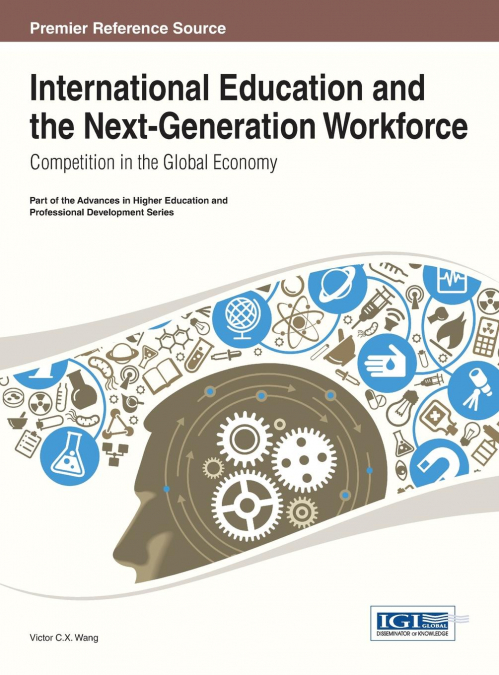
  • International Education and the Next-Generation Workforce
    Wei Wang
    Education is the first stage in developing a viable, dynamic, and long-lived global economy. Unfortunately, in times of economic hardship, educational programs, teacher salaries, and extracurricular opportunities are often the first to be cut. International Education and the Next-Generation Workforce: Competition in the Global Economy presents a detailed discussion of present e...
  • Macroeconomic Policies of Developed Democracies
    Robert J Franzese Jr
    ...
  • End Of The Road
    Louis Holder
    This book is about the mismanagement of Western economies in pursuit of political power, which resulting devastation will have to be borne by future generations. The book establishes that postponement is no longer doable and lays out the hard choices ahead causing much misery and agony.Although not fully recognized because of masking by asset bubbles, which are spun/sold as in...
    Disponible

    16,42 €

  • The Darwin Economy
    Robert H. Frank
    What Charles Darwin can teach us about building a fairer societyWho was the greater economist-Adam Smith or Charles Darwin? The question seems absurd. Darwin, after all, was a naturalist, not an economist. But Robert Frank, New York Times economics columnist and best-selling author of The Economic Naturalist, predicts that within the next century Darwin will unseat Smith as the...
    Disponible

    22,42 €

  • Myth and Measurement
    Alan B. Krueger / David Card
    From David Card, winner of the Nobel Prize in Economics, and Alan Krueger, a provocative challenge to conventional wisdom about the minimum wageDavid Card and Alan B. Krueger have already made national news with their pathbreaking research on the minimum wage. Here they present a powerful new challenge to the conventional view that higher minimum wages reduce jobs for low-wage ...
    Disponible

    39,64 €

Otros libros del autor

  • Modeling Economic Instability
    Michaël Assous / Vincent Carret
    This book offers a fresh perspective on the early history of macroeconomics, by examining the macro-dynamic models developed from the late 1920s to the late 1940s, and their treatment of economic instability. It first explores the differences and similarities between the early mathematical business cycle models developed by Ragnar Frisch, Michal Kalecki, Jan Tinbergen and other...
    Disponible

    148,46 €

  • Modeling Economic Instability
    Michaël Assous / Vincent Carret
    This book offers a fresh perspective on the early history of macroeconomics, by examining the macro-dynamic models developed from the late 1920s to the late 1940s, and their treatment of economic instability. It first explores the differences and similarities between the early mathematical business cycle models developed by Ragnar Frisch, Michal Kalecki, Jan Tinbergen and other...