
Mo Molybdenum

Mo Molybdenum


81,95 €
IVA incluido
Disponible
Editorial:
Springer Nature B.V.
Año de edición:
2013
ISBN:
9783662078389
81,95 €
IVA incluido
Disponible

Selecciona una librería:

  • Librería Samer Atenea
  • Librería Aciertas (Toledo)
  • Kálamo Books
  • Librería Perelló (Valencia)
  • Librería Elías (Asturias)
  • Donde los libros
  • Librería Kolima (Madrid)
  • Librería Proteo (Málaga)

This volume contains the hydrous oxo compounds of the metals Sb to Cr (System Nos. 18 to 52) with molybdenum. (The corresponding anhydrous compounds have been described in the volumes 'Molybdan' Erg.-Bd. B 1 and B 2.) With these metals, molybdenum forms monomolyb­ dates, isopolymolybdates, peroxomolybdates, and molybdometalates. Antimony forms only the compound H3SbM01204o’ n H0 and with bismuth no hydrous oxo 2 compounds are known. More than half the volume describes the monomolybdates, isopolymolybdates, and peroxo­ molybdates of the alkali and alkaline earth metals, including ammonium and organic cations. First, a detailed review on the structures, spectra, and other properties of the various iso­ polymolybdate types is given. It also contains a comprehensive description on photochromism, a property characteristic of many of the organic ammonium polymolybdates. Then follows the description of the individual alkali compounds. The large group of molybdates with organic cations is placed after the caesium molybdates. The photochromism and the photogalvanic effect are investigated at length for (i-C3H7NH3)6[M07024)’ 3 H0. The alkaline earth molybdates 2 are treated briefly compared with the alkali molybdates, e. g., no new data are available on beryllium molybdates.

Artículos relacionados

  • Recycled Polymers
    Didier Perrin
    The efficient ecodesign of secondary raw materials from recycled multiphase polymer systems is performed through the study of various things, such as:The compatibility of mixtures of recycled polymers where work on knowledge of the miscibility of mixtures depends on the different rates and the nature of the constituents;The aging of recycled polymers in terms of the structuring...
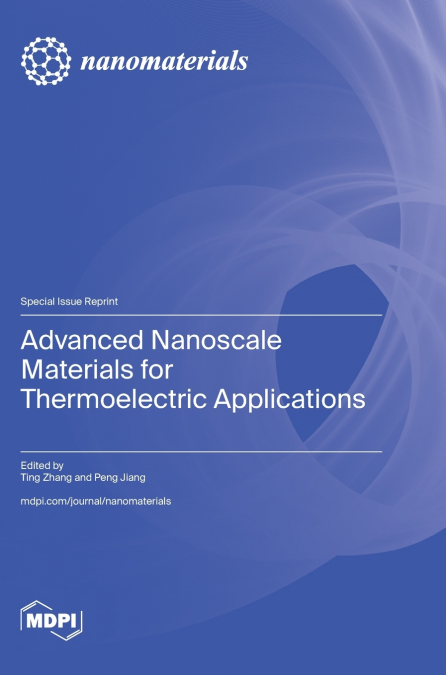
  • Advanced Nanoscale Materials for Thermoelectric Applications
    This Special Issue covers preparations, measurements, devices, and applications based on thermoelectric nanomaterials and summarizes the latest developments towards highly efficient thermoelectric nanomaterials and thermoelectric devices. ...
  • Repair and Strengthening of Existing Reinforced Concrete Structures
    Andreas Lampropoulos
    It is crucial that we strengthen existing structures worldwide, especially in earthquake-prone areas. Recent earthquakes have highlighted the inadequacy of many existing structures, which have been damaged from previous powerful earthquakes and have been designed without code provisions or according to old code provisions that are now obsolete. Furthermore, the majority of exis...
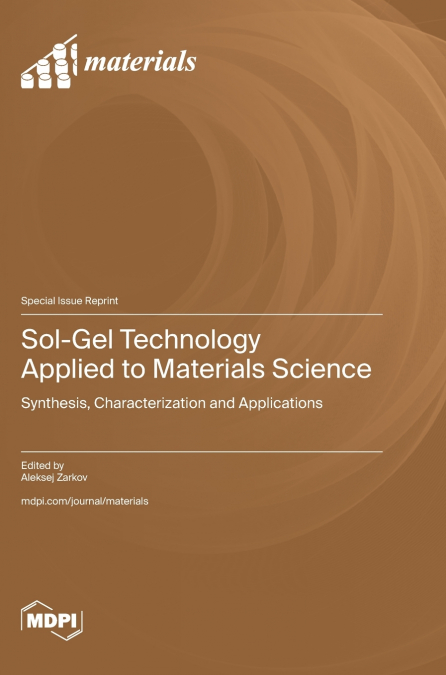
  • Sol-Gel Technology Applied to Materials Science
    Aleksej Zarkov
    Rapid advances in technologies around the globe necessitate the development of new materials, nanostructures, and multicomponent composites with specific chemical and physical properties that can meet the requirements of modern technologies. Using appropriate synthetic approaches is crucial for the preparation of inorganic materials with designed microstructure and properties. ...
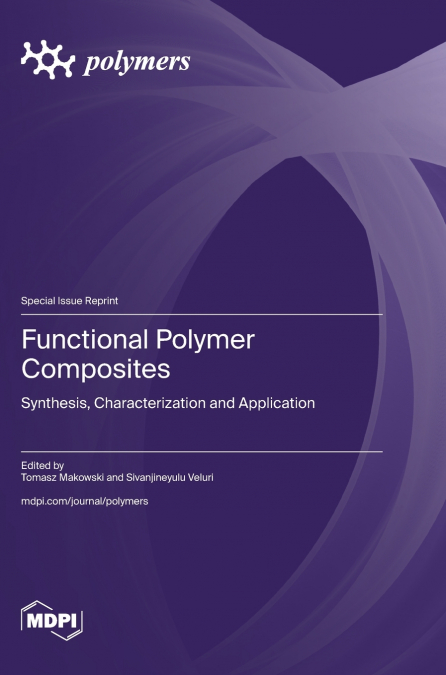
  • Functional Polymer Composites
    Functional polymer composites are showing increasing potential as materials in chemistry and materials science. Polymer composites, including nanocomposites, are made via the incorporation of fillers in polymer matrices and offer many advantages. The properties of polymer composites are further improved via the surface modification of fillers or the matrix phase. Currently, the...
  • Feature Papers in Section Biosensors 2023
    Evgeny Katz
    This reprint, based on the Special Issue, provides a general overview of different biosensors, briefly explaining the general approaches to identifying them, their construction, and their performance. A discussion concerning how the required components of biosensors are combined to perform analytical work is presented. Different signal-transducing mechanisms are discussed, part...