 Librería Samer Atenea
 Kálamo Books
 Librería Elías (Asturias)
 Librería Kolima (Madrid)
 Librería Proteo (Málaga)
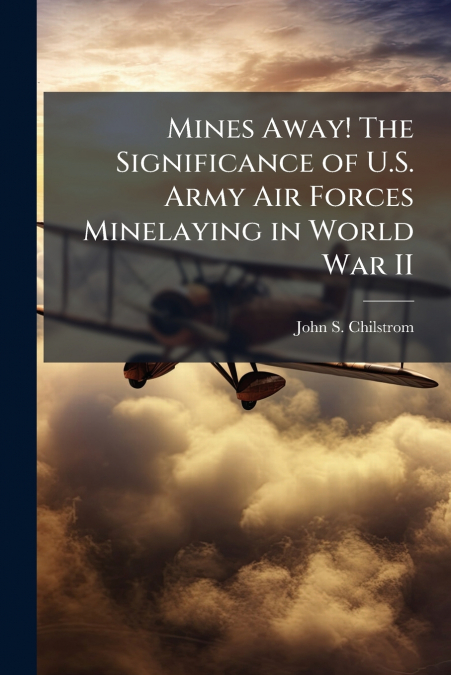
In World War II/s Pacific Theater, the U.S. Army Air Forces (AAF) devoted a small percentage of its long-range capability to aerial minelaying against Japanese warships and commerce. Sea mines--explosive underwater devices that damaged, sank, or deterred ships--were weapons that had difficulty gaining the same acceptance as guns, bombs, and torpedoes. Yet, with time, a small number of aerial mining advocates influenced wartime commanders to ensure the growth of minelaying doctrine, equipment development, and combat experience. Ultimately, aerial minelaying became one of the most successful AAF maritime missions of the war and signalled an important role in sea control for the future U.S. Air Force. The history of mine warfare spanned more than two hundred years, but as an offensive strategy matured only in the twentieth century, hastened by submarine and aircraft delivery. In World War II, the Luftwaffe was first to lay mines from the air and first to field many of the weapon’s innovations. The Royal Air Force mounted a significant minelaylng effort in Europe and helped the United States advance its mining in the Pacific. Though slow to start, aerial minelaying in Japan’s 'Outer Zone' by the air forces of Britain, Australia, and the United States accomplished a worthwhile attrition of Japanese shipping. Finally, in 1945, 'Operation Starvation,' the aerial mining of Japan’s home islands by AAF B-29s, made a dramatic contribution to the blockade of Japan and mines sunk more ships than allied submarines in the war/s final months.This work has been selected by scholars as being culturally important, and is part of the knowledge base of civilization as we know it. This work was reproduced from the original artifact, and remains as true to the original work as possible. Therefore, you will see the original copyright references, library stamps (as most of these works have been housed in our most important libraries around the world), and other notations in the work.This work is in the public domain in the United States of America, and possibly other nations. Within the United States, you may freely copy and distribute this work, as no entity (individual or corporate) has a copyright on the body of the work.As a reproduction of a historical artifact, this work may contain missing or blurred pages, poor pictures, errant marks, etc. Scholars believe, and we concur, that this work is important enough to be preserved, reproduced, and made generally available to the public. We appreciate your support of the preservation process, and thank you for being an important part of keeping this knowledge alive and relevant.