Inicio > Humanidades > Historia > Metternich’s Diplomacy at its Zenith, 1820-1823
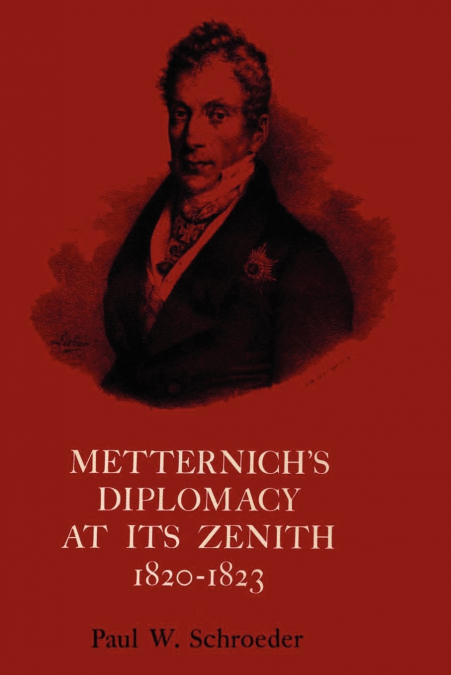
Metternich’s Diplomacy at its Zenith, 1820-1823

Metternich’s Diplomacy at its Zenith, 1820-1823

Paul W. Schroeder / Paul WSchroeder

40,30 €
IVA incluido
Disponible
Editorial:
Univ of Chicago behalf of University of Texas
Año de edición:
1962
Materia
Historia
ISBN:
9780292750340
40,30 €
IVA incluido
Disponible

Selecciona una librería:

  • Librería Samer Atenea
  • Librería Aciertas (Toledo)
  • Kálamo Books
  • Librería Perelló (Valencia)
  • Librería Elías (Asturias)
  • Donde los libros
  • Librería Kolima (Madrid)
  • Librería Proteo (Málaga)

What Metiernich wanted at the peak of his career, why he wanted it, and the methods by which he achieved his goals are questions brilliantly answered in this survey and analysis of the Austrian chancellor’s diplomacy during the period when he was the pre-eminent figure in European politics. Metternich’s single-minded objective during 1820-1823 was to preserve the Austrian hegemony he had gained in Central Europe after long wars, enormous effort, and great sacrifice. If the internal security and international-power position secured by Austria at the Congress of Vienna were to be defended against the impact of widespread revolution in Europe, it was imperative that peace in Europe and the status quo be maintained. This required an unyielding opposition to all political movements that might disturb the equilibrium, especially French chauvinism and the spread of French constitutional ideas. A one-man distillate of the doctrine of absolute monarchy, Metternich was the relentless foe of any cause, just or unjust, that threatened European repose. Hence, when the revolution in Naples seriously menaced Austrian hegemony in Italy, Metternich determined that the constitutional regime in Naples must be overthrown by an Austrian armed force, an absolute monarchy restored, and an Austrian army of occupation kept there. Nor did he scruple to use duplicity, secret negotiation, trickery, or deceit against ally and adversary alike in his effort to enlist them in the common cause of all thrones. At the Congress of Troppau, Metternich succeeded not only in defeating Russian ideas for peaceful intervention and a moderate constitution at Naples, but also in converting Tsar Alexander to thoroughly conservative views, thereby making Russia a powerful supporter of Austrian policies and knowingly alienating England, formerly Austria’s closest ally. Paul W. Schroeder brings to this bookexceptional scholarship and an objectivity hard to attain when dealing with a personality. Although Metternich, as Schroeder sees him, doubtless helped to maintain European peace and order, his real greatness consisted not in his European principles, but in his ability to defend Austrian interests under the guise of European principles. The evidence, gathered from documentary material in the Haus Hof- und Staatsarchiv in Vienna, has forced the author to the conclusion that Metternich was no real statesman. The very qualities that distinguished him as a brilliant diplomat-keen vision, cogent analysis, fertility of expedients, farsightedness, flexibility, and firmness of purpose-were converted into those of blindness to reality, superficial analysis, sterility of expedients, dogmatism, and failure of will when confronted with fundamental problems of state and society.


Artículos relacionados

  • Raising Freedom's Banner
    Paul Harris
    World wide history of peaceful street demonstrations from their earliest beginning in eighteenth century England to their use throughout the world in the twenty-first century. Describes why some demonstration movements succeeded and others failed. Contrasts demonstrations within the law with civil disobedience demonstrations. Describes Peterloo, the Chartists, the Suffragettes,...
    Disponible

    23,59 €

  • Waipi’o Valley
    Jeffrey L. Gross
    Waipi’o Valley: A Polynesian Journey from Eden to Eden recounts the remarkable migrations of the Polynesians across a third of the circumference of the earth. Their amazing journey began from Kalana i Hau’ola, the biblical “Garden of Eden” located along the shore of the Persian Gulf, extended to the Indus River Valley of ancient Vedic India, to Egypt where some ancestors of the...
  • Floralia
    June Rainsford Butler
    A century characterized by a growing interest in science, the opportunity for travel, and leisure for gardening furnishes the setting for Butler’s book. The rise of landscape gardening in England is traced, and the origin and history of its most famous gardens are given. The close relation between England and America in the field of horticulture is also discussed.Originally pub...
    Disponible

    61,20 €

  • President Wilson’s Addresses
    Woodrow Wilson
    'These addresses of President Woodrow Wilson are almost entirely concerned with political affairs, and more specifically with defining Americanism. Yet they also show that even as he moved from academia to the heights of politics, Wilson retained something of the teacher’s interest in showing the relation between specific instances and the general forms of thought or action of ...
  • The Story of my Life
    John Albert Macy
    The Story of My Life, is Helen Keller’s autobiography detailing her early life, especially her experiences with Anne Sullivan. The book is dedicated to inventor Alexander Graham Bell. The dedication reads, 'To ALEXANDER GRAHAM BELL Who has taught the deaf to speak and enabled the listening ear to hear speech from the Atlantic to the Rockies, I dedicate this Story of My Life.' ...
  • The Story of My Life Vol. 6 Spanish Passions
    Giacomo Casanova
    Casanova was an Italian adventurer and author from the Republic of Venice. His autobiography, Histoire de ma vie (Story of My Life), is regarded as one of the most authentic sources of the customs and norms of European social life during the 18th century. He has become so famous for his often complicated and elaborate affairs with women that his name is now synonymous with 'wom...